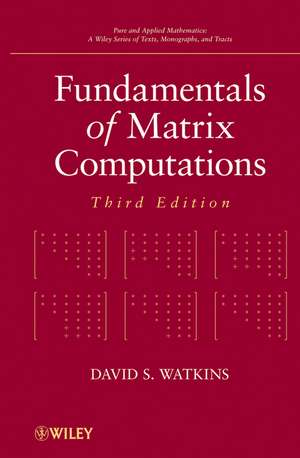
Fundamentals of Matrix Computations
Autor David S. Watkinsen Limba Engleză Hardback – 12 mar 2014
Preț: 835.86 lei
Preț vechi: 918.54 lei
-9%
Puncte Express: 1254
Carte tipărită la comandă
Livrare economică 26 septembrie-10 octombrie
Livrare prin curier în România Termenul estimat este afișat lângă disponibilitate.
Transport gratuit pentru acest produs Plată online sau ramburs, în funcție de opțiunile comenzii.
Retur gratuit în 14 zile Comandă securizată și suport în română.
Specificații
ISBN-13: 9780470528334
ISBN-10: 0470528338
Pagini: 664
Dimensiuni: 161 x 240 x 40 mm
Greutate: 1.15 kg
Ediția:3rd edition
Editura: Wiley
Locul publicării:Hoboken, United States
ISBN-10: 0470528338
Pagini: 664
Dimensiuni: 161 x 240 x 40 mm
Greutate: 1.15 kg
Ediția:3rd edition
Editura: Wiley
Locul publicării:Hoboken, United States
V-ar putea interesa
-
 -17%Preț: 142.89 lei171.23 lei
 -
 Revise Mathematics to Further Level GCSEChristine Graham-23%Preț: 297.92 lei386.59 lei
 -
 Topology and GeometryGlen E. Bredon-15%Preț: 494.41 lei581.65 lei
 -
 Number: The Language of ScienceTobias DantzigPreț: 134.94 lei
 -
 Multivariable Model-BuildingRoyston-9%Preț: 792.91 lei871.33 lei
 -
 Fundamentals of MathematicsBernd S W Schröder-8%Preț: 603.74 lei656.24 lei
 -
 Mathematical DiscoveryGeorge Polya-27%Preț: 1496.20 lei2049.59 lei
 -
 -9%Preț: 921.44 lei1012.58 lei
 -
 Queueing Systems Vol 1Kleinrock-9%Preț: 1002.30 lei1101.42 lei
 -
 Integration Vol 16Nielsen-9%Preț: 1316.25 lei1446.43 lei
 -
 -18%Preț: 1017.34 lei1240.66 lei
 -
 Topology and Its ApplicationsWilliam F. Basener-9%Preț: 863.04 lei948.40 lei
 -
 The Pleasures of CountingT. W. Körner-8%Preț: 397.14 lei431.67 lei
Public țintă
As a reference book for mathematicians, computer scientists, engineers, and other professionals and scientists who use numerical methods; also appropriate for software developers who need to solve matrix equations; as a textbook for upper–undergraduate and beginning–graduate level courses in matrix computations or applied numerical linear algebra within Mathematics, Engineering, and/or Computer Science departments; and academic libraries.Descriere
* This Third Edition explains how to perform matrix computations efficiently and accurately by providing a detailed introduction to the fundamental ideas of numerical linear algebra and utilizes MATLAB(R) to perform elaborate computational experiments.
Textul de pe ultima copertă
This new, modernized edition provides a clear and thorough introduction to matrix computations, a key component of scientific computing Retaining the accessible and hands–on style of its predecessor, Fundamentals of Matrix Computations, Third Edition thoroughly details matrix computations and the accompanying theory alongside the author′s useful insights. The book presents the most important algorithms of numerical linear algebra and helps readers to understand how the algorithms are developed and why they work.
Along with new and updated examples, the Third Edition features:
Fundamentals of Matrix Computations, Third Edition is an excellent book for courses on matrix computations and applied numerical linear algebra at the upper–undergraduate and graduate level. The book is also a valuable resource for researchers and practitioners working in the fields of engineering and computer science who need to know how to solve problems involving matrix computations.
Along with new and updated examples, the Third Edition features:
- A novel approach to Francis′ QR algorithm that explains its properties without reference to the basic QR algorithm
- Application of classical Gram–Schmidt with reorthogonalization
- A revised approach to the derivation of the Golub–Reinsch SVD algorithm
- New coverage on solving product eigenvalue problems
- Expanded treatment of the Jacobi–Davidson method
- A new discussion on stopping criteria for iterative methods for solving linear equations
Fundamentals of Matrix Computations, Third Edition is an excellent book for courses on matrix computations and applied numerical linear algebra at the upper–undergraduate and graduate level. The book is also a valuable resource for researchers and practitioners working in the fields of engineering and computer science who need to know how to solve problems involving matrix computations.
Cuprins
Preface. Acknowledgments.
1 Gaussian Elimination and Its Variants.
1.1 Matrix Multiplication.
1.2 Systems of Linear Equations.
1.3 Triangular Systems.
1.4 Positive Definite Systems; Cholesky Decomposition.
1.5 Banded Positive Definite Systems.
1.6 Sparse Positive Definite Systems.
1.7 Gaussian Elimination and the LU Decomposition.
1.8 Gaussain Elimination and Pivoting.
1.9 Sparse Gaussian Elimination.
2 Sensitivity of Linear Systems.
2.1 Vector and Matrix Norms.
2.2 Condition Numbers.
2.3 Perturbing the Coefficient Matrix.
2.4 A Posteriori Error Analysis Using the Residual.
2.5 Roundoff Errors; Backward Stability.
2.6 Propagation of Roundoff Errors.
2.7 Backward Error Analysis of Gaussian Elimination.
2.8 Scaling.
2.9 Componentwise Sensitivity Analysis.
3 The Least Squares Problem.
3.1 The Discrete Square Problem.
3.2 Orthogonal Matrices, Rotators and Reflectors.
3.3 Solution of the Least Squares Problem.
3.4 The Gram–Schmidt Process.
3.5 Geometric Approach.
3.6 Updating the QR Decomposition.
4 The Singular Value Decomposition.
4.1 Introduction.
4.2 Some Basic Applications of Singular Values.
4.3 The SVD and the Least Squares Problem.
4.4 Sensitivity of the Least Squares Problem.
5 Eigenvalues and Eigenvectors I.
5.1 Systems of Differential Equations.
5.2 Basic Facts.
5.3 The Power Method and Some Simple Extensions.
5.4 Similarity Transforms.
5.5 Reduction to Hessenberg and Tridiagonal Forms.
5.6 Francis′s Algorithm.
5.7 Use of Francis′s Algorithm to Calculate Eigenvectors.
5.8 The SVD Revisted.
6 Eigenvalues and Eigenvectors II.
6.1 Eigenspaces and Invariant Subspaces.
6.2 Subspace Iteration and Simultaneous Iteration.
6.3 Krylov Subspaces and Francis′s Algorithm.
6.4 Large Sparse Eigenvalue Problems.
6.5 Implicit Restarts.
6.6 The Jacobi–Davidson and Related Algorithms.
7 Eigenvalues and Eigenvectors III.
7.1 Sensitivity of Eigenvalues and Eigenvectors.
7.2 Methods for the Symmetric Eigenvalue Problem.
7.3 Product Eigenvalue Problems.
7.4 The Generalized Eigenvalue Problem.
8 Iterative Methods for Linear Systems.
8.1 A Model Problem.
8.2 The Classical Iterative Methods.
8.3 Convergence of Iterative Methods.
8.4 Descent Methods; Steepest Descent.
8.5 On Stopping Criteria.
8.6 Preconditioners.
8.7 The Conjugate–Gradient Method.
8.8 Derivation of the CG Algorithm.
8.9 Convergence of the CG Algorithm.
8.10 Indefinite and Nonsymmetric Problems.
References.
Index.
Index of MATLAB Terms.
1 Gaussian Elimination and Its Variants.
1.1 Matrix Multiplication.
1.2 Systems of Linear Equations.
1.3 Triangular Systems.
1.4 Positive Definite Systems; Cholesky Decomposition.
1.5 Banded Positive Definite Systems.
1.6 Sparse Positive Definite Systems.
1.7 Gaussian Elimination and the LU Decomposition.
1.8 Gaussain Elimination and Pivoting.
1.9 Sparse Gaussian Elimination.
2 Sensitivity of Linear Systems.
2.1 Vector and Matrix Norms.
2.2 Condition Numbers.
2.3 Perturbing the Coefficient Matrix.
2.4 A Posteriori Error Analysis Using the Residual.
2.5 Roundoff Errors; Backward Stability.
2.6 Propagation of Roundoff Errors.
2.7 Backward Error Analysis of Gaussian Elimination.
2.8 Scaling.
2.9 Componentwise Sensitivity Analysis.
3 The Least Squares Problem.
3.1 The Discrete Square Problem.
3.2 Orthogonal Matrices, Rotators and Reflectors.
3.3 Solution of the Least Squares Problem.
3.4 The Gram–Schmidt Process.
3.5 Geometric Approach.
3.6 Updating the QR Decomposition.
4 The Singular Value Decomposition.
4.1 Introduction.
4.2 Some Basic Applications of Singular Values.
4.3 The SVD and the Least Squares Problem.
4.4 Sensitivity of the Least Squares Problem.
5 Eigenvalues and Eigenvectors I.
5.1 Systems of Differential Equations.
5.2 Basic Facts.
5.3 The Power Method and Some Simple Extensions.
5.4 Similarity Transforms.
5.5 Reduction to Hessenberg and Tridiagonal Forms.
5.6 Francis′s Algorithm.
5.7 Use of Francis′s Algorithm to Calculate Eigenvectors.
5.8 The SVD Revisted.
6 Eigenvalues and Eigenvectors II.
6.1 Eigenspaces and Invariant Subspaces.
6.2 Subspace Iteration and Simultaneous Iteration.
6.3 Krylov Subspaces and Francis′s Algorithm.
6.4 Large Sparse Eigenvalue Problems.
6.5 Implicit Restarts.
6.6 The Jacobi–Davidson and Related Algorithms.
7 Eigenvalues and Eigenvectors III.
7.1 Sensitivity of Eigenvalues and Eigenvectors.
7.2 Methods for the Symmetric Eigenvalue Problem.
7.3 Product Eigenvalue Problems.
7.4 The Generalized Eigenvalue Problem.
8 Iterative Methods for Linear Systems.
8.1 A Model Problem.
8.2 The Classical Iterative Methods.
8.3 Convergence of Iterative Methods.
8.4 Descent Methods; Steepest Descent.
8.5 On Stopping Criteria.
8.6 Preconditioners.
8.7 The Conjugate–Gradient Method.
8.8 Derivation of the CG Algorithm.
8.9 Convergence of the CG Algorithm.
8.10 Indefinite and Nonsymmetric Problems.
References.
Index.
Index of MATLAB Terms.
Notă biografică
DAVID S. WATKINS, PhD, is Professor in the Department of Mathematics at Washington State University. He has published more than 100 articles in his areas of research interest, which include numerical linear algebra, numerical analysis, and scientific computing.