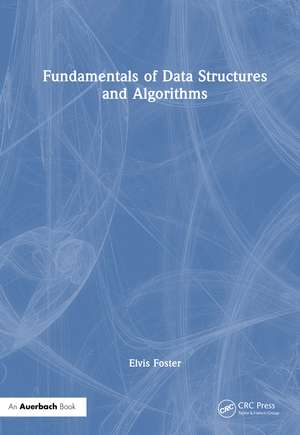
Fundamentals of Data Structures and Algorithms
1725.36 lei Preț vechi: 2156.70 lei -20% Precomandă
Carte nepublicată încă Apare 31 dec 2026. O trimitem imediat ce e disponibilă.
Te anunțăm când e disponibilă:
Se trimite...
Adaugă în listă2588 Puncte Express
- Transport gratuit pentru acest produs
- Plată online sau ramburs
- Retur gratuit în 14 zile
Despre carte
Developed in the classroom, Fundamentals of Data Structures and Algorithms is a textbook that provides a comprehensive but concise discussion of fundamental data structures and algorithms that form the foundation of software development.
The book discusses concepts, principles, implementation, and application of various data structures and algorithms including array-lists, vectors, linked lists, stacks, queues, sorting, trees, hashing, graphs, and data compression. It explains algorithms in a generic way that allows for implementation in any programming language. However, programming examples are presented in Java. Each chapter is organized systematically into brief, reader-friendly sections itemizing important points to remember. Diagrams and illustrations also sum up salient points to enhance learning. The Unified Modeling Language (UML) notation for class diagrams has been employed, and students are encouraged to apply this standard in the development of their own algorithms for programming problems. Programming examples are typically based on real-to-life problems that students can draw from long after the course ends.
The text has been prepared specifically to meet three objectives: comprehensive coverage, brevity, and motivating students to strive towards becoming excellent software developers. It aims to give students:
- A working knowledge of fundamental data structures and algorithms necessary for intermediate and advanced software development
- Reinforcement of sound and sustainable programming habits
- Preparation for success in additional advanced courses in computer science at the undergraduate as well as graduate level
- Solid grounding in problem analysis, program design, and construction