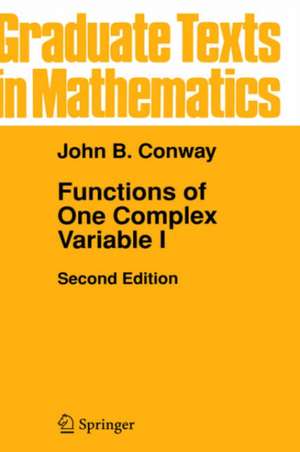
Functions of One Complex Variable I
Autor John B. Conwayen Limba Engleză Hardback – 24 aug 1978
În peisajul academic al analizei matematice, adesea se resimte lipsa unui text care să nu trateze analiza complexă doar ca pe un instrument de calcul, ci ca pe o fundație pentru ramuri avansate ale matematicii pure. Găsim în volumul Functions of One Complex Variable I, semnat de John B. Conway, exact această punte necesară. Autorul propune o viziune în care studiul funcțiilor de o variabilă complexă devine o introducere în structuri mai vaste, anticipând concepte din teoria varietăților sau omotopie. Structura cărții, publicată de Springer în prestigioasa serie Graduate Texts in Mathematics, este remarcabil de coerentă. Primele capitole ancorează cititorul în sistemul numerelor complexe și topologia spațiilor metrice, oferind rigoarea necesară înainte de a trece la proprietățile funcțiilor analitice și integrarea complexă. Merită menționat că, deși se adresează nivelului de studii masterale, textul este surprinzător de accesibil: Conway demonstrează în detaliu chiar și rezultatele de calcul avansat utilizate, eliminând nevoia consultării constante a altor surse. În contextul operei autorului, această lucrare reflectă același stil analitic precis întâlnit în A Course in Functional Analysis sau A First Course in Analysis. Totuși, spre deosebire de An Introduction to Complex Function Theory de Bruce P. Palka, care se concentrează pe o dezvoltare elementară și lentă, volumul lui Conway avansează mai rapid spre rezultate fundamentale precum Teorema de Reprezentare a lui Riemann, fiind ideal pentru un curs intensiv de un an. De asemenea, dacă Twenty-One Lectures on Complex Analysis de Alexander Isaev adoptă un stil conversațional, Conway preferă o expunere formală, structurată pe definiții și teoreme impecabile, ceea ce o transformă într-o referință stabilă pentru bibliografia de examen.
Preț: 410.60 lei
Carte disponibilă
Livrare economică 17 noiembrie-01 decembrie
Livrare express 03-07 noiembrie pentru 46.76 lei
Specificații
ISBN-10: 0387903283
Pagini: 340
Ilustrații: XIV, 322 p.
Dimensiuni: 161 x 240 x 24 mm
Greutate: 0.64 kg
Ediția:Second Edition 1978
Editura: Springer
Colecția Graduate Texts in Mathematics
Locul publicării:New York, NY, United States
V-ar putea interesa
-
 Introduction to Complex AnalysisH. A. Priestley-10%Preț: 390.11 lei431.60 lei
 -
 Short CalculusSerge LangPreț: 402.65 lei
 -
 A Course in Functional AnalysisJohn B. Conway-15%Preț: 498.70 lei586.70 lei
 -
 Lectures on the HyperrealsRobert Goldblatt-15%Preț: 661.87 lei778.67 lei
 -
 Real Analysis Through Modern InfinitesimalsNader Vakil-14%Preț: 1256.13 lei1460.62 lei
 -
 A Course in Mathematical AnalysisD. J. H. GarlingPreț: 416.67 lei
 -
 -9%Preț: 874.72 lei961.24 lei
 -
 A Course in Functional AnalysisJohn B. Conway-49%Preț: 283.78 lei556.17 lei
 -
 The Mathematica GuideBook for ProgrammingMichael TrottPreț: 555.02 lei
 -
 Elementary AnalysisKenneth A. RossPreț: 392.71 lei
 -
 More Calculus of a Single VariablePeter R. MercerPreț: 174.85 lei
 -
 An Introductory Course in Lebesgue SpacesRene Erlin Castillo-15%Preț: 507.07 lei596.56 lei
 -
 Complex Analysis with ApplicationsNakhlé H. AsmarPreț: 445.70 lei
 -
 Tensor Spaces and Numerical Tensor CalculusWolfgang Hackbusch-24%Preț: 759.08 lei998.80 lei
 -
 Real Analysis on IntervalsA. D. R. ChoudaryPreț: 424.67 lei
 -
 Wiener Chaos: Moments, Cumulants and DiagramsGiovanni PeccatiPreț: 390.72 lei
 -
 Analytic Function Theory of Several VariablesJunjiro Noguchi-15%Preț: 530.03 lei623.55 lei
 -
 ADV COURSES OF MATHEMATICAL ANALYSIS IVAl F Javier Perez-Fernandez Et-18%Preț: 754.94 lei920.67 lei
 -
 MODERN INTRO TO PART PHYS(3RD ED)Fayyazuddin-15%Preț: 526.71 lei619.66 lei
 -
 STOCHASTIC PROCESS IN GENETICS & EVOLUTIMode Charles J-18%Preț: 1467.85 lei1790.06 lei
 -
 GROBNER BASES IN RING THEORYLi Huishi-15%Preț: 668.74 lei786.76 lei
 -
 The Guide to PamirStephen L. AdlerPreț: 413.02 lei
 -
 Preț: 202.89 lei
Public țintă
GraduateDe ce să citești această carte
Această ediție a doua a Functions of One Complex Variable I este esențială pentru studenții la matematică ce doresc o bază teoretică solidă. Cititorul câștigă nu doar tehnici de lucru cu funcții analitice, ci și o înțelegere profundă a legăturilor dintre analiza complexă și topologie. Este recomandată celor care apreciază rigoarea matematică și demonstrațiile complete, servind drept standard în curriculumul universitar internațional.