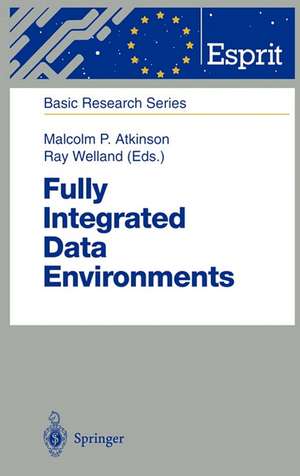
Fully Integrated Data Environments: Persistent Programming Languages, Object Stores, and Programming Environments: ESPRIT Basic Research Series
Editat de Malcolm P. Atkinson, Ray Wellanden Limba Engleză Hardback – 30 noi 1999
Preț: 638.90 lei
Preț vechi: 798.63 lei
-20%
Puncte Express: 958
Carte tipărită la comandă
Livrare economică 27 noiembrie-11 decembrie
Livrare prin curier în România Termenul estimat este afișat lângă disponibilitate.
Transport gratuit pentru acest produs Plată online sau ramburs, în funcție de opțiunile comenzii.
Retur gratuit în 14 zile Comandă securizată și suport în română.
Specificații
ISBN-13: 9783540657729
ISBN-10: 354065772X
Pagini: 646
Ilustrații: X, 629 p.
Dimensiuni: 155 x 235 x 40 mm
Greutate: 0.94 kg
Ediția:2000
Editura: Springer Berlin, Heidelberg
Colecția Springer
Seria ESPRIT Basic Research Series
Locul publicării:Berlin, Heidelberg, Germany
ISBN-10: 354065772X
Pagini: 646
Ilustrații: X, 629 p.
Dimensiuni: 155 x 235 x 40 mm
Greutate: 0.94 kg
Ediția:2000
Editura: Springer Berlin, Heidelberg
Colecția Springer
Seria ESPRIT Basic Research Series
Locul publicării:Berlin, Heidelberg, Germany
V-ar putea interesa
-
 -27%Preț: 676.09 lei926.15 lei
 -
 Software Modeling and DesignHassan Gomaa-20%Preț: 665.25 lei831.56 lei
 -
 KanbanDavid J. Anderson-20%Preț: 264.20 lei330.25 lei
 -
 The Human Side of AgileGil BrozaPreț: 271.68 lei
 -
 Software EngineeringRuneson-20%Preț: 471.15 lei588.94 lei
 -
 Professional GitBrent Laster-20%Preț: 256.78 lei320.97 lei
 -
 Python AlgorithmsMagnus Lie Hetland-20%Preț: 468.00 lei584.99 lei
 -
 The Definitive Guide to HTML5 WebSocketVanessa Wang-20%Preț: 372.28 lei465.36 lei
 -
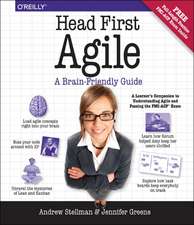 Head First AgileAndrew Stellman-20%Preț: 343.20 lei429.00 lei
 -
 Software Engineering EducationNorman E. Gibbs-20%Preț: 330.61 lei413.26 lei
 -
 FairnessNissim Francez-20%Preț: 323.25 lei404.06 lei
 -
 Reliability and Optimization of Structural SystemsRudiger Rackwitz-20%Preț: 1244.28 lei1555.34 lei
 -
 Knowledge-Based Software EngineeringDorothy E. Setliff-20%Preț: 638.97 lei798.71 lei
 -
 Continuous Delivery with Visual Studio ALM 2015Mathias Olausson-20%Preț: 299.70 lei374.63 lei
 -
 Design It! : Pragmatic ProgrammersMicahel Keeling-20%Preț: 257.50 lei321.87 lei
 -
 Mastering ServiceNow - Second EditionMartin Wood-20%Preț: 368.74 lei460.93 lei
 -
 -20%Preț: 342.66 lei428.32 lei
 -
 Data Types and PersistenceMalcolm P. Atkinson-20%Preț: 672.58 lei840.73 lei
 -
 High-level Petri NetsKurt Jensen-20%Preț: 363.39 lei454.25 lei
 -
 Kryptographie in C und C++Michael Welschenbach-20%Preț: 314.65 lei393.32 lei
 -
 Software Engineering for Large Software SystemsB.A. Kitchenham-20%Preț: 326.72 lei408.40 lei
Public țintă
Professional/practitionerCuprins
1 Persistent Languages: Introduction and Overview.- 1.1 Language Design: Introduction and State of the Art.- 1.1.1 Higher-Order Persistent Polymorphic Programming in Tycoon.- 1.1.2 Fibonacci: A Programming Language for Object Databases.- 1.1.3 The Napier88 Persistent Programming Language and Environment.- 1.2 Linguistic Reflection: Introduction and State of the Art.- 1.2.1 Type-Safe Linguistic Reflection: A Generator Technology.- 1.2.2 Type-Safe Linguistic Run-time Reflection: A Practical Perspective.- 1.3 Type Systems: Introduction and State of the Art.- 1.3.1 A Calculus for Overloaded Functions with Subtyping.- 1.3.2 Protection in Persistent Object Systems.- 1.3.3 Subtyping and Assignment in Database Programming Languages.- 1.4 Bulk Types and Iterators: Introduction and State of the Art.- 1.4.1 The Joy of Sets.- 1.4.2 Bulk Types: Built-In or Add-On?.- 1.4.3 Extensible Objects for Database Evolution: Language Features and Implementation Issues.- 1.5 Concurrency and Transactions: Introduction and State of the Art.- 1.5.1 Specifying Flexible Concurrency Control Schemes: an Abstract Operational Approach.- 1.5.2 Persistent Threads.- 2 Persistent Support Systems: Introduction and Overview.- 2.1 Architecture and Abstract Machines: Introduction and State of the Art.- 2.1.1 Persistent Foundations for Scalable Multi-Paradigmal Systems.- 2.1.2 The DBPL Project: Advances in Modular Database Programming.- 2.1.3 The PamCase Machine.- 2.1.4 Tycoon: A Scalable and Interoperable Persistent System Environment.- 2.2 Object Store Design: Introduction and State of the Art.- 2.2.1 An Open System Architecture for a Persistent Object Store.- 2.2.2 Overview of PIOS: a Physically Independent Object Server.- 2.2.3 Efficient Incremental Garbage Collection for Client-Server Object Database Systems.- 2.2.4 Towards a Unified Model of Untyped Object Stores: Experience with the Tycoon Store Protocol.- 2.2.5 Measuring Persistent Object Systems.- 2.3 Implementation Techniques: Introduction and State of the Art.- 2.3.1 Concurrent Shadow Paging in the Flask Architecture.- 2.3.2 Locking in OODBMS Clients Supporting Nested Transactions.- 2.3.3 Query Processing in PIOS.- 2.3.4 Optimization of Nested Queries in Object Bases.- 2.3.5 Integrating Query and Program Optimization Using Persistent CPS Representations.- 2.3.6 An ad hoc Approach to the Implementation of Polymorphism.- 3 Using Persistent Languages: Introduction and Overview.- 3.1 Persistent Programming Environments: Introduction and State of the Art.- 3.1.1 Exploiting Persistent Linkage in Software Engineering Environments.- 3.1.2 Using Persistence Technology to Control Schema Evolution.- 3.1.3 Unifying Interaction with Persistent Data and Program.- 3.1.4 The Persistent Workshop: Programming Environment for Napier88.- 3.1.5 The Glasgow Persistent Libraries.- 3.1.6 Visualising Persistent Stores.- 3.2 Data Modelling: Introduction and State of the Art.- 3.2.1 Application Development using Data Modelling.- 3.2.2 The STYLE Workbench: Systematics of Typed Language Environments.- 3.2.3 Using Extensible Grammars for Data Modelling.- 3.3 Interoperability: Introduction and State of the Art.- 3.3.1 Querying the File.- 3.3.2 Updating the File.- 3.3.3 Lean Languages and Models: Towards an Interoperable Kernel for Persistent Object Systems.- List of Contributors.
Caracteristici
Research toward massively reducing the cost of building large, complex, sophisticated information systems Work brought together about 50 researchers from 7 European research groups and international collaborators Report on a major step in the campaign of research projects Authors synthesized consistent integrations of enabling technology and demonstrated beneficial results Includes supplementary material: sn.pub/extras