
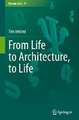
From Life to Architecture, to Life: Biosemiotics
Autor Tim Irelanden Limba Engleză Paperback – 20 mar 2025
| Toate formatele și edițiile | Preț | Express |
|---|---|---|
| Paperback (1) | 755.65 lei 38-44 zile | |
| Springer – 20 mar 2025 | 755.65 lei 38-44 zile | |
| Hardback (1) | 763.32 lei 6-8 săpt. | |
| Springer International Publishing – 19 ian 2024 | 763.32 lei 6-8 săpt. |
Din seria Biosemiotics
- 18%
 Preț: 912.09 lei
 - 15%
 Preț: 615.84 lei
 - 18%
 Preț: 752.87 lei
 - 15%
 Preț: 619.45 lei
 - 15%
 Preț: 561.12 lei
 - 18%
 Preț: 1499.12 lei
 - 15%
 Preț: 622.11 lei
 - 24%
 Preț: 848.53 lei
 - 24%
 Preț: 840.99 lei
 - 18%
 Preț: 1588.14 lei
 - 18%
 Preț: 1061.02 lei
 - 15%
 Preț: 628.73 lei
 - 18%
 Preț: 694.50 lei
 - 18%
 Preț: 1064.20 lei
 - 18%
 Preț: 750.58 lei
 - 24%
 Preț: 696.45 lei
 - 18%
 Preț: 706.46 lei
 - 18%
 Preț: 763.32 lei
 - 18%
 Preț: 757.11 lei
 - 18%
 Preț: 754.23 lei
 - 18%
 Preț: 2033.82 lei
 - 18%
 Preț: 904.83 lei
 - 18%
 Preț: 911.05 lei
 - 18%
 Preț: 1169.91 lei
 - 18%
 Preț: 1596.35 lei
 - 18%
 Preț: 1170.47 lei
 - 18%
 Preț: 859.76 lei
Preț: 755.65 lei
Preț vechi: 994.28 lei
-24% Nou
Puncte Express: 1133
Preț estimativ în valută:
133.75€ • 155.91$ • 116.97£
133.75€ • 155.91$ • 116.97£
Carte tipărită la comandă
Livrare economică 17-23 ianuarie 26
Preluare comenzi: 021 569.72.76
Specificații
ISBN-13: 9783031459276
ISBN-10: 303145927X
Pagini: 440
Dimensiuni: 155 x 235 x 24 mm
Greutate: 0.66 kg
Editura: Springer
Seria Biosemiotics
ISBN-10: 303145927X
Pagini: 440
Dimensiuni: 155 x 235 x 24 mm
Greutate: 0.66 kg
Editura: Springer
Seria Biosemiotics
Cuprins
1. Introduction.- Part 1. Architecture to Biosemiotics.- 2. The Essence of Architectural Creation.- 3. Architecture is like a Language.- Part 2. Biosemiotics to Architecture.- 4. Computing Life and Architecture.- 5. A Biosemiotic Conception of Space.- Part 3. Architecture to Life.- 6. Architecture and Life.
Notă biografică
Tim Ireland is an architect and lecturer of digital architecture at the Sheffield School of Architecture, University of Sheffield, UK. Interested in natural systems and computation his teaching and research focus on biological theory, semiotics and computational design.
Textul de pe ultima copertă
The book establishes a correlation between architectural theory and the biosemiotic project, and suggest how this coupling establishes a framework leading to an architectural-biosemiotic paradigm that puts biosemiotic theory at the heart of cognising the built environment, and offers an approach to understanding and shaping the built environment that supports (and benefits) human, and organismic, spatial intelligence.
Caracteristici
First book to establish a correlation between architectural theory and the biosemiotic project Illustrates how signs may be understood as forces that inform and direct an organism’s engagement with its environment using Jakob von Uexküll’s (1864 - 1944) sign oriented notion of space Sets out to establish a framework for an architectural-biosemiotic paradigm that puts biosemiotic theory at the heart of building an environment that supports (and benefits) human, organismic, and spatial intelligence