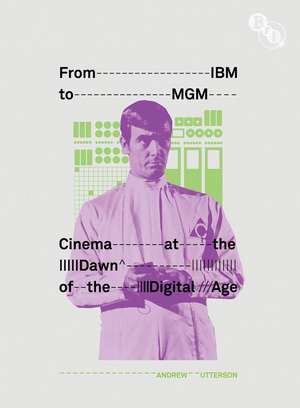
From IBM to MGM: Cinema at the Dawn of the Digital Age
Autor Andrew Uttersonen Limba Engleză Hardback – 11 ian 2011
| Toate formatele și edițiile | Preț | Express |
|---|---|---|
| Paperback (1) | 238.22 lei 3-5 săpt. | |
| British Film Institute – 12 ian 2011 | 238.22 lei 3-5 săpt. | |
| Hardback (1) | 616.04 lei 6-8 săpt. | |
| Bloomsbury Publishing – 11 ian 2011 | 616.04 lei 6-8 săpt. |
Preț: 616.04 lei
Preț vechi: 929.05 lei
-34% Nou
Puncte Express: 924
Preț estimativ în valută:
109.01€ • 127.83$ • 95.73£
109.01€ • 127.83$ • 95.73£
Carte tipărită la comandă
Livrare economică 11-25 februarie 26
Preluare comenzi: 021 569.72.76
Specificații
ISBN-13: 9781844573240
ISBN-10: 1844573249
Pagini: 184
Ilustrații: 52 b/w photos
Dimensiuni: 172 x 234 x 18 mm
Greutate: 0.52 kg
Ediția:2011
Editura: Bloomsbury Publishing
Colecția British Film Institute
Locul publicării:London, United Kingdom
ISBN-10: 1844573249
Pagini: 184
Ilustrații: 52 b/w photos
Dimensiuni: 172 x 234 x 18 mm
Greutate: 0.52 kg
Ediția:2011
Editura: Bloomsbury Publishing
Colecția British Film Institute
Locul publicării:London, United Kingdom
V-ar putea interesa
-
 Why Horror SeducesMathias Clasen-11%Preț: 269.62 lei303.09 lei
 -
 Animating the Science Fiction ImaginationJ.P. TelottePreț: 243.87 lei
 -
 -16%Preț: 91.42 lei108.67 lei
 -
 Sorry Not SorryNaya RiveraPreț: 125.65 lei
 -
 Film Theory: Critical Concepts in Media and Cultural StudiesK. J. Shepherdson-39%Preț: 4212.27 lei6920.85 lei
 -
 Technology and Culture, The Film ReaderAndrew Utterson-34%Preț: 243.03 lei365.71 lei
 -
 -21%Preț: 248.44 lei313.93 lei
 -
 The Death of Cinema: History, Cultural Memory and the Digital Dark AgePaolo Cherchi UsaiPreț: 230.98 lei
 -
 Fellini LexiconSam RohdiePreț: 237.56 lei
 -
 -22%Preț: 238.71 lei307.85 lei
 -
 Preț: 218.12 lei
 -
 -26%Preț: 99.36 lei133.49 lei
 -
 Truths, Half Truths and Little White LiesNick Frost-28%Preț: 63.57 lei88.66 lei
 -
 -20%Preț: 274.18 lei343.55 lei
Caracteristici
Case studies include Godard's Alphaville (196, Kubrick's 2001: A Space Odyssey (1968) and Crichton's Westworld (197
Notă biografică
ANDREW UTTERSON Senior Lecturer in Film and Digital Media at Canterbury Christ Church University, UK. He is the editor of Technology and Culture: The Film Reader (2005) and co-editor of Film Theory: Critical Concepts in Media and Cultural Studies (2004).
Cuprins
Introduction.- Computers in the Workplace: IBM and the 'Electronic Brain' of Desk Set (1957).- From the Scrap-Heap to the Science Lab: The Pioneers of Computer Animation.- Tarzan vs. IBM: Humans and Computers in Alphaville (1965).- Digital Harmony: The Art and Technology Movement.- 'I'm Sorry Dave, I'm Afraid I Can't Do That': Artificial Intelligence in 2001: A Space Odyssey (1968).- Expanded Consciousness, Expanded Cinema: A Techno-Utopian Counterculture.- To See Ourselves as Androids See Us: The Pixel Perspectives of Westworld (1973).- Conclusion.- Filmography.- Bibliography.- Index.
Recenzii
...a stimulating and very engaging read
Utterson adroitly draws out the tensions between "technophobic" film portrayals of computers and an avant-garde of digital utopians engaged in computer-aided art (spare a thought for the sad fate of the "lightpen"), who tempted directors to adopt their technology, as with Westworld's pixellated point-of-view shots. Quirky techno-anecdotes abound: the hacking of scavenged second-world-war ballistics computers; the origin of ASCII art; talk of a computer that makes a "Freudian slip"; and even an evocative appeal to "robotic ontology". Is it time to watch The Matrix again yet?'
Utterson adroitly draws out the tensions between "technophobic" film portrayals of computers and an avant-garde of digital utopians engaged in computer-aided art (spare a thought for the sad fate of the "lightpen"), who tempted directors to adopt their technology, as with Westworld's pixellated point-of-view shots. Quirky techno-anecdotes abound: the hacking of scavenged second-world-war ballistics computers; the origin of ASCII art; talk of a computer that makes a "Freudian slip"; and even an evocative appeal to "robotic ontology". Is it time to watch The Matrix again yet?'
Descriere
Descriere de la o altă ediție sau format:
Andrew Utterson's unique study charts the beginnings of digital cinema, addressing both how filmmakers used new digital technologies and how attitudes and anxieties about the rise of the computer were represented in films such as Lang's Desk Set, Godard's Alphaville, Kubrick's 2001: A Space Odyssey and Crichton's Westworld.
Andrew Utterson's unique study charts the beginnings of digital cinema, addressing both how filmmakers used new digital technologies and how attitudes and anxieties about the rise of the computer were represented in films such as Lang's Desk Set, Godard's Alphaville, Kubrick's 2001: A Space Odyssey and Crichton's Westworld.