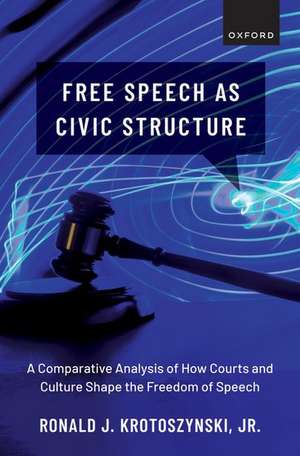
Free Speech as Civic Structure: A Comparative Analysis of How Courts and Culture Shape the Freedom of Speech
Autor Ronald J. Krotoszynski, Jr.en Limba Engleză Hardback – 26 sep 2024
Preț: 507.38 lei
Preț vechi: 723.02 lei
-30%
Puncte Express: 761
Carte disponibilă
Livrare economică 30 octombrie-04 noiembrie
Livrare prin curier în România Termenul estimat este afișat lângă disponibilitate.
Transport gratuit pentru acest produs Plată online sau ramburs, în funcție de opțiunile comenzii.
Retur gratuit în 14 zile Comandă securizată și suport în română.
Specificații
ISBN-13: 9780197662199
ISBN-10: 0197662196
Pagini: 330
Dimensiuni: 152 x 226 x 28 mm
Greutate: 0.61 kg
Editura: Oxford University Press
Colecția OUP USA
Locul publicării:New York, United States
ISBN-10: 0197662196
Pagini: 330
Dimensiuni: 152 x 226 x 28 mm
Greutate: 0.61 kg
Editura: Oxford University Press
Colecția OUP USA
Locul publicării:New York, United States
V-ar putea interesa
-
 -15%Preț: 162.89 lei192.25 lei
 -
 Comparative Constitutional LawVicki C. Jackson-31%Preț: 1321.18 lei1921.03 lei
 -
 Free Speech: What Everyone Needs to Know®Nadine Strossen-18%Preț: 77.82 lei94.77 lei
 -
 Putting Courts Under Pressure: When Lawmakers Push Constitutional BoundariesPhilipp A. Schroeder-33%Preț: 543.31 lei808.93 lei
 -
 -32%Preț: 664.50 lei977.30 lei
 -
 A Theory of Constitutional RightsRobert Alexy-22%Preț: 478.37 lei613.49 lei
 -
 State Constitutions and Criminal JusticeBarry Latzer-23%Preț: 501.43 lei651.20 lei
 -
 Weak Courts, Strong RightsMark TushnetPreț: 255.00 lei
 -
 -18%Preț: 1060.21 lei1292.94 lei
 -
 Key Ideas in Constitutional LawDavid Feldman-35%Preț: 73.59 lei112.73 lei
 -
 -45%Preț: 763.77 lei1397.69 lei
 -
 Extrajudicial Communication: Perspectives and PracticeDr Hélène Tyrrell-33%Preț: 577.70 lei866.74 lei
 -
 -33%Preț: 615.24 lei915.01 lei
 -
 Preț: 79.42 lei
 -
 Is Free Speech Under Threat?Charlotte Lydia RileyPreț: 76.86 lei
 -
 Is Free Speech Under Threat?Charlotte Lydia RileyPreț: 120.18 lei
 -
 The Power of JudgesDavid Neuberger-22%Preț: 43.00 lei55.36 lei
 -
 -44%Preț: 66.37 lei117.62 lei
Recenzii
This is an exceptional learned and thoughtful book. Krotoszynski leaves no doubt that that our comparative constitutional law of free speech is too impoverished to make sense of the realities in the globe, where law is created by judges." - James Q. Whitman, Ford Foundation Professor of Comparative and Foreign Law, Yale Law School
In Free Speech as Civic Structure, Professor Ronald Krotoszynski has once again delivered an ambitious and innovative analysis of the norms and institutions governing speech regulations across continents and cultures. Krotoszynski incisively explains how judicial rulings dictate the scope of speech freedoms to a far greater degree than core constitutional and legislative text would indicate. His insightful observations across multiple countries are compelling national case studies, and collectively offer a novel framework for how judges and scholars understand the regulation of speech." - Charlotte Garden, Julius E. Davis Professor of Law, University of Minnesota Law School
How much does it matter that a constitution has or doesn't have a provision saying that the constitution protects freedom of expression? Professor Krotoszynski's impressive comparative study answers, “Some, but much less than you might think.” Detailed studies of constitutional provisions (or their absence) and case law in the United States, South Africa, the United Kingdom, Australia, and Israel show that judicial attitudes toward representative democracy and embedded social and legal cultures are more important than constitutional texts in defining the contours of freedom of expression. A valuable and careful comparative study that scholars of free expression, comparative constitutional law, and interpretive methods will all profit from reading." - Mark Tushnet, William Nelson Cromwell Professor of Law Emeritus, Harvard Law School
Professor Krotoszynski has written a brilliant book about how free speech is protected across the world. Looking at several countries, he shows that ultimately the protection of expression depends on the judges far more than the text of a constitution. Beautifully written and meticulously researched, Professor Krotoszynski's analysis provides crucial insights as to how a society can ensure freedom of speech." - Erwin Chemerinsky, Dean & Jesse H. Choper Distinguished Professor of Law, Berkeley Law School
The great 20th century jurist Learned Hand famously opined that “liberty lies in the hearts of men and women; when it dies there, no constitution, no law, no court can even do much to help it. While it lies there it needs no constitution, no law, no court to save it.” Ronald Krotoszynski's Free Speech as Civic Structure partly challenges and partly confirms Hand's observation. Krotoszynski takes readers on a remarkable tour of common law jurisdictions around the globe. He finds that judges play a critical role in protecting and defining the reach of free expression, bounded by the views of the culture in which they work-that is, by what lies in the hearts of men and women. This thoroughly researched and carefully argued book convincingly demonstrates that codification in a national constitution is neither a necessary nor sufficient condition for robust protection of free expression." - Michael C. Dorf, Robert S. Stevens Professor of Law, Cornell Law School
This is an exceptional learned and thoughtful book. Krotoszynski leaves no doubt that that our comparative constitutional law of free speech is too impoverished to make sense of the realities in the globe, where law is created by judges.
Professor Krotoszynski has written a brilliant book about how free speech is protected across the world. Looking at several countries, he shows that ultimately the protection of expression depends on the judges far more than the text of a constitution. Beautifully written and meticulously researched, Professor Krotoszynski's analysis provides crucial insights as to how a society can ensure freedom of speech.
The great 20th century jurist Learned Hand famously opined that "liberty lies in the hearts of men and women; when it dies there, no constitution, no law, no court can even do much to help it. While it lies there it needs no constitution, no law, no court to save it." This book partly challenges and partly confirms Hand's observation. Krotoszynski takes readers on a remarkable tour of common law jurisdictions around the globe. He finds that judges play a critical role in protecting and defining the reach of free expression, bounded by the views of the culture in which they work -that is, by what lies in the hearts of men and women. This book convincingly demonstrates that codification in a national constitution is neither a necessary nor sufficient condition for robust protection of free expression.
It is hard to dispute the author's conclusions, given that in all the countries with which he deals, there are many examples of courts and lawmakers both intervening and restraining themselves, largely in accordance with the prevailing climate (or occasionally trying to stop some perceived moral, ethical or legal danger). The book is accordingly a valuable contribution to a never-ending debate.
In Free Speech as Civic Structure, Professor Ronald Krotoszynski has once again delivered an ambitious and innovative analysis of the norms and institutions governing speech regulations across continents and cultures. Krotoszynski incisively explains how judicial rulings dictate the scope of speech freedoms to a far greater degree than core constitutional and legislative text would indicate. His insightful observations across multiple countries are compelling national case studies, and collectively offer a novel framework for how judges and scholars understand the regulation of speech." - Charlotte Garden, Julius E. Davis Professor of Law, University of Minnesota Law School
How much does it matter that a constitution has or doesn't have a provision saying that the constitution protects freedom of expression? Professor Krotoszynski's impressive comparative study answers, “Some, but much less than you might think.” Detailed studies of constitutional provisions (or their absence) and case law in the United States, South Africa, the United Kingdom, Australia, and Israel show that judicial attitudes toward representative democracy and embedded social and legal cultures are more important than constitutional texts in defining the contours of freedom of expression. A valuable and careful comparative study that scholars of free expression, comparative constitutional law, and interpretive methods will all profit from reading." - Mark Tushnet, William Nelson Cromwell Professor of Law Emeritus, Harvard Law School
Professor Krotoszynski has written a brilliant book about how free speech is protected across the world. Looking at several countries, he shows that ultimately the protection of expression depends on the judges far more than the text of a constitution. Beautifully written and meticulously researched, Professor Krotoszynski's analysis provides crucial insights as to how a society can ensure freedom of speech." - Erwin Chemerinsky, Dean & Jesse H. Choper Distinguished Professor of Law, Berkeley Law School
The great 20th century jurist Learned Hand famously opined that “liberty lies in the hearts of men and women; when it dies there, no constitution, no law, no court can even do much to help it. While it lies there it needs no constitution, no law, no court to save it.” Ronald Krotoszynski's Free Speech as Civic Structure partly challenges and partly confirms Hand's observation. Krotoszynski takes readers on a remarkable tour of common law jurisdictions around the globe. He finds that judges play a critical role in protecting and defining the reach of free expression, bounded by the views of the culture in which they work-that is, by what lies in the hearts of men and women. This thoroughly researched and carefully argued book convincingly demonstrates that codification in a national constitution is neither a necessary nor sufficient condition for robust protection of free expression." - Michael C. Dorf, Robert S. Stevens Professor of Law, Cornell Law School
This is an exceptional learned and thoughtful book. Krotoszynski leaves no doubt that that our comparative constitutional law of free speech is too impoverished to make sense of the realities in the globe, where law is created by judges.
Professor Krotoszynski has written a brilliant book about how free speech is protected across the world. Looking at several countries, he shows that ultimately the protection of expression depends on the judges far more than the text of a constitution. Beautifully written and meticulously researched, Professor Krotoszynski's analysis provides crucial insights as to how a society can ensure freedom of speech.
The great 20th century jurist Learned Hand famously opined that "liberty lies in the hearts of men and women; when it dies there, no constitution, no law, no court can even do much to help it. While it lies there it needs no constitution, no law, no court to save it." This book partly challenges and partly confirms Hand's observation. Krotoszynski takes readers on a remarkable tour of common law jurisdictions around the globe. He finds that judges play a critical role in protecting and defining the reach of free expression, bounded by the views of the culture in which they work -that is, by what lies in the hearts of men and women. This book convincingly demonstrates that codification in a national constitution is neither a necessary nor sufficient condition for robust protection of free expression.
It is hard to dispute the author's conclusions, given that in all the countries with which he deals, there are many examples of courts and lawmakers both intervening and restraining themselves, largely in accordance with the prevailing climate (or occasionally trying to stop some perceived moral, ethical or legal danger). The book is accordingly a valuable contribution to a never-ending debate.
Notă biografică
Ronald J. Krotoszynski, Jr. is the John S. Stone Chair, Director of the Program in Constitutional Studies & Initiative for Civic Engagement , and Professor of Law at the University of Alabama School of Law. His teaching and research focus on constitutional law, First Amendment law, administrative law, telecommunications law, and comparative constitutional law. Professor Krotoszynski frequently writes and lectures on topics related to freedom of expression and how law and culture inform speech and law - particularly from a comparative law perspective. He is the author of numerous law review articles and several books, including The Disappearing First Amendment (2019), Privacy Revisited (2016), and The First Amendment in Cross-Cultural Perspective (2006).