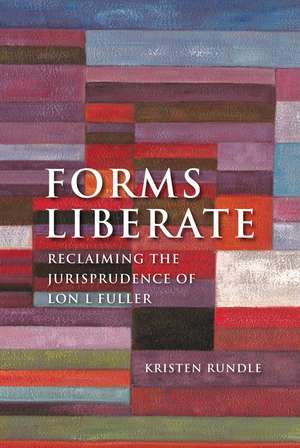
Forms Liberate: Reclaiming the Jurisprudence of Lon L Fuller
Autor Kristen Rundleen Limba Engleză Paperback – 28 aug 2013
Remarcăm, încă de la primele capitole, o structură riguroasă care propune un parcurs de reabilitare intelectuală: Forms Liberate începe prin definirea metodei de cercetare, traversează geneza conceptului de „eunomică” și culminează cu o analiză critică a marilor dezbateri filosofice care au marginalizat opera lui Fuller. Kristen Rundle nu se limitează la o simplă trecere în revistă, ci organizează materialul astfel încât să demonstreze cum forma juridică impune limite puterii de legiferare prin conexiunea sa intrinsecă cu agenția umană. Apreciem în mod deosebit modul în care autoarea utilizează arhivele pentru a clarifica răspunsurile lui Fuller către criticii săi, oferind o perspectivă mult mai nuanțată decât cea rezultată din simplificările istorice ale disputei cu H.L.A. Hart.
Cititorul care a aplicat ideile din The Morality of Law va găsi aici instrumentele necesare pentru a înțelege de ce principiile statului de drept nu sunt simple condiții de eficiență, ci fundamente morale ale sistemului juridic. În timp ce The Morality of Law stabilește distincția între moralitatea datoriei și cea a aspirației, Forms Liberate explică mecanismul prin care aceste forme „eliberează” subiectul de drept, protejându-i capacitatea de auto-determinare. Această lucrare completează viziunea autorului despre „arhitecții structurii sociale”, oferind o bază teoretică solidă pentru provocările juridice ale secolului XXI.
În contextul operei sale, Kristen Rundle continuă explorarea începută în Revisiting the Rule of Law, unde oferea o introducere în teoriile statului de drept. Dacă în Cases for Principles of Administrative Law abordarea era orientată spre raționamentul juridic în contexte factuale, în volumul de față autoarea urcă spre sursa filosofică a acestor principii. Este o demonstrație de autoritate academică ce mută discuția de la o concepție pur instrumentală a legii către una care recunoaște demnitatea umană ca element central al validității juridice.
Preț: 241.64 lei
Preț vechi: 321.74 lei
-25%
Carte tipărită la comandă
Livrare economică 04-18 decembrie
Specificații
ISBN-10: 1849464960
Pagini: 222
Dimensiuni: 152 x 232 x 14 mm
Greutate: 0.32 kg
Editura: Bloomsbury Publishing
Colecția Hart Publishing
Locul publicării:London, United Kingdom
V-ar putea interesa
-
 The Rule of LawTom BinghamPreț: 92.43 lei
 -
 -32%Preț: 663.19 lei975.89 lei
 -
 Preț: 259.96 lei
 -
 The Concept of LawHLA Hart-20%Preț: 358.21 lei448.20 lei
 -
 Philosophy of Law: A Very Short IntroductionRaymond Wacks-20%Preț: 56.65 lei70.82 lei
 -
 The Morality of LawLon L. FullerPreț: 195.53 lei
 -
 Preț: 72.21 lei
 -
 Jurisprudence and Theology: The Australian SchoolJonathan Crowe-18%Preț: 1066.48 lei1300.59 lei
 -
 An Introduction to the Philosophy of LawRoscoe PoundPreț: 45.39 lei
 -
 Preț: 140.76 lei
 -
 HydrojusticeAndreas Philippopoulos-MihalopoulosPreț: 85.20 lei
 -
 Bernard Williams on Law and Jurisprudence: From Agency and Responsibility to MethodologyDaniel Peixoto Murata-32%Preț: 635.73 lei928.89 lei
 -
 Taking Rights SeriouslyProfessor Ronald Dworkin-23%Preț: 188.72 lei246.49 lei
 -
 Confluences of Law and HistoryNiamh HowlinPreț: 444.00 lei
 -
 Preț: 363.87 lei
 -
 Law's EmpireProfessor Ronald Dworkin-20%Preț: 224.84 lei281.22 lei
 -
 With the Law on Our SideLady HalePreț: 191.77 lei
 -
 The Age of ExtractionTim WuPreț: 107.73 lei
De ce să citești această carte
Această carte este esențială pentru cercetătorii și practicienii care doresc să înțeleagă fundamentele morale ale dreptului dincolo de pozitivismul juridic clasic. Veți învăța cum structura formală a legii acționează ca o barieră împotriva arbitrariului și veți câștiga o perspectivă profundă asupra dezbaterii Hart-Fuller. Este o resursă valoroasă pentru oricine studiază filosofia dreptului sau teoria constituțională, oferind o argumentație solidă pentru limitarea puterii prin formă.
Descriere
In 'Forms Liberate: Reclaiming the Jurisprudence of Lon L Fuller', Kristen Rundle offers a close textual analysis of Fuller's published writings and working papers to explain how his claims about the internal morality of law belong to a wider exploration of the ways in which the distinctive form of law introduces meaningful limits to lawgiving power through its connection to human agency. By reading Fuller on his own terms, 'Forms Liberate' demonstrates why his challenge to a purely instrumental conception of law remains salient for twenty-first century legal scholarship.
Cuprins
I Form and Agency
II What is Being 'Reclaimed'?
III About the Book: Method, Material and Structure
IV Outline of the Chapters
2 Before the Debate
I The Early Fuller: Positivism and Natural Law at Mid-century
II Eunomics: A 'Science or Theory of Good Order and Workable Social Arrangements'
III Navigating the Labels
IV Conclusion
3 The 1958 Debate
I Mapping the Debate
II Reclaiming Fuller through the Nazi Law Debate
III Fuller and Legal Validity
IV Conclusion
4 The Morality of Law
I Mapping The Morality of Law
II Hart's Review of The Morality of Law
III A Different Path?
IV Conclusion
5 The Reply to Critics
I Mapping the 'Reply to Critics'
II Generality, Efficacy and Agency: Insights from the Archive
III Reflections on the 'Reply to Critics'
IV Conclusion
6 Resituating Fuller I: Raz
I Fuller and Raz
II Raz on the Rule of Law
III Raz on Authority
IV Conclusion: Form, Agency and Authority
7 Resituating Fuller II: Dworkin
I Fuller and Dworkin
II The 1965 Essays
III Dworkin's Project
IV Fuller, Dworkin and Interpretation
V Fuller, Dworkin and Methodology
VI Fuller, Dworkin and the Value of Legality
VII Conclusion: Taking Form Seriously
8 Three Conversations
I Morality
II Instrumentalism
III Legality
Fuller and Shapiro: A New Conversation?
IV Conclusion
Recenzii
Rundle has written a beautiful book about the 'jurisprudence' of Fuller. This was to be expected for those who were already familiar with her work.
(Translated from the original Dutch)
...a highly informative and thought-provoking book, rich in detail, sensitivity and rigour. It succeeds admirably in its aim to re-orientate our understandings of Fuller's thinking, and leaves the reader with the desire to revisit and reflect anew on his central concerns.
In her thoughtful and elegantly written book Forms Liberate, Kristen Rundle offers a host of valuable insights into Lon L Fuller's theory of law and its place within modern jurisprudential thought.
In a rigorous, beautifully written and carefully designed monograph, Rundle draws on both Fuller's published works and archival material to reconstruct a number of Fuller's theses whose interest lies not just in their historical significance but also, and indeed primarily, in the role they can play in the contemporary debate in the philosophy of law.
Rundle successfully reclaims Fuller from the distorted picture that arose in the wake of the Hart-Fuller debate and argues for taking the form of law seriously.