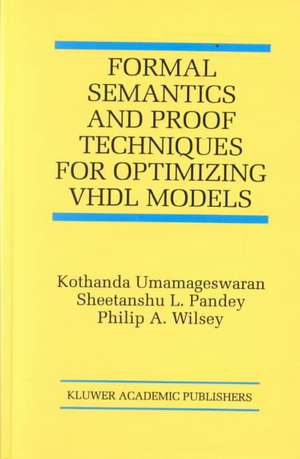
Formal Semantics and Proof Techniques for Optimizing VHDL Models
Autor Kothanda Umamageswaran, Philip A. Wilsey, Sheetanshu L. Pandeyen Limba Engleză Hardback – 30 noi 1998
Formal Semantics and Proof Techniques for Optimizing VHDL Models is written for hardware designers who are interested in the formal semantics of VHDL.
Preț: 660.08 lei
Preț vechi: 776.57 lei
-15%
Puncte Express: 990
Carte tipărită la comandă
Livrare economică 26 noiembrie-10 decembrie
Livrare prin curier în România Termenul estimat este afișat lângă disponibilitate.
Transport gratuit pentru acest produs Plată online sau ramburs, în funcție de opțiunile comenzii.
Retur gratuit în 14 zile Comandă securizată și suport în română.
Specificații
ISBN-13: 9780792383758
ISBN-10: 0792383753
Pagini: 184
Ilustrații: XXI, 158 p.
Dimensiuni: 160 x 241 x 15 mm
Greutate: 0.4 kg
Ediția:1999
Editura: Springer Us
Locul publicării:New York, NY, United States
ISBN-10: 0792383753
Pagini: 184
Ilustrații: XXI, 158 p.
Dimensiuni: 160 x 241 x 15 mm
Greutate: 0.4 kg
Ediția:1999
Editura: Springer Us
Locul publicării:New York, NY, United States
V-ar putea interesa
-
 The C++ Programming LanguageBjarne Stroustrup-20%Preț: 507.21 lei634.02 lei
 -
 Python Programming for BiologyTim J. Stevens-20%Preț: 460.01 lei575.01 lei
 -
 Beginning Programming with C++ For DummiesStephen R. Davis-20%Preț: 173.62 lei217.02 lei
 -
 Pro ASP.NET Web API SecurityBadrinarayanan Lakshmiraghavan-20%Preț: 525.86 lei657.33 lei
 -
 -20%Preț: 230.97 lei288.71 lei
 -
 -20%Preț: 153.00 lei191.25 lei
 -
 Functional Programming in ScalaRunar Bjarnason-20%Preț: 340.60 lei425.75 lei
 -
 Python Programming for BeginnersJoseph Joyner-20%Preț: 53.61 lei67.02 lei
 -
 The Fortran 2003 HandbookJeanne C. Adams-20%Preț: 1530.72 lei1913.41 lei
 -
 Murachs C# 2012Joel Murach-28%Preț: 359.74 lei496.79 lei
 -
 Ada Software Tools InterfacesPeter J. L. Wallis-20%Preț: 315.61 lei394.51 lei
 -
 Recent Trends in Data Type SpecificationDonald Sannella-20%Preț: 320.93 lei401.17 lei
 -
 Foundations of Object-Oriented LanguagesJ. W. De Bakker-20%Preț: 330.15 lei412.69 lei
 -
 Ada: The Choice for '92Dimitris Christodoulakis-20%Preț: 328.49 lei410.62 lei
 -
 Compiler ConstructionTibor Gyimóthy-20%Preț: 325.83 lei407.29 lei
 -
 Ada 95, Quality and StyleChristine Ausnit-Hood-20%Preț: 350.21 lei437.76 lei
 -
 -20%Preț: 318.67 lei398.33 lei
Public țintă
ResearchCuprins
1. Introduction.- 1.1 Goals of the Work.- 1.2 Scope of the Work.- 1.3 Notation.- 1.4 Overview of Book.- 2. Related Work.- 2.1 Higher Order Logic.- 2.2 Denotational Semantics.- 2.3 Functional Semantics.- 2.4 Axiomatic Semantics.- 2.5 Petri Nets.- 2.6 Evolving Algebras.- 2.7 Boyer-Moore Logic.- 2.8 Summary.- 3. The Static Model.- 3.1 The VHDL World.- 3.2 Signals.- 3.3 Variables.- 3.4 The Port Hierarchy.- 3.5 Data Types.- 3.6 Expressions.- 3.7 Subprograms.- 3.8 Sequential Statements.- 3.9 Concurrent Statements.- 3.10 Summary.- 4. A Well-Formed VHDL Model.- 4.1 Signals.- 4.2 Variables.- 4.3 The Port Hierarchy.- 4.4 Data Types.- 4.5 Expressions.- 4.6 Sequential Statements.- 4.7 Concurrent Statements.- 4.8 Summary.- 5. The Reduction Algebra.- 5.1 Signal Assignment Statements.- 5.2 Concurrent Statements.- 5.3 The Reduced Form.- 6. Completeness of the Reduced Form.- 6.1 A Brief Overview of PVS.- 6.2 The Specification of the Reduction Algebra in PVS.- 6.3 Signal Assignment Reduction.- 6.4 Completeness.- 6.5 Irreducibility.- 6.6 Conclusion.- 7. Interval Temporal Logic.- 8. The Dynamic Model.- 8.1 Methodology.- 8.2 Evaluation of VHDL Statements.- 8.3 Transaction Lists.- 8.4 The State Space.- 8.5 Waveforms.- 8.6 Observability.- 8.7 Attributes.- 8.8 Conclusions.- 9. Applications of the Dynamic Model.- 9.1 Similarity Revisited.- 9.2 Process Folding.- 9.3 Signal Collapsing.- 9.4 Elimination of Marking.- 9.5 Summary.- 10. A Framework for Proving Equivalences using PVS.- 10.1 The Dynamic Model.- 10.2 Validation of the Semantics.- 10.3 Developing Proofs of Optimizations.- 10.4 Applications to Practical Use.- 11. Conclusions.- 11.1 Contributions of this research.- 11.2 Future Work.- Appendices A—.- A.1 The relation during(b,a) holds.- A.2 The relation finishes(b,a) holds.- A.3 Therelation overlaps(a,b) holds.- References.