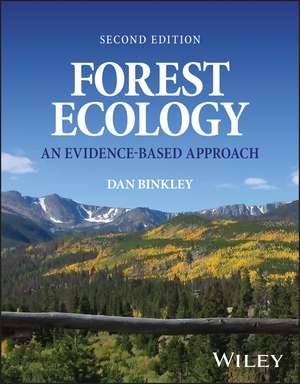
Forest Ecology
Autor Dan Binkleyen Limba Engleză Paperback – oct 2026
Ne-a atras atenția modul în care Forest Ecology reușește să redefinească standardele educaționale în domeniu, propunând o abordare riguroasă bazată pe dovezi („evidence-based”), într-o eră în care simplificările narative despre natură pot duce la erori de gestionare. Notăm cu interes faptul că Dan Binkley respinge modelele deterministe rigide ale ecologiei clasice din secolul trecut, preferând să exploreze natura contingentă și adesea imprevizibilă a ecosistemelor forestiere reale. Această lucrare extinde cadrul propus de Ecology of Woodlands and Forests de Peter Thomas, trecând de la o descriere funcțională a structurilor la o analiză profundă a modului în care datele empirice recente pot corecta neînțelegerile istorice despre funcționarea pădurilor. Putem afirma că volumul este organizat pentru a oferi o progresie logică, de la nivelul micro al fiziologiei și adaptării (capitolele 3 și 4), spre procese complexe de sistem, precum ciclurile nutrienților și hidrologia. Un punct forte al structurii îl reprezintă secțiunile dedicate evenimentelor perturbatoare — vânt, insecte, boli și foc — tratate nu ca anomalii, ci ca elemente intrinseci ale dinamicii forestiere. Spre deosebire de Individual-based Methods in Forest Ecology and Management, care se concentrează pe modelarea matematică a interacțiunilor dintre indivizi, Forest Ecology oferă o sinteză mai largă, integrând ecologia faunei sălbatice și managementul conservării într-un tot unitar. Textul reflectă experiența autorului acumulată în lucrări precum Acidic Deposition and Forest Soils, însă aici focusul se mută de la impactul poluanților către o viziune holistică asupra pădurilor viitorului, pregătind studenții pentru provocările schimbărilor globale.
Preț: 540.76 lei
Preț vechi: 667.61 lei
-19% Precomandă
Carte nepublicată încă
Specificații
ISBN-10: 1394436343
Pagini: 304
Ediția:2. Auflage
Editura: John Wiley & Sons, Inc.
V-ar putea interesa

De ce să citești această carte
Este resursa esențială pentru studenții de la silvicultură și ecologie care doresc să depășească teoria abstractă. Cititorul câștigă o înțelegere bazată pe date reale despre cum funcționează pădurile, învățând să distingă între miturile ecologice populare și realitatea empirică. Este un ghid practic pentru viitorii specialiști în conservare și management forestier, oferind argumente solide pentru decizii de restaurare sustenabilă.
Despre autor
Dan Binkley este un expert recunoscut în ecologie forestieră și știința solului, fiind autorul unor lucrări de referință precum Ecology and Management of Forest Soils 5e. Cariera sa a fost marcată de studierea impactului factorilor de mediu asupra pădurilor, de la poluarea atmosferică la schimbările climatice globale. Prin această lucrare publicată la John Wiley and Sons Ltd, Binkley își consolidează reputația de cercetător care pune accent pe rigoarea observației de teren, transformând datele complexe în resurse educaționale accesibile pentru mediul academic și profesional.
Notă biografică
Cuprins
ACKNOWLEDGMENTS xvi
1 The Nature of Forests 1
2 Forest Environments 13
3 Evolution and Adaptation in Forests 33
4 Physiology and Life History of Trees 50
5 Ecology of Wildlife in Forests 67
6 Forest Soils, Hydrology, and Nutrient Cycling 85
7 Ecology of Growth of Trees and Forests 106
8 Forests Across Space 129
9 Forests Through Time 149
10 Events in Forests: Winds, Insects, and Diseases 168
11 Events in Forests: Fires 190
12 Events in Forests: Management 213
13 Conservation, Sustainability, and Restoration of Forests 234
14 Forests of the Future 254
REFERENCES 271
INDEX 285
Descriere scurtă
Classical approaches to forest ecology often were shaped around appealing concepts that were poorly grounded in real forests. Now in its Second Edition, Forest Ecology: An Evidence-Based Approach replaces those misconceptions with insights that rely on observable science. This revised edition examines features common to all forests alongside site-specific factors that determine forest structure, function, and future trajectories.
New to this edition are updated topics in forest policy and management and expanded coverage of the role of people in forest ecology. The book retains its concise structure designed for use in a single semester course. A core framework built on three direct questions guides readers through empirical evaluation of forest patterns, clearly focusing on to best understand the dynamic nature of forests.
Readers will also find:
- A method for distinguishing appealing ecological stories from those that accurately describe real forest systems and processes
- Coverage of deterministic and indeterminant interactions among forest components across multiple scales of space and time
- Empirical treatment of plant and animal interactions grounded in the vast observational data now available on forests
- Analysis of environmental features that shape forest ecosystems, from site-specific conditions to broad landscape-level drivers
- An approach praised by educators internationally for inspiring critical and creative thinking in students and early-career researchers
Descriere
An Evidence-Based Approach
Forest ecology is the science that deals with everything in forests, including plants and animals (and their interactions), the features of the environment that affect plants and animals, and the interactions of humans and forests. All of these components of forests interact across scales of space and time. Some interactions are constrained, deterministic, and predictable; but most are indeterminant, contingent, and only broadly predictable.
Forest Ecology: An Evidence-Based Approach examines the features common to all forests, and those unique cases that illustrate the importance of site-specific factors in determining the structure, function, and future of a forest. The author emphasizes the role of evidence in forest ecology, because appealing, simple stories often lead to misunderstandings about how forests work. A reliance on evidence is central to distinguishing between appealing stories and stories that actually fit real forests.
The evidence-based approach emphasizes the importance of real-world, observable science in forests. Classical approaches to ecology in the twentieth century often over-emphasized appealing concepts that were not sufficiently based on real forests. The vast amount of information now available on forests allows a more complete coverage of forest ecology that relies on a strong, empirical foundation.
Forest Ecology: An Evidence-Based Approach is the ideal companion text for the teaching of upper-level undergraduate and graduate courses in forest ecology.