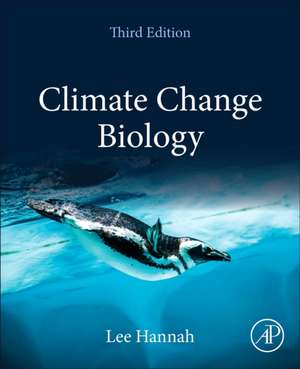
Climate Change Biology
Autor Lee Hannahen Limba Engleză Paperback – 25 iun 2021
All sections are updated using the more than 5,000 research papers that have appeared on the topic since the publication of the second edition. Sections on the combined effects of ocean acidification and climate change are especially strengthened, with over six new case studies and end of chapter questions in each chapter.
- Covers the evolving discipline of human-induced climate change and the resulting shifts in the distributions of species and timing of biological events
- Offers positive solutions and policy relevant insights on how extinctions can be avoided
- Includes stunning full-color illustrations from original research
Preț: 605.66 lei
Preț vechi: 897.11 lei
-32%
Puncte Express: 908
Carte tipărită la comandă
Livrare economică 13-27 noiembrie
Livrare express 15-21 octombrie pentru 122.40 lei
Livrare prin curier în România Termenul estimat este afișat lângă disponibilitate.
Transport gratuit pentru acest produs Plată online sau ramburs, în funcție de opțiunile comenzii.
Retur gratuit în 14 zile Comandă securizată și suport în română.
Specificații
ISBN-13: 9780081029756
ISBN-10: 0081029756
Pagini: 528
Dimensiuni: 191 x 235 x 30 mm
Greutate: 1.1 kg
Ediția:3
Editura: ELSEVIER SCIENCE
ISBN-10: 0081029756
Pagini: 528
Dimensiuni: 191 x 235 x 30 mm
Greutate: 1.1 kg
Ediția:3
Editura: ELSEVIER SCIENCE
V-ar putea interesa
-
 Climate Change and Nature: A Biological PerspectiveStephen Tilling-20%Preț: 181.72 lei225.98 lei
 -
 Marine BiologyJeffrey Levinton-27%Preț: 1322.42 lei1811.54 lei
 -
 Marine Biology: A Very Short IntroductionPhilip V. Mladenov-19%Preț: 58.10 lei71.69 lei
 -
 Animal Physiology: an environmental perspectivePatrick Butler-18%Preț: 548.27 lei668.05 lei
 -
 -13%Preț: 131.16 lei151.45 lei
 -
 Biodiversity and Climate Change: Transforming the BiosphereThomas E. LovejoyPreț: 262.64 lei
 -
 Climate Change and Human MigrationLyly LuhachackPreț: 127.51 lei
 -
 Ecology for the 21st centuryOrianna Carter-33%Preț: 640.53 lei953.52 lei
 -
 The Decline and Fall of the Human EmpireHenry Gee-34%Preț: 80.86 lei122.38 lei
 -
 Forest EcologyDan Binkley-19%Preț: 532.90 lei657.90 lei
 -
 Sink or Swim: How the world needs to adapt to a changing climateSusannah Fisher-26%Preț: 100.23 lei135.49 lei
 -
 -26%Preț: 89.51 lei121.00 lei
 -
 Metamorphosis: A Natural and Human HistoryOren Harman-30%Preț: 133.14 lei191.14 lei
 -
 -23%Preț: 740.87 lei962.17 lei
 -
 Advances in Environmental Research: Volume 18Justin A Daniels-26%Preț: 730.58 lei992.26 lei
 -
 Hurricane Lizards and Plastic SquidThor HansonPreț: 78.70 lei
 -
 KingdomWill MillardPreț: 223.50 lei
 -
 Super NaturalAlex RileyPreț: 157.68 lei
 -
 The Other Side of ChangeMaya ShankarPreț: 121.90 lei
 -
 Human NatureKate MarvelPreț: 136.91 lei
Public țintă
Primary: Undergraduate climate change biology courses, undergraduate ecology courses as a supplemental text, graduate climate change biology courses, AP or upper level high school environmental science courses.Secondary: Professionals who need to understand and manage the effects of climate change on nature and natural resources. Including parks managers, forest managers, water resources managers, private land managers.
Cuprins
1. A New Discipline: Climate Change Biology
2. The Climate System and Climate Change
3. The Impact of Human Induced Climate Change
4. Phenology: Changes in Timing of Biological Events due to Climate Change
5. Ecosystem Change
6. Past Terrestrial Response
7. Past Marine Ecosystem Changes
8. Past Freshwater Changes
9. Extinctions
10. Insights from Experimentation
11. Modeling Species and Ecosystem Responses
12. Estimating Extinction Risk from Climate Change
13. Ecosystem Services
14. Adaption of Conservation Strategies
15. Connectivity and Landscape Management
16. Species Management
17. International Climate Policy
18. Mitigation
19. Carbon Sinks and Sources
20. Assessing Risks, Designing Solutions
2. The Climate System and Climate Change
3. The Impact of Human Induced Climate Change
4. Phenology: Changes in Timing of Biological Events due to Climate Change
5. Ecosystem Change
6. Past Terrestrial Response
7. Past Marine Ecosystem Changes
8. Past Freshwater Changes
9. Extinctions
10. Insights from Experimentation
11. Modeling Species and Ecosystem Responses
12. Estimating Extinction Risk from Climate Change
13. Ecosystem Services
14. Adaption of Conservation Strategies
15. Connectivity and Landscape Management
16. Species Management
17. International Climate Policy
18. Mitigation
19. Carbon Sinks and Sources
20. Assessing Risks, Designing Solutions
Notă biografică
Lee Hannah is Senior Scientist in Climate Change Biology at the Moore Center for Science at Conservation International (CI). He heads CI's efforts to understand climate change impacts on species and ecosystems. His research has appeared in journals including Nature, PNAS and Science. Dr. Hannah has been a leader in quantifying extinction risk from climate change and conservation responses to this challenge. His work in these areas has been cited over 15,000 times. He edited Climate Change and Biodiversity: Transforming the Biosphere (Yale: 2018) and its award-winning 2005 predecessor with Thomas E. Lovejoy. His undergraduate textbook on the biological impacts of climate change, Climate Change Biology (Elsevier: 2011) is the first in the field. Thompson-Reuters has named him a highly cited researcher, designating him among the most cited scientists in the field of ecology and conservation. Dr. Hannah holds an undergraduate degree in biology from the University of California at Berkeley and a Doctorate in Environmental Science from UCLA. He is based in Santa Barbara, California, at the Bren School of Environmental Science at UCSB.