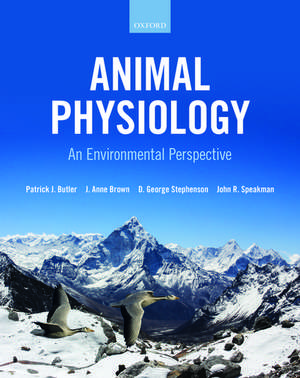
Animal Physiology: an environmental perspective
Autor Patrick Butler, Anne Brown, George Stephenson, John Speakmanen Limba Engleză Paperback – 25 feb 2021
Notăm cu interes apariția acestui manual comprehensiv, Animal Physiology: an environmental perspective, o lucrare de referință publicată sub egida OUP Oxford care reîncadrează studiul fiziologiei animale în contextul ecologic actual. Volumul, structurat în cinci părți ample, depășește abordarea tradițională de laborator pentru a explora modul în care animalele sălbatice navighează medii complexe, supuse unor schimbări rapide din cauza activității umane, precum poluarea și schimbările climatice. Prima parte stabilește fundamentele proceselor vitale și strategiile de hrănire, în timp ce secțiunile următoare detaliază funcționarea sistemelor respirator, circulator și excretor sub influența temperaturii ambientale.
Reținem precizia cu care autorii, printre care se numără Patrick Butler și John Speakman, analizează mecanismele de control și coordonare prin sistemele nervos și endocrin. Cititorii familiarizați cu Introduction to Animal Physiology de Dr Ian Kay vor aprecia aici profunzimea perspectivei ecologice; în timp ce volumul lui Kay oferă o introducere solidă în principii, lucrarea de față ancorează aceste procese în realitatea dură a Antropocenului. De asemenea, spre deosebire de Efficiency and Economy in Animal Physiology de Robert W. Blake, care se concentrează pe optimizarea evolutivă, acest manual pune accent pe capacitatea de adaptare a fiziologiei la stresori de mediu imprevizibili. Structura didactică este susținută de panouri experimentale și o bibliotecă digitală de imagini, facilitând integrarea informațiilor în curriculumul universitar de biologie.
Preț: 501.55 lei
Preț vechi: 616.06 lei
-19%
Carte disponibilă
Livrare economică 15-26 mai
Livrare express 02-08 mai pentru 184.56 lei
Specificații
ISBN-10: 0199655456
Pagini: 1104
Dimensiuni: 278 x 220 x 44 mm
Greutate: 2.72 kg
Editura: OUP OXFORD
Colecția OUP Oxford
Locul publicării:Oxford, United Kingdom
V-ar putea interesa
-
 Animal PhysiologyRichard Hill-14%Preț: 853.43 lei992.36 lei
 -
 Human PhysiologyGillian Pocock-15%Preț: 572.28 lei671.34 lei
 -
 Human Physiology: A Very Short IntroductionJamie A. Davies-21%Preț: 53.28 lei67.68 lei
 -
 Ecological and Environmental Physiology of MammalsPhilip C. Withers-21%Preț: 455.44 lei579.83 lei
 -
 -16%Preț: 121.79 lei144.57 lei
 -
 Preț: 242.37 lei
 -
 -15%Preț: 125.41 lei146.73 lei
 -
 The Physiology Coloring BookWynn KapitPreț: 241.60 lei
 -
 AdaptableHerman PontzerPreț: 179.82 lei
 -
 Introduction to Veterinary Anatomy and Physiology TextbookVictoria Aspinall-31%Preț: 244.73 lei352.57 lei
 -
 ACSM's Advanced Exercise PhysiologyAmerican College of Sports Medicine-24%Preț: 749.62 lei992.44 lei
 -
 -9%Preț: 901.83 lei991.02 lei
 -
 Dukes' Physiology of Domestic AnimalsWilliam O. Reece-5%Preț: 753.33 lei792.98 lei
 -
 Moyes, C: Principles of Animal PhysiologyPatricia Schulte-15%Preț: 630.77 lei742.08 lei
 -
 -5%Preț: 576.00 lei606.32 lei
 -
 Preț: 117.76 lei
 -
 Super NaturalAlex RileyPreț: 152.39 lei
 -
 Human NatureKate MarvelPreț: 130.60 lei
 -
 -25%Preț: 110.43 lei147.54 leiRecomandat
De ce să citești această carte
Recomandăm acest manual studenților și cercetătorilor în biologie care doresc să înțeleagă nu doar „cum” funcționează un organism, ci și „cum” rezistă acesta în habitate degradate. Este un instrument esențial pentru viitorii specialiști în conservare, oferind fundamentul fiziologic necesar pentru a proteja speciile în fața schimbărilor climatice. Câștigați acces la resurse online valoroase și studii de caz care fac legătura între teorie și cercetarea de teren.
Despre autor
Patrick Butler este profesor asociat la Melbourne Business School, în cadrul Universității din Melbourne, Australia. Deși bibliografia sa include și lucrări de istorie locală sau relatări militare, expertiza sa în domeniul biologiei se reflectă în rigoarea științifică a acestui manual. Alături de coautori precum John Speakman, renumit pentru cercetările sale în bioenergetică, Butler contribuie la o sinteză interdisciplinară care leagă fiziologia clasică de provocările ecologice moderne, oferind o perspectivă globală asupra adaptării speciilor.
Descriere
Recenzii
Very clearly explained. Easy and enjoyable to read.
The descriptions and explanations are excellent...the best I have read in a long time.
The emphasis on the environmental factors influencing physiological processes and the link from this to adaption to change is particularly helpful.