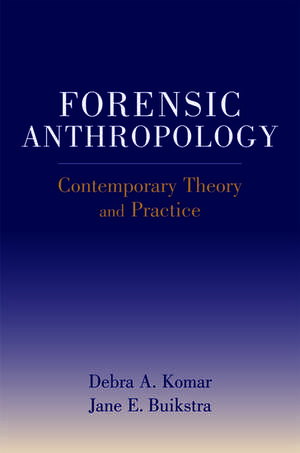
Forensic Anthropology: Contemporary Theory and Practice
Autor Debra Komar, Jane Buikstraen Limba Engleză Hardback – 15 noi 2007
Preț: 576.07 lei
Preț vechi: 760.67 lei
-24%
Puncte Express: 864
Carte tipărită la comandă
Livrare economică 20 noiembrie-01 decembrie
Livrare prin curier în România Termenul estimat este afișat lângă disponibilitate.
Transport gratuit pentru acest produs Plată online sau ramburs, în funcție de opțiunile comenzii.
Retur gratuit în 14 zile Comandă securizată și suport în română.
Specificații
ISBN-13: 9780195300291
ISBN-10: 0195300297
Pagini: 384
Ilustrații: 82 halftones, 12 line drawings
Dimensiuni: 236 x 155 x 25 mm
Greutate: 0.66 kg
Editura: Oxford University Press
Colecția OUP USA
Locul publicării:New York, United States
ISBN-10: 0195300297
Pagini: 384
Ilustrații: 82 halftones, 12 line drawings
Dimensiuni: 236 x 155 x 25 mm
Greutate: 0.66 kg
Editura: Oxford University Press
Colecția OUP USA
Locul publicării:New York, United States
V-ar putea interesa
-
 The Human Bone ManualTim D. White-25%Preț: 246.80 lei331.09 lei
 -
 A Laboratory Manual for Forensic AnthropologyAngi M. Christensen-8%Preț: 375.08 lei407.69 lei
 -
 Forensic Anthropology: Current Methods and PracticeAngi M. Christensen-31%Preț: 531.88 lei775.49 lei
 -
 Oxford Handbook of Forensic MedicineJonathan P. WyattPreț: 277.21 lei
 -
 -14%Preț: 129.19 lei150.84 lei
 -
 Forensic Nursing ScienceVirginia A. Lynch-29%Preț: 517.25 lei724.57 lei
 -
 Case Studies in Forensic Anthropology: Bonified SkeletonsHeather M. Garvin-8%Preț: 496.00 lei539.14 lei
 -
 Forensic Anthropology: A Comprehensive Introduction, Second EditionNatalie R. Langley-8%Preț: 501.45 lei545.05 lei
 -
 Introduction to Forensic AnthropologySteven N. Byers-9%Preț: 640.49 lei703.84 lei
 -
 Simpson's Forensic MedicineJason Payne-JamesPreț: 444.48 lei
 -
 -8%Preț: 577.41 lei627.62 leiRecomandat
 -
 -8%Preț: 482.95 lei524.94 lei
 -
 Forensic Justice: A Global PerspectiveBeulah ShekharPreț: 419.34 lei
 -
 Preț: 365.47 lei
 -
 FORENSIC ANTHROPOLOGYAndrew C. SeidelPreț: 563.71 lei
 -
 Forensic ScienceJay SiegelPreț: 76.92 lei
 -
 Crime Scene to CourtNiamh NicdaeidPreț: 465.10 lei
 -
 Forensic PathologyRebekah Jacques-5%Preț: 795.44 lei837.31 lei
 -
 Legal and Forensic MedicineRoy G. Beran-18%Preț: 5311.56 lei6477.52 lei
Recenzii
"This book is definitely one that I would use in my classes. As a reference text it is one that all practicing forensic anthropologists will want to own and will want their students to have. Other volumes do not provide a comprehensive resource for the challenges facing us today. Such a volume as [this one] will certainly advance that cause."--Mary H. Manhein, Louisiana State University and Deputy Coroner of East Baton Rouge Parish
"This book is superior to any other source on the market today. In recommending this book to colleagues I should note its coverage of the U.S. legal system, enlightened discussion of the NAGPRA issue and related ethical problems, its adequate history of the American advances in forensic anthropology, and the excellent case histories that it includes."--Kenneth A. R. Kennedy, Cornell University
"This book is superior to any other source on the market today. In recommending this book to colleagues I should note its coverage of the U.S. legal system, enlightened discussion of the NAGPRA issue and related ethical problems, its adequate history of the American advances in forensic anthropology, and the excellent case histories that it includes."--Kenneth A. R. Kennedy, Cornell University
Cuprins
- Chapters 2-10 open with an Introduction and end with a Conclusion.
- 1. Introduction
- Forensic Anthropology: A Brief History (1972-2006)
- What Is Forensic Anthropology Today?
- Where Do Forensic Anthropologists Work?
- Is Forensic Anthropology Expanding in the United States?
- Forensic Anthropology Outside the United States
- Research in Forensic Anthropology Today
- Forensic Anthropology in Perspective
- 2. The Medicolegal System
- The Medicolegal System
- Jurisdiction
- Cause and Manner of Death
- Autopsy and Postmortem Examinations
- 3. Evidence and the Judicial System
- Evidence
- Evidence Interpretation: Rationality versus Parsimony
- The Judicial System: An Overview
- Testifying as a Witness
- Homicide
- 4. Crime Scene Investigation: Identifying Medicolegal Remains, Search Strategies, and Scene Documentation
- Identifying Remains of Medicolegal Significance
- Differentiating Human from Animal Bone and Nonbiological Materials
- Jurisdiction and the Crime Scene
- Evaluating Scenes
- Search Strategies
- Evidence
- Documentation
- Burials
- Report Writing
- 5. Beginning the Identification Process: Developing a Biological Profile
- Theories and Methods in Forensic Anthropology
- The Estimation of Sex from Skeletal Remains
- The Estimation of Age-at-Death from Skeletal Remains
- Ancestry
- Stature Estimation
- Other Physical Features
- 6. Pathology and Trauma Assessment
- The Language of Pathology, Anatomy, and Medicine
- Pathology: An Overview
- Trauma Assessment
- Gunshot Wound Interpretation
- 7. Forensic Taphonomy
- Forensic Taphonomy
- The Goals of Forensic Taphonomy
- 8. Personal Identification
- How Identification Is Established
- Categories of Identification
- Methods of Positive Identification
- Alternative Medical Imaging
- Impact of Daubert on Positive Identification
- Photographic Superimposition and Facial Recognition
- 9. Mass Death and International Investigations of Human Rights Violations
- War Crimes
- Personal Identification
- Humanitarian versus Medicolegal Response
- Mass Graves
- Objectivity
- 10. Biohistory: Historical Questions, Methods, and Ethics
- Biohistory: Past and Present
- Noninvasive Analyses
- A Case Study in Biohistorical and Forensic Investigation: Billy the Kid
- Glossary
- References Cited and Related Bibliographic Items
- Index