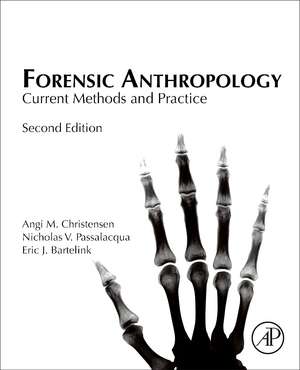
Forensic Anthropology: Current Methods and Practice
Autor Angi M. Christensen, Nicholas V. Passalacqua, Eric J. Bartelinken Limba Engleză Hardback – 23 sep 2019
Subliniem expertiza colectivă a autorilor Angi M. Christensen, Nicholas V. Passalacqua și Eric J. Bartelink, a căror activitate de teren și cercetare fundamentează acest volum de referință. Ediția a doua a lucrării Forensic Anthropology reflectă expansiunea rapidă a disciplinei în contextul juridic și mediatic actual, oferind o sinteză între bazele teoretice evoluționiste și rigoarea procedurilor tehnice moderne.
Notăm cu interes structura riguroasă a celor 15 capitole, care ghidează cititorul de la fundamentele osteologiei și odontologiei umane către complexitatea arheologiei criminalistice și procesării locului faptei. Lucrarea nu se rezumă la analiza schematică a rămășițelor, ci abordează teme de o actualitate stringentă, precum antropologia judiciară în investigațiile privind drepturile omului și dezastrele în masă, aspecte detaliate în capitolele finale. Comparabil cu A Laboratory Manual for Forensic Anthropology în ceea ce privește rigoarea științifică, acest volum se distinge prin actualizarea metodelor de estimare a vârstei, sexului și staturii, fiind recalibrat pentru noile standarde de validare statistică din medicina legală.
În contextul operei autorilor, Forensic Anthropology servește drept fundament teoretic și metodologic complet, în timp ce lucrări precum The Routledge Handbook of Forensic Anthropology (coordonat de Passalacqua) oferă o perspectivă mai largă, multidisciplinară. Progresia materialului este logică: după stabilirea semnificației medico-legale și a tafonomiei, textul avansează spre tehnici avansate de analiză a traumelor scheletice și variațiilor individuale. Utilizarea studiilor de caz reale și a întrebărilor de reflecție transformă acest tratat într-un instrument pedagogic esențial pentru mediul universitar superior.
Preț: 501.36 lei
Preț vechi: 740.10 lei
-32%
Carte disponibilă
Livrare economică 11-25 mai
Livrare express 01-07 mai pentru 144.23 lei
Specificații
ISBN-10: 0128157348
Pagini: 520
Dimensiuni: 191 x 235 x 35 mm
Greutate: 1.24 kg
Ediția:2. Auflage
Editura: ELSEVIER SCIENCE
Public țintă
Primary: Introductory and/or upper level courses in forensic anthropologySecondary: Reference for other courses involving human identification, skeletal biology or human osteology; practical guide for beginning practitionersDe ce să citești această carte
Această ediție a doua este indispensabilă studenților și practicienilor la început de drum în medicina legală sau criminalistică. Cititorul câștigă o înțelegere profundă a metodelor actuale de recuperare și analiză a rămășițelor umane, fundamentată pe dovezi științifice validate. Este o resursă echilibrată care îmbină teoria biomecanică cu aplicațiile practice necesare în investigațiile moderne de identificare umană.
Cuprins
1. Introduction to forensic anthropology 2. Human osteology and odontology 3. Skeletal examination and documentation methods 4. Medicolegal significance 5. Forensic taphonomy 6. Forensic archaeology and scene processing methods 7. Processing, resolving commingling, and preserving remains 8. Sex estimation 9. Ancestry estimation 10. Age estimation 11. Stature estimation and other skeletal metrics 12. Individual skeletal variation 13. Analysis of skeletal trauma 14. Personal identification 15. Forensic anthropology in humanitarian and human rights investigations
Recenzii
"Forensic Anthropology (2nd edition) ... is comprehensive, providing its reader with a solid foundation in all areas of forensic anthropology, including its history, application, and methods. It covers forensic archaeology, processing, laboratory procedures and analyses, and legal implications. I can’t think of a single subject matter I’d plan on teaching in an Intro to Forensic Anthropology course that was not covered in the text. This is a textbook written by experts in the field and it shows."--Heather Garvin
"Overall, book is well written with excellent examples and I am looking forward to using it in my Forensic Anthropology classes! The book includes the most up to date research and is useful for both practitioners and students in the discipline."--Alexandra Klales
Descriere
Forensic anthropology has seen a recent expansion in depth and scope as well as increased attention from the media and the legal system. This constantly evolving science requires a comprehensive introductory text that approaches forensic anthropology as a modern discipline, with attention to theory as well as recent advances in research, technology, and challenges in the field.
Forensic Anthropology: Current Methods and Practice, 2nd edition approaches forensic anthropology using current practices and case studies drawn from the varied experiences, backgrounds, and practices of working forensic anthropologists. This text guides the reader through all aspects of human remains recovery and forensic anthropological analysis. It presents principles at a level that is appropriate for those new to the field, while at the same time incorporating evolutionary, biomechanical, and other theoretical foundations for the features and phenomena encountered in forensic anthropological casework.
Attention is focused on the most recent and scientifically valid applications commonly employed by working forensic anthropologists. Readers will learn about innovative techniques in the discipline, and aspiring practitioners will be prepared by understanding the necessary background needed to work in the field today. Instructors and students will find Forensic Anthropology: Current Methods and Practice, 2nd edition comprehensive, practical, and relevant to the modern discipline of forensic anthropology.
- Focuses on current methods, advances in research and technology, and recent challenges in the science of forensic anthropology
- Addresses issues of international relevance such as the role of forensic anthropology in mass disaster response and human rights investigations
- Includes chapter summaries, topic-oriented case studies, keywords, and reflective questions to increase active student learning