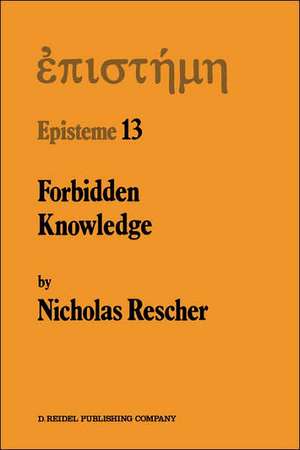
Forbidden Knowledge: Episteme, cartea 13
Autor N. Rescheren Limba Engleză Hardback – 31 aug 1987
Din seria Episteme
- 20%
 Preț: 333.81 lei
 - 18%
 Preț: 980.35 lei
 - 15%
 Preț: 665.77 lei
 -
 Preț: 407.11 lei
 - 20%
 Preț: 1022.45 lei
 - 18%
 Preț: 1023.09 lei
 -
 Preț: 383.75 lei
 - 15%
 Preț: 662.57 lei
 - 15%
 Preț: 664.01 lei
 - 18%
 Preț: 982.68 lei
 - 20%
 Preț: 620.16 lei
 - 18%
 Preț: 921.87 lei
 - 15%
 Preț: 674.91 lei
 - 18%
 Preț: 984.16 lei
 - 15%
 Preț: 666.74 lei
 - 20%
 Preț: 316.28 lei
 -
 Preț: 367.92 lei
 -
 Preț: 391.80 lei
 - 15%
 Preț: 674.48 lei
 - 18%
 Preț: 1270.46 lei
 -
 Preț: 375.34 lei
 -
 Preț: 368.24 lei
 -
 Preț: 377.21 lei
 - 18%
 Preț: 976.98 lei
Preț: 658.81 lei
Preț vechi: 775.07 lei
-15%
Puncte Express: 988
Carte tipărită la comandă
Livrare economică 23 noiembrie-07 decembrie
Livrare prin curier în România Termenul estimat este afișat lângă disponibilitate.
Transport gratuit pentru acest produs Plată online sau ramburs, în funcție de opțiunile comenzii.
Retur gratuit în 14 zile Comandă securizată și suport în română.
Specificații
ISBN-13: 9789027724106
ISBN-10: 9027724105
Pagini: 172
Ilustrații: XIV, 154 p.
Dimensiuni: 157 x 235 x 13 mm
Greutate: 0.36 kg
Ediția:1987
Editura: SPRINGER NETHERLANDS
Colecția Episteme
Seria Episteme
Locul publicării:Dordrecht, Netherlands
ISBN-10: 9027724105
Pagini: 172
Ilustrații: XIV, 154 p.
Dimensiuni: 157 x 235 x 13 mm
Greutate: 0.36 kg
Ediția:1987
Editura: SPRINGER NETHERLANDS
Colecția Episteme
Seria Episteme
Locul publicării:Dordrecht, Netherlands
V-ar putea interesa
-
 The Philosophy of InformationLuciano Floridi-11%Preț: 365.76 lei410.39 lei
 -
 Replacing TruthKevin Scharp-31%Preț: 680.92 lei985.77 lei
 -
 Essays on SkepticismAnthony Brueckner-21%Preț: 349.88 lei441.70 lei
 -
 -29%Preț: 502.39 lei704.32 lei
 -
 -6%Preț: 364.36 lei387.69 lei
 -
 Oxford Studies in Epistemology Volume 4Tamar Szabó Gendler-31%Preț: 776.19 lei1125.00 lei
 -
 Oxford Studies in Epistemology Volume 4Tamar Szabó Gendler-11%Preț: 377.88 lei424.54 lei
 -
 -31%Preț: 695.66 lei1008.31 lei
 -
 Know HowJason Stanley-13%Preț: 264.15 lei303.88 lei
 -
 -13%Preț: 304.68 lei349.23 lei
 -
 -13%Preț: 303.53 lei347.35 lei
 -
 The A Priori in PhilosophyAlbert Casullo-31%Preț: 636.02 lei920.53 lei
 -
 Causation and its Basis in Fundamental PhysicsDouglas Kutach-31%Preț: 659.96 lei959.52 lei
 -
 Philosophy of Science: A Unified ApproachGerhard Schurz-15%Preț: 461.35 lei542.77 lei
 -
 Preț: 315.80 lei
 -
 Truth and MethodHans-Georg Gadamer-23%Preț: 196.66 lei256.29 lei
Public țintă
ResearchCuprins
One/Forbidden Knowledge: Moral Limits of Scientific Research.- 1. A Range of Positions.- 2. Regulation vs. Laissez Faire.- 3. Moral Limits Pertain to Different Aspects of Knowledge.- 4. Can Knowledge as Such be Morally Inappropriate?.- 5. Knowledge is Only One Good among Others.- 6. The Enforcement of Morals.- 7. Coda.- Two/Truth as Ideal Coherence.- 1. The ‘Continuity Condition’ Relating a Criterion to the Definition of Truth.- 2. Truth as Ideal Coherence.- 3. Coherentism and Truth as Adequation.- 4. Postscript: The Gap Between the Real and the Ideal.- Three/Rationality and Consistency.- 1. Consistency: Initial Requisite or Ultimate Ideal?.- 2. Linearly Inferential vs. Dialectically Cyclic Reasoning.- 3. Ampliative vs. Reductive Reasoning.- 4. Two Very Different Sorts of Acceptability: Qualified vs. Outright Belief.- 5. Different Attitudes Towards Consistency.- 6. The Place of Dialectics in the Human Sciences.- 7. Must Inconsistency-Tolerance Be Motivated Epistemically?.- 8. Consistency as a Cognitive Ideal.- Four/An End to Science?.- 1. Is Scientific Discovery an Inherently Bounded Venture?.- 2. Nature Might Exhibit an Unending Complexity of Physical Constitution.- 3. Nature Might Exhibit an Unending Complexity of Lawful Comportment.- 4. The Phenomena of Nature Might Be Unendingly Diverse.- 5. The Basis for an Unending Prospect of Scientific Discovery Might Lie Wholly in the Character of Our Inquiry Processes.- 6. The Regulative Rationale for Supposing the Cognitive Inexhaustibility of Nature.- Five/On the Probabilistic Bearing of Testimony.- 1. Introduction.- 2. The Reliability of Sources.- 3.The Knowledgeability of Sources.- 4. Some Variations.- 5. A Survey of Probative Virtues.- 6. The Taxicab Problem.- 7. Hume and Laplace on Human Testimony.- 8. Laplace onTestimonial Chains.- 9. The Moral of the Story.- Six/The Limits of Probabilistic Epistemology.- 1. The Probabilist Program.- 2. Probability Is Not Enough.- Seven/The Threefold Way.- 1. The Three Levels.- 2. Some Examples.- 3. Man as a Creature of the Threefold Way.- 4. The Question of Legitimacy: The Utility of the Ideal.- Eight/Number Idolatry and Fallacies of Quantification.- Nine/Life’s Seasons: The Conceptual Phenomenology of Age-Periodization.- 1. The General Idea of a Life Cycle.- 2. The Rationale of Human Age-Periodization Phase Transitions.- 3. The Diversity of Age.- 4. The Conventionality of Phase Transition.- 5. Thought Experiments.- 6. The Upshot.- 7. Broader Vistas.- Ten/Philosophical Taxonomy as A Philosophical Issue.- 1. The Shape of Philosophy: Some Ancient Views.- 2. The Middle Ages and Early Modern Times.- 3. A Later Picture.- 4. Taxonomic Dynamics.- 5. The Post-Kantian Transformation.- 6. Taxonomic Proliferation.- 7. The Contemporary Situation.- 8. The Problem of Progress.- 9. The Dialectic of the Individual and the Community.- 10. Conclusion.- Eleven/Is Philosophy a Guide to Life?.- 1. Philosophy: The Problematic Guide.- 2. The Problem of ‘Applied Philosophy’: Only One’s Own Philosophy Can Provide Guidance.- 3. What Philosophy Per Se Can Contribute.- 4. Some Examples of ‘Applied Philosophy’ in the Public Domain.- 5. The Limited Utility of Methodological Applications.- 6. A Danger of ‘Applied Philosophy’.- Notes.- Index of Names.