Cantitate/Preț
Produs

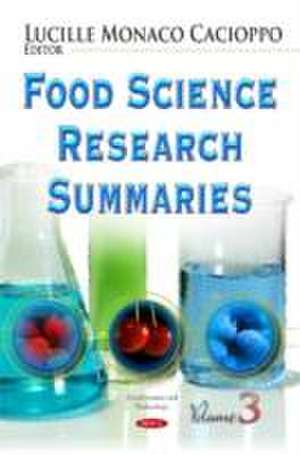
Food Science Research Summaries: Volume 3

Editat de Lucille T Cacioppo
en Hardback – iun 2014

Structura volumului Food Science Research Summaries este concepută ca un compendiu tehnic, oferind o privire de ansamblu asupra direcțiilor actuale din industria alimentară globală. Organizarea conținutului sub formă de rezumate de cercetare permite o parcurgere rapidă a unor subiecte complexe, de la mecanismele moleculare ale mierii în vindecarea rănilor, până la siguranța chimică a alimentelor și trasabilitatea produselor în rețelele de valoare. Această abordare fragmentată, dar exhaustivă, transformă volumul într-un instrument de referință pentru actualizarea cunoștințelor academice.

Pe același raft cu State-of-the-Art Technologies in Food Science, cartea se distinge prin formatul de tip „summaries”, care prioritizează esențializarea datelor în detrimentul analizei narative extinse. În timp ce lucrări precum Functional Foods and Nutraceuticals se concentrează pe formulări și inovații specifice, volumul editat de Lucille T Cacioppo acoperă un spectru mai larg, incluzând atât procesele de producție a laptelui, cât și metabolismul plantelor. Această lucrare continuă viziunea editorială a lui Cacioppo, observată și în Environmental & Agricultural Research Summaries sau Mind & Body Research Summaries, unde accentul cade pe colectarea contribuțiilor de la experți globali pentru a oferi o sinteză interdisciplinară. Subliniem rigoarea cu care sunt tratate teme de nișă, precum impactul procesării non-termice asupra componentelor bioactive, oferind cititorului o imagine clară a progresiei științifice în domeniu.

Citește tot Restrânge

Specificații

ISBN-13: 9781631178641
ISBN-10: 1631178644
Pagini: 282
Dimensiuni: 180 x 260 x 22 mm
Greutate: 0.69 kg
Editura: Nova Science Publishers Inc
Colecția Nova Science Publishers, Inc (US)
Locul publicării:United States

De ce să citești această carte

Recomandăm acest volum specialiștilor din industria alimentară și cercetătorilor care au nevoie de o actualizare rapidă și fundamentată științific asupra tendințelor actuale. Veți găsi aici date esențiale despre alimente funcționale și siguranță alimentară, structurate eficient pentru a economisi timp, oferind în același timp rigoarea academică specifică editurii Nova Science Publishers Inc.


Descriere

This book compiles research summaries from a number of different focuses in the important field of food science.

Cuprins

Preface; Technological Evaluation of Pan Bread Produced with the Addition of Commercial Resistant Starch or Unripe Banana Flour; Importance of French-type Bread in Brazilian Diet; Effect of Adding Ascorbic Acid on the Quality of Sliced Loaf with Partial Substitution of Amaranth Flour (Amaranthus Caudatus) & Wheat Bran (Triticum Aestivum); Maize Bread: Healthy & Safe; Nutritional Quality of Proteins in Breads; Fiber-Enriched Bread as an Aid in the Nutritional Management of Dislipemic Patients; Effect of Different Pineapple Juice (Ananas comosus l.) Preparations on the Microstructure, Staling & Textural Properties of Wheat Bread; Nutritional & Technological Characteristics of Gluten-Free & Low Glycemic Index Baking Products; Experimental Design for the Evaluation of Bread Protein Quality; Packaging & Required Protection for the Preservation of Bread Functional Compounds; Gastrointestinal Health Promotion via Bread Consumption: Elucidation of Preventive Effects in the Etiology of Pathological Events along the Intestine; What Is Coffee?; Antioxidant & Free Radical Processes in Coffee; Properties & Analysis of Caffeine & Chlorogenic Acids in Coffee Beans; Occurrence & Identification of Chlorogenic Acids in Green & Roasted Coffee Beans; Coffee Roasting: Accurate Control for Increased Bioactivity; Characterization of Organic Coffee Using Photothermal Techniques; Coffee Consumption & the Health of the Gastrointestinal & Endocrine Systems; Effects of Coffee on Inflammatory Processes; Epidemiological Evidence for the Association of Coffee Consumption with Cancer; Coffee Consumption & Oxidative DNA Damage; Coffee, Caffeine & the Cardiovascular System; Coffee Consumption & Type 2 Diabetes Mellitus; Neurological Effects of Coffee Consumption; Effects of Coffee Consumption during Pregnancy & in Young Children; Effects of Caffeine Consumption on Exercise; Other Health-Related Aspects of Coffee Consumption; Effect of Ionizing Radiation on Polymeric Food Packaging Materials; Packaging Optimization for Minimally Processed Fruit & Vegetables; Characterization of PLA, PCL & Sodium Caseinate Active Bio-Films for Food Packaging Applications; Metal-Based Micro & Nano-Composites as Antimicrobials in Food Packaging; Alternative Technique for the Quantitative Determination of Antimicrobial Activity of Antimicrobial Packaging Film Containing Lipophilic Materials; Antimicrobial Packaging: Lab Developments & Possible Commercialization; Evaluation of Safety of Recycled Paper & Board Food Contact Materials; Faking Authenticity?; The Multisensory Packaging of Beverages; Water Soluble Components in Green Teas & Their Effects on Human Health; Green Tea: Varieties, Production & Health Benefits; Green Tea & Pancreatic Cancer Chemoprevention; Effects of Green Tea on Cognitive Function & Mental Status: Emerging Evidence; Effects of Anti-Oxidative Stress of Green Tea Catechins on Cardiovascular Diseases; Antidiabetic Properties of Green Tea Catechins; Polyphenol Tea: Protein Protection, Cancer Prevent & Nanotechnology; Green Tea & Skin Benefits; Non-covalent Interactions of Green Tea Polyphenol: Source of Novel Colloidal Structures; Chinese Green Tea: Production, Varietal Resources & Adaptability; Phytochemicals as Potential Pharmacophores to Target Diabetes; Phytochemicals & their Potential Effects on Inflammatory Bowel Disease; Bioactive Compounds in Whole Grain Cereals; Antioxidant & Antimicrobial Activities of Berries Extracts of Five Juniperus Species under Juniperus Section from Turkey; Phenolic Compounds, Health Effects & Antioxidant Properties of Berries; Overview of the Chemical, Natural Occurrence & Antioxidant Activity of Terpenes; Supercritical Extraction of Phloroglucinols from St. John's Wort (Hypericum Perforatum L.) Process Optimization, Mathematical Modeling & Antimicrobial Activity; Natural Antioxidants in Food; Regulation of Inflammation by Dietary Phytochemicals: Current Perspectives; Antioxidative Phytochemicals & Skin Care; Research Progress on Medicinal Plants of Urtica Linn. Genus; Research & Development on Chemical Constituents & Pharmacology of Acanthopanax Genus; Simultaneous Determination of Five Triterpenoid Saponins in the Root of Caulophyllum Robustum Maxim by HPLC-ELSD; Chemical Study & Medical Application of Saponins from the Genus Aralia; Chemical Constituents & Bioactivities of Plants of the Genus Hydrangea; Phytochemicals in Cancer Research: A Review of Their Biological Activities & Anticancer Potentials in Preclinical & Clinical Studies; Mammary Glands, Aquaporins & Milk Production; Science & Pseudo-Science of Milk Implications for Human Health; Ruminant Milk & Human Wellbeing: A Multi-Species Review of the Natural Relations; Colostral & Lactogenic Maternal Immunity: Humoral & Cellular Factors of Induction & Transmission to the Neonate; The Importance of Milk Fatty Acids in Human Nutrition; Investigations on the Geographical Origin of Cow Milk & Comparison of the Lipid Composition of Cow & Buffalo Milk by Means of Traditional & Innovative Physico-Chemical Analyses; Alternative Approaches for the Prevention of Bovine Mastitis. Probiotics, Bioactive Compounds & Vaccines; (María Elena Fátima Nader-Macías, Cristina Bogni, Fernando Juan Manuel Sesma, María Carolina Espeche, Matías Pellegrino, Lucila Saavedra & Ignacio Milk Production of Holsteins under Mediterranean Conditions: Case of the Tunisian Population; Fresh Ewe Milk Production & Cereal Nutrition: A Peripartal Interactive Model of Grain Choice & Level; Fatty Acid Composition of Milk Lipids in Response to Dietary Fish & Safflower Oils; Genetic Factors & Dairy-Technological Valorisation of Milk; Animal Welfare in Dairy Operations: A Postmodern View; Soy: Nutrition, Consumption & Heart Health; Soy Isoflavones in Bone Health & Function; Soys Potential Role in Weight Management; Antihypertensive Activity of Soy & Soy-Derived Compounds; Mechanisms of Anti-Atherosclerotic Activity of Soy & Soy-Derived Compounds; Evaluation of Efficacy of Soy Isoflavones in Reducing the Menopausal Symptoms; Soy-Derived Compounds & Immune Response; The Role of Non-isoflavone Phytochemicals in Soy-derived Health Benefits; Effect of Dietary Fermented Soybean on Physical Endurance in Mice; Soy Consumption & Self-Reported Health; Soy Isoflavones: Bioorganic & Medicinal Chemistry of a Potent Compound Class; Soy Plant Tissue Culture as an Alternative for Isoflavonoid Production; Removal of Antinutritional Factors in Soy-Based Foods Using Lactic Acid Bacteria; Soy Ingredient Addition to Nutritionally Fortified Baked Goods; Increasing the Bioavailability of Soy Isoflavones Using Lactic Acid Bacteria; Combustion of Biodiesel Fuel Made from Soybean Oil; Soy Isoflavone Genistein in Cancer Chemoprevention: Role of Endogenous Copper & Involvement of Reactive Oxygen Species; Chemopreventive Role of Soybean Peptides against Cancer; Impact of Soyfood Intake on Breast & Endometrial Cancer Risk & Thyroid Function: Evaluating Safety Concerns; A Prospective Look at Genistein Use in Cancer Prevention & Treatment; Metal & Polycyclic Aromatic Hydrocarbon Content of Products in Sugar Production; Bioprotective Effects of Sucrose & Trehalose on Proteins; Influence of Sucrose on Surrounding Water by Extended Frequency Range Depolarized Light Scattering; Improvement of Color & Functional Stability of Strawberry Jam by Impregnation with Sucrose; The Effects of Sucrose on Neuronal Activity; Effect of the Addition of Sucrose in Rheological Properties; Reactions of Sucrose in the Presence of Solid Catalysts; Cytotoxic Potential of Sucrose Octaacetate from the Ethanol Extract of the Seeds of Annona Cornifolia A. St.-Hil. (Annonaceae); Myths & Facts on Cytosolic Sucrose Hydrolysis; Tea Polyphenols: Health, Bioavailability & Novel Use; Green Tea & its Impact on Human Health: Myth or Scientific Truth?; Potential Health Benefits of Green Tea: Role of Epigallocatechin-3-Gallate in Prevention of Inflammatory Pathologies; Effects of Green Tea Catechin Consumption on Cardiovascular Diseases; Anti-diabetic Activity of Black, Green & Oolong Tea; Mechanisms Underlying Ischemic Stroke Prevention by Tea (Camellia Sinensis); Green Tea Polyphenolic Compounds & Cardiovascular Disorders; Tea & Healthy Skin; Epigallocatechin-3-gallate (EGCG), a Constituent of Green Tea, & its Antifibrotic Effect; Translational Research of the Green Tea Catechin, Epigallocatechin Gallate, as an HIV-1 Therapy; Passionflower Tea Consumption & Sleep Health; Green Tea Consumption & Male Urinary Incontinence: A Community-based Study in Japan; Greenhouse Tomato Yield & Solar Radiation; Translocation & Distribution of Photosynthates in Tomato Plants; Sensing, Control & Instrumentation during Tomato Growth; Libraries of Tomato Mutants Induced by Heavy-Ion Beam Irradiation: New Effective Method for Analyzing Functional Genomics; Application of Molecular Methods for Tomato Breeding: The Solanum/Clavibacter Pathosystem; Biocontrol of Fungal Diseases of Tomato: Contribution of Pseudomonas sp. PCI2; Begomovirus Disease: The Most Devastating Disease of Cultivated Tomato; Tomato Antioxidant Content as Influenced by Conventional & Organic Production Methods & Post Harvest Management; Sustainable Integrated Disease & Pest Management in Commercial Tomato Production in Open Fields; Trends in Foreign Trade Competitiveness for Fresh Tomato; The Chemical Composition & Nutritional Value of Tomatoes; Factors Affecting the Antioxidant Content of Fresh Tomatoes & their Processed Products; Lycopene in Tomato Fruits & its Content Variation during the Ripening Process after Harvest; Health Properties of Tomato Antioxidants; The Protective Effect of Tomato Juice on the Respiratory System; Trace Elements: Effect on Tomato Plant & on Human Health After Consumption of Tomato Fruit & Tomato Fruit Food Products; Nutraceuticals Recovery from Tomato Processing Waste & by-Products: Lycopene; Index.