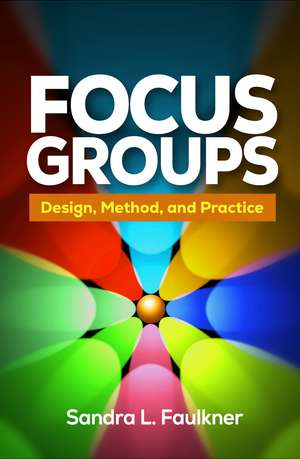
Focus Groups: Design, Method, and Practice
Autor Sandra L. Faulkneren Limba Engleză Paperback – 3 mai 2027
Preț: 260.72 lei
Preț vechi: 308.08 lei
-15% Precomandă
Puncte Express: 391
Carte nepublicată încă
Livrare prin curier în România Precomanda se expediază când titlul devine disponibil.
Transport gratuit de la 400.00 lei Plată online sau ramburs, în funcție de opțiunile comenzii.
Retur gratuit în 14 zile Comandă securizată și suport în română.
Doresc să fiu notificat când acest titlu va fi disponibil:
Se trimite...
Specificații
ISBN-13: 9781462549504
ISBN-10: 1462549500
Pagini: 161
Dimensiuni: 152 x 229 mm
Ediția:1
Editura: Guilford Publications
Colecția Guilford Press
ISBN-10: 1462549500
Pagini: 161
Dimensiuni: 152 x 229 mm
Ediția:1
Editura: Guilford Publications
Colecția Guilford Press
Recenzii
“Reading this well-written book gives the feeling of having a comfortable conversation with the author. Good qualitative research (and writing about it) should give the reader a sense of 'being there.' The examples drawn from actual studies that used focus groups are a key strength of the book. The sample dialogues are quite useful for giving a sense of the context and group dynamics over time, and for showing how rapport and open communication develop within the group.â€--Robin L. Jarrett, PhD, Department of Human Development and Family Studies (Emerita), University of Illinois at Urbana–Champaign
“Faulkner offers critical researchers a long sought-after guide to focus groups. The text allows space for researchers to engage in a thoughtful research design that centers ethics, care, and a commitment to critical reflexivity. Faulker also encourages researchers to think about presenting their focus group work through performance or visual arts. This much-needed intervention in focus group as method allows the work of the academy to shine outside the pages of the academic journal. I recommend this book for graduate students or early-career researchers who are interested in pursuing critical focus groups as method.â€--Desirée D. Rowe, PhD, Department of Communication Studies, Towson University
-
Notă biografică
Sandra L. Faulkner, PhD, is Professor of Media and Communication at Bowling Green State University, where she writes, teaches, and researches about close relationships. Dr. Faulkner’s interests include qualitative methodology, poetic inquiry, inclusive pedagogy, and critical perspectives on interpersonal and family communication. She engages in community-based research focusing on aging and communication across the life course and uses poetry as a form of social justice activism. Dr. Faulkner is Editor in Chief of Communication Studies and is a recipient of numerous awards for her teaching and scholarship, including the Norman K. Denzin Qualitative Research Award from the Carl Couch Center for Social and Internet Research, the Jack Kay Award for Community Engagement and Applied Communication Scholarship from the Central States Communication Association, the Legacy Award from the Ethnography Division of the National Communication Association, and the Patricia Leavy Award for Arts-Based Research from the London Arts-Based Research Centre.
Cuprins
1. Welcome to Focus Group Research
- Overview of Focus Groups
- When to Use Focus Groups
- When Not to Use Focus Groups
- Feminist, Community-Based Participatory, and Critical Approaches
- Research Ethics
- Group Communication
- Conclusion
2. Designing a Focus Group Study
- Designing a Focus Group Study
- Formulating the Research Problem
- Positioning the Study in the Context of Your Research
- Member Checking
- Focus Group Modes
- Focus Group Participants
- Sampling Strategies
- Recruiting Strategies
- Research Ethics and Institutional Review Boards
- Conclusion
3. Conducting Focus Groups
- Developing an Interview Guide
- Pilot Test
- Facilitating Focus Groups
- Moderating a Focus Group
- Conclusion
4. Analyzing Focus Groups
- What to Do after the Focus Group
- The Analysis Process
- Forms of Data
- Transcribing Focus Groups
- Where Do Codes Come From?
- Live Coding
- Thematic Analysis
- Qualitative Content Analysis
- Conversational Analysis
- Conclusion
5. Presenting Focus Group Research
- Representing Focus Group Research
- Traditional Research Format
- Arts-Based Representation
- Qualitative Research Criteria
- Research Ethics
- Transferability
- Conclusion
- Glossary of Abbreviations
- References
- Index
- About the Author