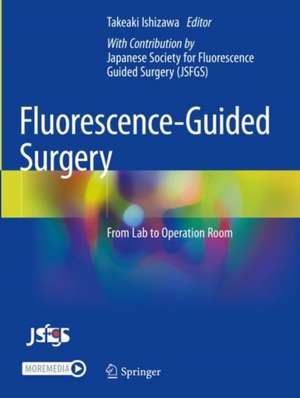
Fluorescence-Guided Surgery
Editat de Takeaki Ishizawaen Limba Engleză Paperback – 4 noi 2024
Destinat chirurgilor, rezidenților, asistentelor de bloc operator și cercetătorilor, Fluorescence-Guided Surgery reprezintă un efort colectiv de referință al experților din cadrul Societății Japoneze pentru Chirurgie Ghidată prin Fluorescență. Considerăm acest volum un ghid clinic esențial, care reușește să sintetizeze tranziția tehnologiei de imagistică prin fluorescență din mediul de laborator direct în practica chirurgicală curentă. Subliniem rigoarea cu care este structurat conținutul: prima parte pune bazele utilizării reactivilor fluorescenți (ICG și 5-ALA), a doua parte explorează aplicațiile practice în evaluarea perfuziei și localizarea oncologică, în timp ce secțiunea finală prefigurează inovațiile din terapie.
Descoperim aici o abordare sistematică a sistemelor de imagistică ICG, adaptate atât pentru chirurgia deschisă, cât și pentru cea laparoscopică sau asistată robotic. Spre deosebire de Fluorescence Imaging for Surgeons, care se concentrează pe experiențele individuale ale cercetătorilor și pe evoluția istorică a metodei, lucrarea editată de Takeaki Ishizawa pune accentul pe standardizarea tehnicilor și pe integrarea lor în fluxul de lucru din sala de operație. Acolo unde The SAGES Manual of Fluorescence-Guided Surgery oferă un cadru general asupra modului în care această modalitate îmbunătățește decizia chirurgicală, volumul de față aprofundează detalii tehnice specifice, precum angiografia coronariană, maparea ganglionilor limfatici și evaluarea perfuziei în chirurgia colorectală sau hepatică, susținute de o componentă vizuală bogată ce include studii de caz și resurse video.
Preț: 798.62 lei
Preț vechi: 840.66 lei
-5%
Carte tipărită la comandă
Livrare economică 23-30 noiembrie
Specificații
ISBN-10: 9811973741
Pagini: 284
Dimensiuni: 210 x 279 x 15 mm
Greutate: 0.78 kg
Editura: Springer
V-ar putea interesa
-
 Image-Guided Interventions: Expert Radiology SeriesKenneth R. Thomson-28%Preț: 1582.25 lei2198.31 lei
 -
 Diagnostic Imaging: Interventional RadiologyBrandt C. Wible-28%Preț: 1867.52 lei2611.47 lei
 -
 EndosonographyShyam Varadarajulu-29%Preț: 1507.22 lei2120.64 lei
 -
 Spinal Fusion TechniquesAlaa Abd-Elsayed-57%Preț: 548.18 lei1262.88 lei
 -
 Diagnostic Pathology: Intraoperative ConsultationSusan C. Lester-29%Preț: 1257.73 lei1761.68 lei
 -
 Principles of Gynecologic Oncology SurgeryPedro T. Ramirez-26%Preț: 1519.58 lei2058.42 lei
 -
 Sabiston Textbook of Surgery: The Biological Basis of Modern Surgical PracticeDouglas Scott Tyler-29%Preț: 1168.66 lei1644.95 leiRecomandat
 -
 Kern's Cardiac Catheterization HandbookPaul Sorajja-27%Preț: 395.98 lei545.02 leiRecomandat
 -
 Small Animal Laparoscopy and ThoracoscopyBoel A. Fransson-5%Preț: 1242.94 lei1308.37 lei
 -
 Clinical Gastrointestinal Endoscopy: Expert Consult - Online and PrintGregory G. Ginsberg-30%Preț: 1313.14 lei1877.71 lei
 -
 Master Techniques in Surgery: Thoracic Surgery: Lung Resections, BronchoplastyDouglas J. Mathisen MD-24%Preț: 1639.65 lei2165.79 lei
 -
 Toolbox for Autologous Breast Reconstruction, An Issue of Clinics in Plastic SurgeryMaurice Y. Nahabedian-5%Preț: 691.04 lei727.42 lei
 -
 Minimally Invasive Spine SurgeryBurak Ozgur-5%Preț: 388.34 lei408.78 lei
 -
 Uflacker's Atlas of Vascular AnatomyMarcelo Guimaraes MD, FSIR-19%Preț: 2009.90 lei2474.78 lei
 -
 Role of Imaging Technology in Current Surgical PracticeGeorgios Tsoulfas-23%Preț: 1591.82 lei2076.89 lei
 -
 -5%Preț: 1128.70 lei1188.11 lei
 -
 The General Surgeon: Recollections from Four ContinentsMoshe Schein MD FACS FCS-17%Preț: 122.79 lei147.55 lei
 -
 -18%Preț: 4508.27 lei5511.75 lei
 -
 Fischer's Mastery of Surgery: Print + eBook with MultimediaE. Christopher Ellison-21%Preț: 2761.87 lei3499.03 lei
 -
 -5%Preț: 1080.73 lei1137.61 lei
 -
 Fluorescence Imaging for SurgeonsFernando D. Dip-5%Preț: 764.28 lei804.51 lei
 -
 Radioguided SurgeryKen Herrmann-5%Preț: 1168.85 lei1230.37 lei
 -
 -5%Preț: 1580.23 lei1663.40 lei
 -
 -5%Preț: 794.05 lei835.84 lei
 -
 Atlas of Upper Gastrointestinal and Hepato-Pancreato-Biliary SurgeryPierre-Alain Clavien-5%Preț: 2610.12 lei2747.49 lei
 -
 Atlas of Laparoscopic Gastrectomy for Gastric CancerChang-Ming Huang-5%Preț: 946.59 lei996.40 lei
De ce să citești această carte
Recomandăm această lucrare oricărui chirurg care dorește să adopte tehnologia de navigație prin fluorescență pentru a crește precizia actului operator. Cititorul câștigă acces la expertiza fondatorilor acestei tehnologii, primind instrucțiuni clare despre setarea echipamentelor și interpretarea imaginilor în timp real. Este un instrument indispensabil pentru reducerea riscurilor intraoperatorii prin vizualizarea structurilor anatomice care, în mod normal, sunt invizibile ochiului liber.
Despre autor
Takeaki Ishizawa este un expert recunoscut la nivel internațional în domeniul chirurgiei hepatobiliare și un promotor activ al tehnologiilor de imagistică intraoperatorie. În calitate de editor principal și reprezentant al Societății Japoneze pentru Chirurgie Ghidată prin Fluorescență, el a coordonat echipe multidisciplinare pentru a standardiza utilizarea Indocianinei Verzi (ICG) în chirurgie. Activitatea sa este definită de efortul de a conecta cercetarea fundamentală cu nevoile clinice, contribuind direct la dezvoltarea ghidurilor care astăzi definesc navigația chirurgicală modernă și îmbunătățesc siguranța pacienților la nivel global.