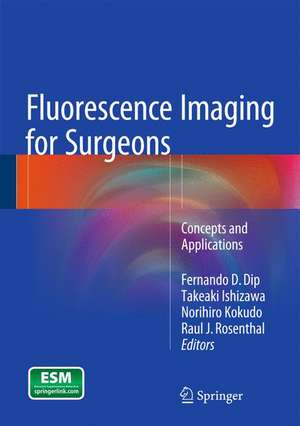
Fluorescence Imaging for Surgeons
Editat de Fernando D. Dip, Takeaki Ishizawa, Norihiro Kokudo, Raul J. Rosenthalen Limba Engleză Hardback – 4 aug 2015
Cum putem asigura o precizie milimetrică în identificarea marginilor tumorale sau în vizualizarea vascularizației în timpul unei intervenții complexe? Aceasta este provocarea clinică centrală pe care Fluorescence Imaging for Surgeons o adresează, oferind o soluție tehnologică ce transformă vizibilitatea intraoperatorie. Reținem că această lucrare nu este doar un manual tehnic, ci o punte între biofizica fluorescenței și practica chirurgicală imediată. Descoperim o structură riguroasă, organizată în trei secțiuni esențiale. Prima parte stabilește fundamentul teoretic și istoric, în timp ce a doua secțiune se concentrează pe aplicațiile clinice vitale: colangiografia prin fluorescență, hepatectomia, navigația ganglionară și chirurgia tractului gastrointestinal. Un aspect distinctiv îl reprezintă secțiunea a treia, care explorează frontierele nanotehnologiei și ale sondelor fluorescente, oferind chirurgilor oncologi și celor specializați în tehnici minim invazive o perspectivă asupra viitorului terapiei fotodinamice. Credem că integrarea detaliilor despre sisteme specifice, precum Firefly System pentru chirurgia robotică, oferă acestui tratat o valoare pragmatică rară. Manualul este o referință solidă, comparabilă cu ICG Fluorescence Imaging and Navigation Surgery de Mitsuo Kusano, însă Fluorescence Imaging for Surgeons se distinge prin accentul pus pe instrumentarul specific (Karl Storz) și prin abordarea multidisciplinară ce include chirurgia pelvină și colorectală. Această lucrare completează viziunea editorului Raul J. Rosenthal asupra formării medicale, făcând trecerea de la pregătirea mentală a rezidentului — temă abordată în Mental Conditioning to Perform Common Operations in General Surgery Training — către stăpânirea tehnologiilor de vizualizare avansată necesare specialistului confirmat.
Preț: 741.68 lei
Preț vechi: 780.72 lei
-5%
Carte disponibilă
Livrare economică 31 octombrie-14 noiembrie
Specificații
ISBN-10: 3319156772
Pagini: 384
Ilustrații: XXI, 360 p. 196 illus., 154 illus. in color.
Dimensiuni: 183 x 260 x 25 mm
Greutate: 1 kg
Ediția:1st ed. 2015
Editura: Springer
Locul publicării:Cham, Switzerland
V-ar putea interesa
-
 Oncologic Imaging: A Multidisciplinary ApproachPaul M. Silverman-28%Preț: 1226.28 lei1699.63 lei
 -
 EndosonographyShyam Varadarajulu-29%Preț: 1507.22 lei2120.64 lei
 -
 Diagnostic Pathology: Intraoperative ConsultationSusan C. Lester-29%Preț: 1257.73 lei1761.68 lei
 -
 Principles of Gynecologic Oncology SurgeryPedro T. Ramirez-26%Preț: 1519.58 lei2058.42 lei
 -
 Optical Imaging of CancerEben Rosenthal-5%Preț: 1105.95 lei1164.16 lei
 -
 Liver CancerSteven A Curley-5%Preț: 1135.04 lei1194.78 lei
 -
 Sabiston Textbook of Surgery: The Biological Basis of Modern Surgical PracticeDouglas Scott Tyler-29%Preț: 1167.99 lei1644.95 leiRecomandat
 -
 -29%Preț: 744.85 lei1050.39 lei
 -
 Hybrid Pet/CT and Spect/CT ImagingDominique Delbeke-5%Preț: 762.66 lei802.80 lei
 -
 Role of Imaging Technology in Current Surgical PracticeGeorgios Tsoulfas-23%Preț: 1591.82 lei2076.89 lei
 -
 Fischer's Mastery of Surgery: Print + eBook with MultimediaE. Christopher Ellison-21%Preț: 2762.20 lei3499.22 lei
 -
 Radioguided SurgeryKen Herrmann-5%Preț: 1132.83 lei1192.45 lei
 -
 -14%Preț: 813.08 lei945.43 lei
 -
 -5%Preț: 1580.23 lei1663.40 lei
 -
 -5%Preț: 794.05 lei835.84 lei
 -
 Atlas of Upper Gastrointestinal and Hepato-Pancreato-Biliary SurgeryPierre-Alain Clavien-5%Preț: 2610.12 lei2747.49 lei
 -
 -5%Preț: 726.12 lei764.33 lei
 -
 Lymph Node Metastasis in Gastrointestinal CancerShoji Natsugoe-5%Preț: 1069.00 lei1125.26 lei
 -
 Atlas of Laparoscopic Gastrectomy for Gastric CancerChang-Ming Huang-5%Preț: 928.59 lei977.47 lei
 -
 Fluorescence-Guided SurgeryTakeaki Ishizawa-5%Preț: 1079.87 lei1136.71 lei
Public țintă
Professional/practitionerDe ce să citești această carte
Pentru chirurgul modern, capacitatea de a vedea dincolo de spectrul vizibil devine un standard de siguranță. Această carte oferă protocoale clare pentru utilizarea ICG și a sistemelor robotice, reducând riscul de leziuni iatrogene și optimizând limfadenectomia. Este o investiție în precizie chirurgicală, esențială pentru cei care doresc să implementeze imagistica prin fluorescență în chirurgia generală, oncologică sau minim invazivă.
Despre autor
Coordonată de o echipă de elită, lucrarea îi are ca editori pe Fernando D. Dip și Raul J. Rosenthal, figuri proeminente în chirurgia minim invazivă. Raul J. Rosenthal este recunoscut internațional pentru contribuțiile sale în chirurgia bariatrică și pentru eforturile de standardizare a educației chirurgicale. Takeaki Ishizawa și Norihiro Kokudo aduc expertiza școlii japoneze, pionieră în utilizarea verde-lui de indocianină (ICG) pentru chirurgia hepatică și biliară. Împreună, acești autori sintetizează decenii de cercetare clinică în utilizarea sistemelor optice avansate pentru îmbunătățirea rezultatelor postoperatorii.
Cuprins
Section I: Background
Chapter 1
Basic Concepts of Fluorescence and Fluorescent Probes
Guillermo O. Menéndez, Federico Coluccio Leskow, and Carla C. Spagnuolo
Chapter 2
Past, Present and Future of Fluorescence
Daniel Debonis, Pablo Quadri, Manuel Montesinos, Jorge Falco, David Nguyen, Diego Sinagra, Fernando Dip, and Raul J. Rosenthal
Chapter 3
Translation of Therapeutic Antibodies for Intraoperative Fluorescence Imaging
Eben L. Rosenthal and Jason M. Warram
Chapter 4
Review of Indocyanine Green Imaging in Surgery
Jarmo T. Alander, Outi M. Villet, Tommi Pätilä, Ilkka S. Kaartinen, Martin Lehecka, Toshiya Nakaguchi, Taku Suzuki, and Valery Tuchin
Section II: Imaging Systems
Chapter 5
D-Light P System (Karl Storz) (with video)
Rutger M. Schols, Nicole D. Bouvy, Ronald M. van Dam, Laurents P.S. Stassen,
Chapter 6
Robotic surgery using Firefly System
Giuseppe Spinoglio, Alessandra Marano, Giampaolo Formisano
Chapter 7
Fluorescence imaging systems (PDE, HyperEye Medical System, and prototypes in Japan)
Takeaki Ishizawa and Norihiro Kokudo
Chapter 8
The Pinpoint System
Jana L. Lewis and Danny A. Sherwinter
Chapter 9
Economic Impact of Fluorescent Cholangiography
Emanuele Lo Menzo, Fernando Dip, Samuel Szomstein, and Raul J. Rosenthal
Chapter 10
Real-time near-infrared fluorescent cholangiography during robotic single-site cholecystectomy
Nicolas C. Buchs
Chapter 11
Fluorescent guided liver surgery: Paul Brousse experiences and perspective
Mohamed Bekheit and Eric Vibert
Chapter 12
Fluorescence imaging in laparoscopic hepatectomy (with video)
Yoshikuni Kawaguchi, Takeo Nomi, David Fuks, Norihiro Kokudo, and Brice Gayet
Section III. Clinical Applications of Intraoperative Fluorescence Imaging
Chapter 13
Identification of hepatic segment (with video)
Masaki Ueno
Chapter 14
Intraoperative evaluation of regional portal uptake function (with video)
Yoshikuni Kawaguchi, Takeaki Ishizawa, and Norihiro Kokudo
Chapter 15
Identification of hepatocellular carcinoma (with video)
Yoshifumi Morita, Takanori Sakaguchi, Hirotoshi Kikuchi, Naoki Unno, and Hiroyuki Konno
Chapter 16
Identification of metastatic liver cancer (with video)
Henricus J.M. Handgraaf, Floris P.R. Verbeek, Cornelis J.H. van de Velde, Merlijn Hutteman, and Alexander L. Vahrmeijer
Chapter 17
Prediction for postoperative intrahepatic recurrence of hepatocellular carcinoma
Kunihito Gotoh, Shigeru Marubashi, Terumasa Yamada, Hirofumi Akita, Hidenori Takahashi, Masahiko Yano, Osamu Ishikawa, Masato Sakon
Chapter 18
Detection of bile leakage after hepatic resection by intraoperative indocyanine green fluorescent imaging
Masaki Kaibori, Kosuke Matsui, Morihiko Ishizaki, Masanori Kwon
Chapter 19
Near-infrared laser photodynamic therapy for human hepatocellular carcinoma cell line tumor with indocyanine green fluorescence
Junichi Kaneko, Yoshinori Inagaki, Takeaki Ishizawa, Norihiro Kokudo
Chapter 20
Photodynamic diagnosis of gastric cancer using 5-aminolevulinic acid (with video)
Tsutomu Namikawa, Keiji Inoue, Taro Shuin, and Kazuhiro Hanazaki
Chapter 21
Applications of ICG Fluorescence Imaging for Surgery in Colorectal cancer
Shingo Shimada, Seiji Ohtsubo, and Mitsuo Kusano
Chapter 22
Fluorophore-conjugated chimeric anti-CEA antibodies for fluorescence-guided surgery of gastrointestinal (GI) tumors
Michael Bouvet and Robert M. Hoffman
Chapter 23
Development of a non-blurring, dual-imaging (X-ray/fluorescence) tissue marker for localization of gastrointestinal tumors
Hideki Hayashi, Taro Toyota, Shoichi Goto, Aki Oishi, Tao Gao, Lau Bik Ee, Hisahiro Matsubara
Chapter 24
Sentinel Node Navigation Surgery by Infrared Imaging in Gastric Cancer
Yoshikazu Uenosono, MD, Takaaki Arigami, Shigehiro Yanagita, Daisuke Matsushita, Sumiya Ishigami, and Shoji Natsugoe
Chapter 25
A dual infrared ray imaging system for sentinel node mapping against early gastric cancer: absorption and florescence methods by infrared ray electronic endoscopy combined with indocyanine green
Naoto Takahashi, Hiroshi Nimura, Muneharu Fujisaki, Norio Mitsumori, and Katsuhiko Yanaga
Chapter 26
Indocyanine green fluorescence-navigated sentinel node biopsy showed higher sensitivity than the conventional radioisotope or blue dye methods: it may help to reduce false-negative sentinel lymph node biopsies in skin cancer
Yasuhiro Fujisawa
Chapter 27
The indocyanine green method is equivalent to the (99m)Tc-labeled radiotracer method for identifying the sentinel node in breast cancer: A concordance and validation study
Bettina Ballardini, Germana Lissidini, and Paolo Veronesi
Chapter 28
Photodynamic detection of lymph node metastases in gastrointestinal cancer by using 5-aminolevulinic acid
Takeo Minamikawa, Yoshinori Harada, and Tetsuro Takamatsu
Chapter 29
Application of photodynamic treatment (with video)
Tomás G. Núñez and Tamara Portas
Chapter 30
Photodynamic diagnosis mediated by 5-aminolevulinic acid for urinary bladder cancer (with video)
Keiji Inoue, Hideo Fukuhara, and Taro Shuin
Chapter 31
Real-time assessment of intestinal perfusion by fluorescence-based enhanced reality
Michele Diana, Vincent Agnus and Jacques Marescaux
Chapter 32
Fluorescent angiography for flap planning and monitoring in reconstructive surgery
Georges Bettega, Clotilde Ochala, Marine Hitier, Cynthia Hamou¸ Stéphanie Guillermet, Pascal Gayet, and Jean-Luc Coll
Chapter 33
Fluorescein-Detection of Myocardial Ischemia in an Experimental Model of Acute Coronary Occlusion
Fernando Dip, Alejandro Damonte, Gaston Quiche, Marcelo Damonte, Fernando M. Safdie, Nicolas Brozzi, and Raul J. Rosenthal
Chapter 34
Spatial and Temporal Monitoring of Perfusion with Indocyanine Green Videoangiography in Rat Heart
Outi M. Villet, Jarmo T. Alander, and Ari L. Harjula
Chapter 35
Ureter identification using methylene blue and fluorescein
Fernando Dip, Alejandro Daniel Moreira Grecco, David Nguyen, Luis Sarotto, Sandy Perrins, and Raul J. Rosenthal
Chapter 36
Chymotrypsin probe for real-time visualization of pancreatic leak
Suguru Yamashita, Takeaki Ishizawa, Masayo Sakabe, Mako Kamiya, Yasuteru Urano, and Norihiro Kokudo
Notă biografică
Fernando Dip, MD, MAAC
The Bariatric and Metabolic Institute
Section of Minimally Invasive Surgery
Department of General and Vascular Surgery
Cleveland Clinic Florida
Weston, FL
USA
And
Oncological Surgical Division, Department of Surgery
Division of Surgical Research
Hospital de Clinicas Buenos Aires
University of Buenos Aires
Buenos Aires, Argentina
Takeaki Ishizawa, MD, PhD, FACS
Department of Gastroenterological Surgery, Cancer Institute Hospital
Japanese Foundation for Cancer Reserach
Koto-ku, Tokyo
Japan
And
Hepato-Biliary-Pancreatic Surgery Division, Department of Surgery
Graduate School of Medicine, The University of Tokyo
Bunkyo-ky, Tokya
Japan
Norihiro Kokudo, MD, PhD, FACS
Professor and Chairman
Hepato-Biliary-Pancreatic Surgery Division, Department of Surgery
Graduate School of Medicine, The University of Tokyo
Bunkyo-ky, Tokya
Japan
Raul J. Rosenthal, MD, FACS
Chief of Staff
The Bariatric & Metabolic Institute
Section of Minimally Invasive Surgery
Department of General & Vascular Surgery
Cleveland Clinic Florida
Weston, FL USA
Textul de pe ultima copertă
This volume presents the experiences of leading researchers and surgeons with different fluorescence methods. Chapters range from basic science of fluorescence to current clinical applications and new horizons. The first few chapters cover the historical evolution and physical principles of fluorescence and provide the foundation for the reader to understand the current scope and limits of its use in surgery. The second section focuses on the clinical applications of intraoperative fluorescence imaging, including subsections on fluorescence cholangiography, applications to hepatectomy, lymph node navigation, applications to GI tract and pelvic surgery and identification of cancer tissues. The third section focuses on new frontiers including fluorescence probes, imaging systems and applications to photodynamic therapy.
Authored by leaders in the development of fluorescent methods worldwide, Fluorescence Imaging for Surgeons: Concepts and Applications will have an impact on numerous medical specialists including general surgeons, colorectal and minimally-invasive surgeons and surgical oncologists. Researchers will find the book to be an invaluable resource on the latest advances in the utilization of nanoparticles and fluorescent probes.
Caracteristici
Richly illustrated with photomicrographs, figures and illustrations
Provides the foundation to understand the current scope and limits of the use of fluorescence in surgery