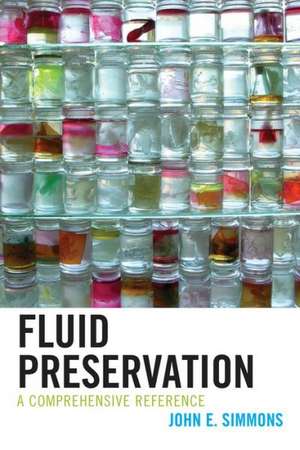
Fluid Preservation: A Comprehensive Reference
Autor John E. Simmonsen Limba Engleză Hardback – 15 mai 2014
Considerăm că gestionarea unei colecții de specimene conservate în fluide reprezintă una dintre cele mai mari provocări tehnice și logistice dintr-un muzeu, dată fiind prezența substanțelor periculoase și degradarea inevitabilă în timp. John E. Simmons abordează direct această complexitate prin analiza „paradoxului penetrării și fixării”, un studiu de caz esențial pentru orice curator care trebuie să decidă între viteza de pătrundere a unui fixativ și calitatea conservării structurale a specimenului. Cartea demonstrează că nu există o soluție universală, ci o serie de decizii fundamentate pe chimia amestecurilor de alcool, glicerină sau acizi.
Suntem de părere că această lucrare ocupă un loc central în opera autorului. Dacă în Museum Registration Methods sau Things Great and Small, John E. Simmons stabilea standardele generale de politici muzeale, în Fluid Preservation el coboară în laborator, oferind un manual tehnic exhaustiv. Ca și William H. Yong în Biobanking, autorul distilează experiență reală în principii acționabile, însă se diferențiază prin perspectiva istorică vastă, acoperind rețete de conservare de acum trei secole care încă pun probleme specialiștilor de azi. Structura cărții este riguros organizată, pornind de la istoria recipientelor de sticlă și evoluția etil-alcoolului, trecând prin chimia fixării și ajungând la managementul riscurilor de sănătate.
Ne-a atras atenția în mod deosebit modul în care Simmons conectează rigoarea științifică de cultura vizuală, dedicând spațiu analizei specimenelor ca obiecte de artă contemporană. Este prima dată când un volum tehnic de o asemenea anvergură reușește să sintetizeze peste 900 de surse bibliografice pentru a oferi un standard de bune practici într-un domeniu marcat adesea de confuzie și metode empirice transmise oral.
Preț: 794.27 lei
Preț vechi: 1244.43 lei
-36%
Carte tipărită la comandă
Livrare economică 18 noiembrie-02 decembrie
Specificații
ISBN-10: 1442229659
Pagini: 364
Ilustrații: illustrations
Dimensiuni: 160 x 232 x 34 mm
Greutate: 0.66 kg
Ediția:New.
Editura: Bloomsbury Publishing
Colecția Rowman & Littlefield
Locul publicării:New York, United States
De ce să citești această carte
Această carte este resursa definitivă pentru curatori, conservatori și manageri de colecții de istorie naturală sau medicină. Cititorul câștigă acces la protocoale clare de fixare și conservare, actualizate cu cercetări moderne despre extracția de ADN. Este un instrument indispensabil pentru oricine gestionează specimene biologice, oferind soluții practice pentru înlocuirea substanțelor toxice și securizarea pe termen lung a patrimoniului muzeal.
Descriere
Despite the fact that fluid preservation has been practiced for more than 350 years, this is the only handbook that summarize all that is known about this complex and often confusing topic. Fluid Preservation: A Comprehensive Reference covers the history and techniques of fluid preservation and how to care for fluid preserved specimens in collections.
More than 900 references on fluid preservation were reviewed for this project.An historical survey of preservative recipes provides for guidance for museums with older collections (many fluid preservatives contain hazardous chemicals). Current standards and best practices for collection care and management are presented.Current and controversial topics (e.g., the preservation of DNA, alternatives to alcohol and formaldehyde) are discussed and fully referenced.Health and safety issues involved with caring for fluid preserved collections are discussed.The final chapter addresses fluid preserved specimens as cultural products and their use in art, literature, film, and song.
Although most fluid-preserved specimens are found in natural history and medical museums, it is not at all uncommon to find them in art museums, history museums, and science centers. In addition to animals, plants, and anatomical specimens, fluid preserved collections include some minerals and fossils and many other objects.
Fluid Preservation is an essential reference for:
Natural history curatorsNatural history collections managers ConservatorsMedical and anatomical museum collections managers and curatorsArt and history museum staff who have fluid preserved specimens and objects in their care (e.g., works by Damien Hirst)Private collectorsResearchers using museum collections as sources of DNA, isotopes, etc.Health and safety professionalsExhibit planners and designersMuseum facilities planners and managersPeople interested in the history of sciencePeople interested in the history of natural history museumsMuseum studies students
Cuprins
Acknowledgements
Part I. Fluid Preservation Techniques and Collections
Chapter 1. History of Fluid Preservation
Fluid Preservation in the Ancient World
History of Ethyl Alcohol
Origin of the Name Alcohol
Glass Containers
The Discovery of Preservation of Specimens in Ethyl Alcohol
Early Instructions for Preserving Specimens in Fluids
Later Instructions for Preserving Specimens in Fluids
Fluid Preserved Collections
Other Fluid Preservatives
Summary
Chapter 2. Fixation
Fixation
Formaldehyde
Origin of the Names Formaldehyde, Formol, and Formalin
Commercial Formaldehyde
Formaldehyde as a Fixative and Preservative
Fixative pH Range
Narcotization
Fixatives for Botanical Specimens
Temperature, Time, and Rates of Penetration of Fixatives
The Penetration-Fixation Paradox
Lipids and Fixation
Formaldehyde and Field Work
Paraformaldehyde
Post-Formaldehyde Fixation Washing
Unwanted Effects of Formaldehyde
Gluteraldehyde
Aldehyde Safety
Alternative and Proprietary Fixatives
Chapter 3. Preservation
Preservation without Fixation
Freezing
Transfer between Fluids
Preservative Quality
Old Fluid Preservatives
Botanical Use of Fluid Preservation
Glycerin
Isopropyl Alcohol
Fluid Preservation for DNA Extraction
Evaporation
Clearing and Staining
Anatomical and Histological Fluid Preparations
Mounting Specimens Inside Containers
Glycol, Phenol, and Phenoxetol as Preservatives
Novec Fluid
Mineral Oil
Universal Fixatives
Criteria for Evaluating Alternative Fixative and Preservative Fluids
Chapter 4. Effects of Fixatives and Preservatives on Specimens
Changes in Body Dimensions and Biomass
Changes in Color
Solvent Extraction in Fixatives and Preservatives
Chapter 5. Managing Fluid Preserved Collections
Identification of Fluid Preservatives
Checking Fluid Concentration
Re-Use of Old Alcohol
pH of Preservative Solutions
Preparing Fixatives and Preservatives
Containers and Seals
Alternatives to Glass Containers
Labeling
The Storage Environment
Topping Up and Replacing Preservatives
Why do Closures Fail?
Bacterial and Fungal Growth in Fluid Collections-Detection and Remediation
Rehydration of Fluid Preserved Specimens
Moving Collections
Exhibition of Fluid Preserved Specimens
Dealing with Old Containers and Old Specimens
Repair of Damaged Fluid Preserved Specimens
Health and Safety
Fire Prevention
Formaldehyde Safety
Chapter 6. Fluid Preserved Collections as Cultural Patrimony
Why Preserve Specimens in Fluid?
The Fluid Preserved Human
Fond Memories of Fluid Preservation
Fluid Preservation in Visual Art
Fluid Preservation in Literature
Fluid Preservation in Film
Fluid Preservation in Popular Culture
The Aesthetics of Fluid Preservation
Part II. Literature in this Field
Chapter 7. Literature Cited.
Chapter 8. Literature Reviewed but Not Cited
Part III. Reference Tables
Table 1. Fluid preservation techniques.
Table 2. Timeline of milestones in published fluid preservation techniques.
Table 3. Tissue matrix types.
Table 4. Proprietary fixatives (based on manufacturer's MSDS, advertisements, and published analyses).
Table 5. Narcotizing agents.
Table 6. Disinfectant mechanisms of some preservatives (based in part on Volk and Wheeler 1984).
Table 7. Summary of factors that affect the long-term usefulness of fluid preserved specimens (after Simmons 2002).
Table 8. Timeline of the known introduction of chemicals in fluid preservation.
Table 9. Anatomical fixation and preservation techniques.
Table 10. Clearing and staining techniques.
Table 11. Disinfectant mechanisms of some preservatives (based in part on van Dam 2003).
Table 12. Criteria for identifying alternative preservative fluids (based in part on van Dam 2003).
Table 13. Summary of fixative and preservative induced changes in invertebrates.
Table 14. Summary of fixative and preservative induced changes in invertebrates by taxonomic group.
Table 15. Summary of fixative and preservative induced changes in vertebrates by taxonomic group.
Table 16. Summary of fixative and preservative induced changes in vertebrates by taxonomic group.
Table 17. Proprietary preservatives (based on manufacturer's MSDS, advertisements, and published analyses).
Table 18. Summary of published fluid concentration and pH testing of fluid preserved collections.
Table 19. Characteristics of containers for fluid preserved specimens (based on Simmons 2002).
Table 20. Oxygen permeablility of container materials.
Table 21. Published recommendations for label substrates and inks.
Table 22. Rehydration techniques for fluid preserved specimens.
Table 23. Treatments and practices that are not recommended for fluid preserved specimens.
Appendix
Index
About the Author
Recenzii
[This] book can be considered essential for all who are responsible for collections in liquid media.
Fluid Preservations is an astounding assemblage of what is knowable through the literature about the fine art - some say voodoo - of keeping organics preserved in chemicals. Simmons guides a reader through a history of best efforts, thereby acknowledging that readers will draw their own rational conclusions when developing best practice(s), while adhering to the caveat to always monitor, record successes and failures, and adapt if/when needed.... This is a compelling read....
This examination of the science behind the fluid preservation of biological specimens is essential reading for curators and conservators alike. There is a wealth of information in this exceptionally well-researched book which is worth buying for the comprehensive reference list alone! John Simmons has also collected anecdotes and misconceptions about fluid preservation which makes his book a suitable read for those outside the small world of museum professionals.
Filled with practical references and recommendations and a bibliography embracing sources from the very beginning of fluid preservation in the early 17th century to DNA preservation, this book summarizes the written knowledge on fixation, preservation, secondary interactions of preservatives and gives valuable information on collection care by exploring available literature far beyond Anglo-American sources. It is more than just a comprehensive reference, it embodies our knowledge of fluid preservation and conveys the most comprehensive practical advice that can be offered, from an author truly devoted to collection care.
John Simmons has created the ultimate reference on the science and mythology of fluid preservation. Thoroughly researched and written with wry wit, it is an indispensable and highly readable resource.