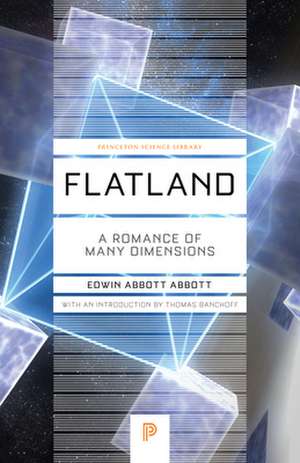
Flatland
Autor Edwin Abbott Abbotten Limba Engleză Paperback – 22 mar 2015
A first-rate fictional guide to the concept of multiple dimensions of space, the book will also appeal to those who are interested in computer graphics. This field, which literally makes higher dimensions seeable, has aroused a new interest in visualization. We can now manipulate objects in four dimensions and observe their three-dimensional slices tumbling on the computer screen. But how do we interpret these images? In his introduction, Thomas Banchoff points out that there is no better way to begin exploring the problem of understanding higher-dimensional slicing phenomena than reading this classic novel of the Victorian era.
Preț: 78.48 lei
Puncte Express: 118
Carte disponibilă
Livrare economică 05-19 noiembrie
Livrare express 22-28 octombrie pentru 39.15 lei
Livrare prin curier în România Termenul estimat este afișat lângă disponibilitate.
Transport gratuit de la 400.00 lei Plată online sau ramburs, în funcție de opțiunile comenzii.
Retur gratuit în 14 zile Comandă securizată și suport în română.
Specificații
ISBN-13: 9780691165554
ISBN-10: 0691165556
Pagini: 104
Ilustrații: 12
Dimensiuni: 136 x 216 x 10 mm
Greutate: 0.09 kg
Editura: Princeton University Press
ISBN-10: 0691165556
Pagini: 104
Ilustrații: 12
Dimensiuni: 136 x 216 x 10 mm
Greutate: 0.09 kg
Editura: Princeton University Press
V-ar putea interesa
-
 Brave New WorldAldous HuxleyPreț: 58.67 lei
 -
 Aspects of the NovelE. M. Forster-26%Preț: 57.92 lei78.50 lei
 -
 Democracy and the New Religious PluralismThomas Banchoff-12%Preț: 253.71 lei289.27 lei
 -
 Preț: 196.80 lei
 -
 FlatlandEdwin A. AbbottPreț: 38.49 lei
 -
 -14%Preț: 136.85 lei159.03 lei
 -
 The Misbehavior of MarketsBenoit MandelbrotPreț: 162.33 lei
 -
 Geometry, Relativity and the Fourth DimensionRudolf RuckerPreț: 88.78 lei
 -
 Tensor Calculus: A Concise CourseBarry SpainPreț: 52.07 lei
 -
 Preț: 105.05 lei
 -
 Preț: 89.22 lei
 -
 CandideVoltairePreț: 32.48 lei
 -
 PCT, Spin and Statistics, and All ThatRaymond F. StreaterPreț: 490.93 lei
 -
 FlatterlandIan StewartPreț: 154.05 lei
 -
 Plus 1David Joseph SharpPreț: 174.17 lei
 -
 A Modern UtopiaH. G. WellsPreț: 51.18 lei
 -
 A Primer of Higher Space (the Fourth Dimension)Claude Fayette BragdonPreț: 111.94 lei
 -
 FlatlandEdwin AbbottPreț: 33.23 lei
 -
 Once Upon a Time in SpaceJames BluemelPreț: 215.96 lei
 -
 Unequal: The Maths of When Things Do and Don’t Add UpEugenia Cheng-18%Preț: 112.95 lei138.06 lei
 -
 The MultiverseBrian CleggPreț: 77.29 lei
 -
 Useful Math & Physical FormulaeM WatkinsPreț: 53.00 lei
 -
 Preț: 34.20 lei
 -
 The Time MachineH. G. WellsPreț: 33.23 lei
 -
 The Man Who Was ThursdayG. K. ChestertonPreț: 38.95 lei
 -
 UtopiaThomas MorePreț: 33.19 lei
 -
 Relativity: The Special and the General TheoryAlbert EinsteinPreț: 39.70 lei
Notă biografică
Edwin Abbott Abbott With an introduction by Thomas Banchoff
Descriere
Reprint. Originally published: 6th ed. New York: Dover Publications, 1953.