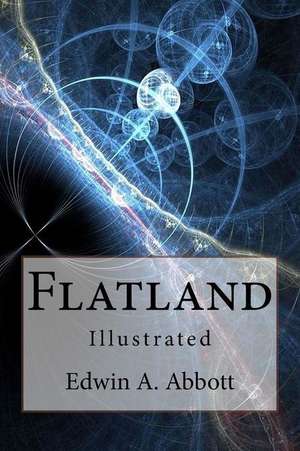
Flatland
Autor Edwin A. Abbotten Limba Engleză Paperback
Notăm cu interes cum Flatland se deschide nu ca un roman convențional, ci ca un tratat de geometrie narativizat, în care perspectiva este limitată riguros la două dimensiuni. Structura este bipartită: prima parte funcționează ca o descriere etnografică a unei lumi plate, unde lungimea și lățimea definesc întreaga existență, în timp ce a doua parte urmărește ascensiunea spirituală și intelectuală a naratorului prin diverse planuri dimensionale. Putem afirma că alegerea lui Edwin A. Abbott de a folosi forme geometrice antropomorfizate — pătrate, triunghiuri sau sfere — pentru a diseca ierarhiile sociale este o dovadă de geniu satiric.
Atmosfera te trimite cu gândul la FLATLAND - A Romance of Many Dimensions (The Distinguished Chiron Edition), deși rigoarea matematică a ediției de față subliniază mai pregnant natura de eseu filosofic a lucrării. Experiența de lectură este una de expansiune mentală; ritmul este deliberat, aproape didactic, pe măsură ce protagonistul, A. Square, încearcă să înțeleagă imposibilul: a treia dimensiune. Tonul este sobru, specific epocii victoriene, însă subtextul critic la adresa inegalității de gen și a rigidității castelor rămâne surprinzător de actual. Spre deosebire de alte lucrări ale sale, precum How to Write Clearly, unde autorul se concentrează pe rigoarea lingvistică, aici Abbott folosește abstracția matematică pentru a sonda limitele percepției umane.
Merită menționat că această operă depășește granițele beletristicii clasice, devenind un instrument de explorare a conceptelor multidimensionale. Este o incursiune fascinantă într-o lume în care o simplă linie poate fi o femeie, iar un cerc, un înalt prelat, totul servind drept oglindă pentru prejudecățile unei societăți care refuză să privească dincolo de propriul orizont bidimensional.
Preț: 36.81 lei
Carte indisponibilă temporar
Specificații
ISBN-10: 1533420602
Pagini: 96
Dimensiuni: 152 x 229 x 5 mm
Greutate: 0.14 kg
V-ar putea interesa
-
 Preț: 196.80 lei
 -
 Games People PlayEric Berne-26%Preț: 62.47 lei84.96 lei
 -
 Brown Paper School book: Math for Smarty PantsMarilyn BurnsPreț: 60.00 lei
 -
 The Face of AnotherKobo AbePreț: 87.86 lei
 -
 -14%Preț: 136.85 lei159.03 lei
 -
 Geometry, Relativity and the Fourth DimensionRudolf RuckerPreț: 88.78 lei
 -
 On LibertyJohn Stuart Mill-55%Preț: 20.90 lei46.20 lei
 -
 Preț: 89.22 lei
 -
 Spaghetti and Meatballs for All!Marilyn BurnsPreț: 50.64 lei
 -
 EragonChristopher Paolini-23%Preț: 62.22 lei81.06 lei
 -
 CandideVoltairePreț: 32.48 lei
 -
 -25%Preț: 59.71 lei79.90 lei
 -
 FlatterlandIan StewartPreț: 154.05 lei
 -
 Why We DreamAlice Robb-34%Preț: 52.25 lei79.02 lei
 -
 A Modern UtopiaH. G. WellsPreț: 51.18 lei
 -
 FlatlandEdwin AbbottPreț: 33.23 lei
 -
 Once Upon a Time in SpaceJames BluemelPreț: 215.96 lei
 -
 Unequal: The Maths of When Things Do and Don’t Add UpEugenia Cheng-18%Preț: 112.95 lei138.06 lei
 -
 -25%Preț: 64.05 lei85.89 leiRecomandat
 -
 The Time MachineH. G. WellsPreț: 33.23 lei
 -
 The Man Who Was ThursdayG. K. ChestertonPreț: 38.95 lei
 -
 UtopiaThomas MorePreț: 33.19 lei
 -
 Relativity: The Special and the General TheoryAlbert EinsteinPreț: 39.70 lei
De ce să citești această carte
Pentru cititorul curios să exploreze intersecția dintre matematică și critică socială. Flatland oferă o perspectivă unică asupra modului în care limitele noastre fizice ne modelează gândirea. Este o lectură esențială pentru cei care apreciază satira clasică și doresc să înțeleagă, prin analogie, concepte complexe de fizică și geometrie, totul într-un format compact și provocator.
Despre autor
Edwin Abbott Abbott (1838–1926) a fost un distins pedagog britanic, teolog și preot anglican. Director al City of London School, el s-a remarcat prin dorința de a simplifica educația și de a promova rigoarea intelectuală. Deși a scris lucrări teologice precum Silanus The Christian și studii filologice ca How to Write Clearly, nemurirea literară i-a fost asigurată de Flatland (1884). Această nuvelă demonstrează capacitatea sa rară de a traduce concepte abstracte în alegorii sociale mușcătoare, reflectând preocupările sale constante pentru moralitate și limitele cunoașterii umane.
Descriere scurtă
Descriere
'Upward, yet not Northward.' How would a creature limited to two dimensions be able to grasp the possibility of a third? Edwin A. Abbott's droll and delightful 'romance of many dimensions' explores this conundrum in the experiences of his protagonist, A Square, whose linear world is invaded by an emissary Sphere bringing the gospel of the third dimension on the eve of the new millennium. Part geometry lesson, part social satire, this classic work of science fiction brilliantly succeeds in enlarging all readers' imaginations beyond the limits of our 'respective dimensional prejudices'. In a world where class is determined by how many sides you possess, and women are straight lines, the prospects for enlightenment are boundless, and Abbott's hypotheses about a fourth and higher dimensions seem startlingly relevant today.This new edition of Flatland illuminates the social and intellectual context that produced the work as well as the timeless questions that it raises about the limits of our perception and knowledge. ABOUT THE SERIES: For over 100 years Oxford World's Classics has made available the widest range of literature from around the globe. Each affordable volume reflects Oxford's commitment to scholarship, providing the most accurate text plus a wealth of other valuable features, including expert introductions by leading authorities, helpful notes to clarify the text, up-to-date bibliographies for further study, and much more.
Notă biografică
Valerie M. Smith earned her PhD from the University of Connecticut. An associate professor of English at Quinnipiac University in Hamden, Connecticut, she is currently at work on a manuscript entitled Crossroads: Cultural Autobiography and Imperial Discourse.
John Allen Paulos is a Professor of Mathematics at Temple University and the bestselling author of eight books including Innumeracy, A Mathematician Reads the Newspaper, and Once upon a Number. He has been a columnist for ABCNews.com, Scientific American, and the Guardian, as well as the author of numerous reviews, articles, and op-ed pieces for a variety of publications. Among his many honors are the American Association for the Advancement of Science Award for Promoting Public Understanding of Science and the 2013 Mathematics Communication Award from the Joint Policy Board for Mathematics.
Cuprins
I. Of the Nature of Flatland 15
II. Of the Climate and Houses in Flatland 17
III. Concerning the Inhabitants of Flatland 20
IV. Concerning the Women 24
V. Of our Methods of Recognizing
one another 30
VI. Of Recognition by Sight 35
VII. Concerning Irregular Figures 41
VIII. Of the Ancient Practice of Painting 45
IX. Of the Universal Colour Bill 48
X. Of the Suppression of the
Chromatic Sedition 52
XI. Concerning our Priests 57
XII. Of the Doctrine of our Priests 60
Part II: Other Worlds 65
XIII. How I had a Vision of Lineland 67
XIV. How I vainly tried to explain the
nature of Flatland 72
XV. Concerning a Stranger from
Spaceland 78
XVI. How the Stranger vainly
endeavoured to reveal to me in
words the mysteries of Spaceland 82
XVII. How the Sphere, having in vain
tried words, resorted to deeds 90
XVIII. How I came to Spaceland, and
what I saw there 93
XIX. How, though the Sphere shewed me
other mysteries of Spaceland, I still
desired more; and what came of it 99
XX. How the Sphere encouraged me in
a Vision 107
XXI. How I tried to teach the Theory
of Three Dimensions to my Grandson,
and with what success 110
XXII. How I then tried to diffuse the
Theory of Three Dimensions by
other means, and of the result 113