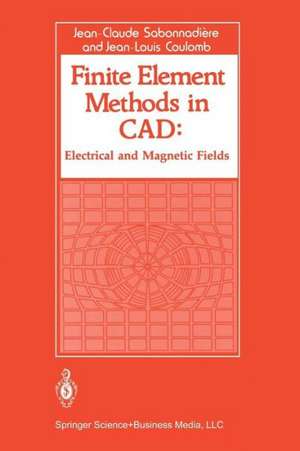
Finite Element Methods in CAD
Autor Jean Claude Sabonnadiere, Jean Louis Coulomben Limba Engleză Paperback – 20 oct 2013
Preț: 371.03 lei
Puncte Express: 557
Carte tipărită la comandă
Livrare economică 07-21 decembrie
Livrare prin curier în România Termenul estimat este afișat lângă disponibilitate.
Transport gratuit de la 400.00 lei Plată online sau ramburs, în funcție de opțiunile comenzii.
Retur gratuit în 14 zile Comandă securizată și suport în română.
Specificații
ISBN-13: 9781468487411
ISBN-10: 1468487418
Pagini: 208
Ilustrații: VIII, 194 p. 40 illus.
Dimensiuni: 155 x 235 x 12 mm
Greutate: 0.32 kg
Ediția:Softcover reprint of the original 1st ed. 1987
Editura: Springer
Locul publicării:New York, NY, United States
ISBN-10: 1468487418
Pagini: 208
Ilustrații: VIII, 194 p. 40 illus.
Dimensiuni: 155 x 235 x 12 mm
Greutate: 0.32 kg
Ediția:Softcover reprint of the original 1st ed. 1987
Editura: Springer
Locul publicării:New York, NY, United States
V-ar putea interesa
-
 Automata and LanguagesJohn M. Howie-35%Preț: 339.47 lei520.04 lei
 -
 -35%Preț: 613.73 lei950.54 lei
 -
 Lambda Calculi: A Guide for Computer ScientistsChris Hankin-36%Preț: 359.37 lei564.70 lei
 -
 Advances in Logic Programming TheoryGiorgio Levi-38%Preț: 794.97 lei1280.71 lei
 -
 Concrete MathematicsRonald Graham-20%Preț: 560.73 lei700.91 lei
 -
 GraphsK. Thulasiraman-9%Preț: 1683.73 lei1850.25 lei
 -
 -20%Preț: 356.23 lei445.29 lei
 -
 A Distributed Pi-CalculusMatthew Hennessy-20%Preț: 552.00 lei690.01 lei
 -
 Quantum Computing for Computer ScientistsNoson S. Yanofsky-8%Preț: 590.98 lei642.37 lei
 -
 Essential Linear Algebra with ApplicationsTitu Andreescu-15%Preț: 534.62 lei628.97 lei
 -
 Seamless R and C++ Integration with RcppDirk Eddelbuettel-20%Preț: 561.37 lei701.71 lei
 -
 Distributed AlgorithmsNancy A. Lynch-40%Preț: 756.29 lei1250.97 lei
 -
 Approximation AlgorithmsVijay V. Vazirani-20%Preț: 595.17 lei743.97 lei
 -
 Computer ArithmeticMircea Vl¿du¿iu-20%Preț: 673.79 lei842.25 lei
Public țintă
ResearchCuprins
1 Principles of the finite element method.- 1.1. Principle equations of mathematical physics.- 1.2. The idea of a well posed problem.- 1.3. Integral formulation.- 1.4. Approximation of the unknown functions.- 1.5. Minimization of the functional with the aid of approximation functions.- 1.6. The finite element mesh and the approximation functions.- 2 From one dimension ... to three.- 2.1. Elementary principles of the finite element method.- 2.2. Example 1: one dimension.- 2.3. Example 2: two dimensions.- 2.4. Example 3: three dimensions.- 2.5. Example 4: problems in the time domain.- 3 Finite elements and approximation functions.- 3.1. Introduction.- 3.2. One-dimensional elements.- 3.3. Two-dimensional elements.- 3.4. Three-dimensional elements.- 3.5. Conclusion.- 4 Numerical methods.- 4.1. Methods for solving systems of linear equations.- 4.2. Non-linear systems: the Newton-Raphson method.- 4.3. Numerical methods for calculating definite integrals.- 4.4. Differential equations with initial conditions.- 4.5. Conclusion.- 5 General theory of second order isoparametric elements.- 5.1. Introduction.- 5.2. Setting up the equations.- 5.3. Application of the Newton-Raphson method.- 5.4. Construction of the matrix H and the vectors F and R.- 5.5. The finite elements.- 5.6. Application.- 6 General architecture of CAD systems based on the finite element method.- 6.1. General structure.- 6.2. The data entry module.- 6.3. The solver.- 6.4. Postprocessors.- 6.5. Architecture of finite element software.- 6.6. Communication between programs.- 6.7. Interdisciplinary software.- 6.8. Conclusion.- 7 Geometry, mesh generation and physical properties.- 7.1. Description of the geometry.- 7.2. Discretization of the domain.- 7.3. Description of physical characteristics.- 7.4. Conclusion.- 8 Postprocessing.- 8.1. Objectives of postprocessing.- 8.2. Extraction of information.- 8.3. Visualization of the information.- 8.4. Conclusion.- 9 Applications.- 9.1. The FLUX2D package.- 9.2. FLUX3D.- 9.3. Microcomputer software.- 9.4. The super programs.- Conclusion.