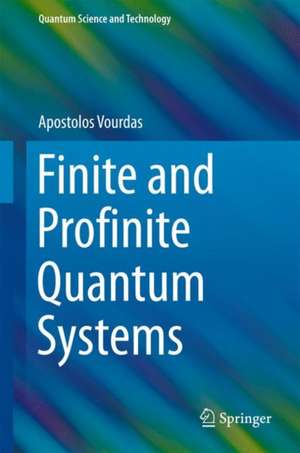
Finite and Profinite Quantum Systems: Quantum Science and Technology
Autor Apostolos Vourdasen Limba Engleză Hardback – 28 iul 2017
Remarcăm în Finite and Profinite Quantum Systems o lucrare de o rigoare matematică deosebită, care reușește să sintetizeze domenii aparent divergente: mecanica cuantică, algebra abstractă, geometria finită și teoria numerelor. Această monografie, apărută în prestigioasa serie Quantum Science and Technology de la Springer, propune un cadru teoretic formal pentru studiul sistemelor cuantice cu spații de fază discrete, un fundament esențial pentru dezvoltarea tehnologiilor cuantice moderne. Structura volumului reflectă o progresie logică de la finit la infinitul profinit. Prima parte se concentrează pe sistemele „qubit” și „qudit”, unde spațiul pozițiilor este o rețea periodică finită, introducând logica cuantică și porțile cuantice. A doua parte ridică nivelul de abstractizare, analizând sistemele unde poziția ia valori într-un corp Galois, fuzionând astfel mecanica cuantică cu teoria corpurilor. În final, autorul extinde discuția către grupurile profinite, utilizând limite inverse și directe pentru a studia mecanica cuantică pe numere p-adice. Acoperă aceeași arie tematică precum Galois Fields and Galois Rings Made Easy de Maurice Kibler, dar cu o abordare mult mai tehnică și orientată spre cercetare, trecând dincolo de introducerea elementară în inele și corpuri pentru a explora limitele sistemelor de dimensiuni foarte mari. Dacă lucrările similare se opresc adesea la aplicațiile imediate în codare, Apostolos Vourdas investighează structuri matematice profunde, precum dualitatea Pontryagin și transformatele Fourier rapide în context cuantic. Considerăm că textul este un instrument indispensabil pentru înțelegerea bazelor reciproc imparțiale și a aplicațiilor acestora în criptografia cuantică.
Din seria Quantum Science and Technology
- 18%
 Preț: 1071.48 lei
 - 18%
 Preț: 787.48 lei
 - 15%
 Preț: 622.99 lei
 - 18%
 Preț: 1191.55 lei
 - 15%
 Preț: 647.73 lei
 - 18%
 Preț: 923.32 lei
 - 18%
 Preț: 912.59 lei
 - 18%
 Preț: 701.32 lei
 - 20%
 Preț: 931.83 lei
 - 18%
 Preț: 1071.02 lei
 - 18%
 Preț: 1394.66 lei
 -
 Preț: 440.50 lei
 - 18%
 Preț: 893.18 lei
 - 18%
 Preț: 943.69 lei
 - 18%
 Preț: 862.97 lei
 - 18%
 Preț: 916.19 lei
 - 20%
 Preț: 377.09 lei
 - 15%
 Preț: 632.70 lei
 - 20%
 Preț: 796.47 lei
 - 24%
 Preț: 758.94 lei
Preț: 547.92 lei
Preț vechi: 644.61 lei
-15%
Carte disponibilă
Livrare economică 27 octombrie-10 noiembrie
Specificații
ISBN-10: 331959494X
Pagini: 212
Ilustrații: XIII, 196 p. 7 illus., 4 illus. in color.
Dimensiuni: 160 x 241 x 17 mm
Greutate: 0.53 kg
Ediția:1st edition 2017
Editura: Springer
Colecția Quantum Science and Technology
Seria Quantum Science and Technology
Locul publicării:Cham, Switzerland
De ce să citești această carte
Recomandăm această monografie cercetătorilor și studenților la nivel masteral sau doctoral care doresc să stăpânească formalismul matematic din spatele tehnologiilor cuantice. Cititorul câștigă o înțelegere profundă a modului în care structurile discrete, de la corpurile Galois la numerele p-adice, dictează comportamentul sistemelor cuantice finite. Este un argument solid pentru utilizarea matematicii discrete în fizica teoretică și informatică.
Despre autor
Apostolos Vourdas este un expert recunoscut în domeniul fizicii matematice, cu o activitate academică susținută în studiul sistemelor cuantice și al aplicațiilor matematicii discrete în fizică. Interesele sale de cercetare includ optica cuantică, informația cuantică și aplicarea teoriei numerelor în mecanica cuantică. Prin lucrarea de față, publicată sub egida Springer, autorul își consolidează poziția de autoritate în analiza sistemelor cuantice pe structuri algebrice finite și profinite, oferind o resursă academică de referință pentru comunitatea științifică internațională.
Descriere scurtă
The first major part of this monograph studies the so-called `qubits' and `qudits', systems with periodic finite lattice as position space. It also discusses the so-called mutually unbiased bases, which have applications in quantum information and quantum cryptography. Quantum logic and its applications to quantum gates is also studied.
The second part studies finite quantum systems, where the position takes values in a Galois field. This combines quantum mechanics with Galois theory. The third part extends the discussion to quantum systems with variables in profinite groups, considering the limit where the dimension of the system becomes very large. It uses the concepts of inverse and direct limit and studies quantum mechanics on p-adic numbers.
Applications of the formalism include quantum optics and quantum computing, two-dimensional electron systems in magnetic fields and the magnetic translation group, the quantum Hall effect, other areas in condensed matter physics, and Fast Fourier Transforms.
The monograph combines ideas from quantum mechanics with discrete mathematics, algebra, and number theory. It is suitable for graduate students and researchers in quantum physics, mathematics and computer science.