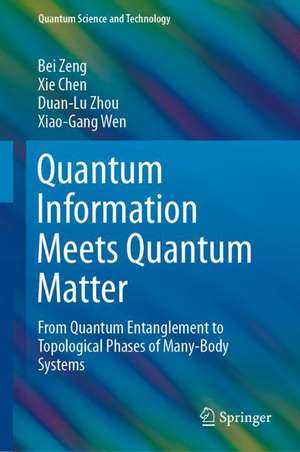
Quantum Information Meets Quantum Matter: Quantum Science and Technology
Autor Bei Zeng, Xie Chen, Duan-Lu Zhou, Xiao-Gang Wenen Limba Engleză Hardback – 29 mar 2019
Ne-a atras atenția modul în care lucrarea Quantum Information Meets Quantum Matter redefinește metodologia de studiu a fizicii materiei condensate, înlocuind paradigmele clasice Landau cu un set de instrumente extrase direct din arhitectura informației cuantice. Reținem o trecere riguroasă de la designul circuitelor cuantice și codurile de corectare a erorilor către analiza sistemelor cu interacțiune puternică, unde formalismul fermionilor liberi devine insuficient. Găsim în această carte o demonstrație clară a modului în care entanglement-ul nu este doar o proprietate exotică, ci o unitate de măsură fundamentală pentru clasificarea fazelor cuantice. Structura volumului este una progresivă și tehnică, fiind organizată în cinci părți distincte. Primele secțiuni pun bazele teoretice necesare înțelegerii Hamiltonienilor locali și a stărilor fundamentale, evoluând natural spre concepte complexe de ordine topologică și rețele tensoriale. Un aspect distinctiv față de alte lucrări de profil este utilizarea reprezentărilor de tip Matrix Product State (MPS) și Tensor Product States pentru a capta structura de entanglement a stărilor topologice, oferind astfel un cadru sistematic de clasificare a materiei. Abordarea autorilor Bei Zeng și Xiao-Gang Wen diferă de Strongly Coupled Field Theories for Condensed Matter and Quantum Information Theory de Alvaro Ferraz prin faptul că este mai puțin axată pe prelegeri abstracte și mai mult pe un cadru aplicabil de unificare a informației cu materia. În timp ce alte titluri din domeniu se concentrează pe fenomene specifice, această ediție publicată de Springer propune o metodologie unitară, transformând rețelele tensoriale dintr-un simplu instrument de calcul într-un limbaj fundamental pentru fizica modernă.
Din seria Quantum Science and Technology
- 15%
 Preț: 549.35 lei
 - 18%
 Preț: 1071.48 lei
 - 18%
 Preț: 812.48 lei
 - 15%
 Preț: 667.64 lei
 - 18%
 Preț: 1271.07 lei
 - 15%
 Preț: 667.86 lei
 - 18%
 Preț: 984.44 lei
 - 18%
 Preț: 941.93 lei
 - 18%
 Preț: 755.34 lei
 - 20%
 Preț: 961.73 lei
 - 18%
 Preț: 1154.71 lei
 -
 Preț: 440.50 lei
 - 18%
 Preț: 921.82 lei
 - 20%
 Preț: 853.83 lei
 - 18%
 Preț: 943.69 lei
 - 18%
 Preț: 862.97 lei
 - 18%
 Preț: 987.83 lei
 - 20%
 Preț: 377.09 lei
 - 15%
 Preț: 632.70 lei
 - 24%
 Preț: 758.94 lei
Preț: 1441.55 lei
Preț vechi: 1757.98 lei
-18%
Carte tipărită la comandă
Livrare economică 28 noiembrie-12 decembrie
Specificații
ISBN-10: 1493990829
Pagini: 388
Ilustrații: XXII, 364 p. 192 illus., 110 illus. in color.
Dimensiuni: 160 x 241 x 27 mm
Greutate: 0.69 kg
Ediția:1st ed. 2019
Editura: Springer
Colecția Quantum Science and Technology
Seria Quantum Science and Technology
Locul publicării:New York, NY, United States
V-ar putea interesa
-
 Berry Phases in Electronic Structure TheoryDavid Vanderbilt-11%Preț: 611.80 lei687.41 lei
 -
 Principles of ThermodynamicsJean-Philippe Ansermet-11%Preț: 505.68 lei568.19 lei
 -
 A Short Course on Topological InsulatorsJános K. AsbóthPreț: 362.32 lei
De ce să citești această carte
Această carte se adresează cercetătorilor și studenților la nivel de doctorat care doresc să stăpânească intersecția dintre fizica stării solide și computația cuantică. Cititorul câștigă o înțelegere profundă a ordinii topologice și a tehnicilor de rețele tensoriale, instrumente esențiale pentru dezvoltarea noilor materiale cuantice și a sistemelor de procesare a informației de înaltă fidelitate.
Despre autor
Lucrarea reunește un colectiv de experți de renume, printre care se numără Bei Zeng și Xiao-Gang Wen, acesta din urmă fiind o figură legendară în fizica teoretică, cunoscut pentru introducerea conceptului de ordine topologică. Contribuțiile autorilor, afiliați unor instituții de prestigiu precum MIT și University of Guelph, acoperă un spectru larg, de la teoria informației cuantice la fizica materiei condensate. Expertiza lor combinată permite o abordare pedagogică a unor subiecte extrem de complexe, facilitând tranziția de la concepte abstracte la aplicații riguroase în domeniul tehnologiilor cuantice emergente.
Cuprins
Part I Basic Concepts in Quantum Information Theory
1 Correlation and Entanglement.
2 Evolution of Quantum Systems.
3 Quantum Error-Correcting Codes.
Part II Local Hamiltonians, Ground States and Many-body Entanglement.
4 Local Hamiltonians and Ground States.
5 Gapped Quantum Systems and Entanglement Area Law.
Part III Topological order and Long-Range Entanglement.
6 Introduction to Topological order.
7 Local Transformations and Long-Range Entanglement.
Part IV Gapped Topological Phases and Tensor Network.
8 Matrix Product State and 1D Gapped Phase.
9 Tensor Product States and 2D Gapped Phases.
10 Symmetry Protected Topological Phases.
Part V Outlook.
11 A Unification of Information and Matter.
Recenzii
Notă biografică
Bei Zeng received the B.Sc. degree in physics and mathematics and M.Sc. degree in physics from Tsinghua University, Beijing, China, in 2002 and 2004, respectively. She received the Ph.D. degree in physics from Massachusetts Institute of Technology (MIT), Cambridge, Massachusetts, USA, in 2009. From 2009 to 2010, she was a postdoctoral fellow at the Institute for Quantum Computing (IQC) and the Department of Combinatorics & Optimization, University of Waterloo, Waterloo, Ontario, Canada. In 2010, she joined the Department of Mathematics & Statistics, University of Guelph, Guelph, Ontario, Canada, as an assistant professor, and promoted to Tenured Associate Professor in 2014 and Professor in 2018.
Xie Chen is an Associate Professor of Theoretical Physics at the California Institute of Technology. Dr. Chen obtained her Ph.D. degree from MIT in 2012 and was a Miller research fellow at the University of California, Berkeley for two years before joining Caltech in 2014. Dr. Chen is interested in studying quantum mechanical systems with a large number of degrees of freedom and how the constituent degrees of freedom cooperate with each other to realize amazing emergent phenomena, both at equilibrium and in dynamical processes. Dr. Chen was awarded the Sloan Research Fellowship and the NSF Faculty Early Career Award in 2017.
Duan-Lu Zhou is a Professor of physics at the Institute of Physics, Beijing National Laboratory for Condensed Matter, Physics, Chinese Academy of Sciences, and also teaches at University of Chinese Academy of Sciences. His main research interest is in quantum physics and quantum information, where he has published 70 academic papers.
Xiao-Gang Wen is a theoretical condensed matter physicist, recognized for his work on introducing the notion topological order (1989) and developing the theories of this new class of quantum states of matter. He is known particularly for his theoretical discovery of perfect conducting 1D chiral Luttinger liquids, Z2 spin liquid with emergent fermion, non-abelian fractional quantum Hall states for topological quantum computation, symmetry protected topological order, and string-net unification of elementary particles and interactions. Since 2000, the study of topological states of matter slowly became a very active new field in condensed matter physics. Wen enter the graduate school of Princeton University in 1982, and earned a Ph.D degree in the field of superstring theory under Prof. Witten. During his postdoctoral period (1987-1989) in ITP, Santa Barbara, he started to pursue research in condensed matter physics. After a two-years stay in IAS, Princeton, he joined the faculty of department of Physics, MIT in 1991. He was a Distinguished Moore Scholar at Caltech (2006). Newton Chair at Perimeter Institute for Theoretical Physics (2012 – 2014). He was awarded Oliver E. Buckley Condensed Matter Prize by APS in 2017, and Dirac Medal by ICTP in 2018. He is a Cecil and Ida Green Professor of Physics at MIT since 2004, and became a member of National Academy of Science in 2018.
Caracteristici
Provides a coherent link between the language of quantum information science and modern condensed matter physics
Defines and classifies the topological order in terms of entanglement
Descriere
This book approaches condensed matter physics from the perspective of quantum information science, focusing on systems with strong interaction and unconventional order for which the usual condensed matter methods like the Landau paradigm or the free fermion framework break down. Concepts and tools in quantum information science such as entanglement, quantum circuits, and the tensor network representation prove to be highly useful in studying such systems. The goal of this book is to introduce these techniques and show how they lead to a new systematic way of characterizing and classifying quantum phases in condensed matter systems.
The first part of the book introduces some basic concepts in quantum information theory which are then used to study the central topic explained in Part II: local Hamiltonians and their ground states. Part III focuses on one of the major new phenomena in strongly interacting systems, the topological order, and shows how it can essentially be defined and characterized in terms of entanglement. Part IV shows that the key entanglement structure of topological states can be captured using the tensor network representation, which provides a powerful tool in the classification of quantum phases. Finally, Part V discusses the exciting prospect at the intersection of quantum information and condensed matter physics – the unification of information and matter.
Intended for graduate students and researchers in condensed matter physics, quantum information science and related fields, the book is self-contained and no prior knowledge of these topics is assumed.