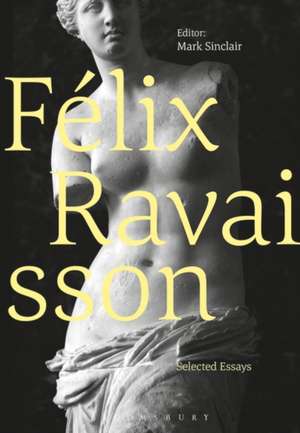
Félix Ravaisson
Editat de Mark Sinclairen Limba Engleză Paperback – 20 oct 2016
| Toate formatele și edițiile | Preț | Express |
|---|---|---|
| Paperback (1) | 190.75 lei 43-57 zile | |
| BLOOMSBURY ACADEMIC – 20 oct 2016 | 190.75 lei 43-57 zile | |
| Hardback (1) | 512.64 lei 40-51 zile | |
| OUP OXFORD – 29 dec 2022 | 512.64 lei 40-51 zile |
Preț: 190.75 lei
Preț vechi: 244.79 lei
-22% Nou
Puncte Express: 286
Preț estimativ în valută:
33.75€ • 39.58$ • 29.64£
33.75€ • 39.58$ • 29.64£
Carte tipărită la comandă
Livrare economică 09-23 februarie 26
Preluare comenzi: 021 569.72.76
Specificații
ISBN-13: 9781472574879
ISBN-10: 1472574877
Pagini: 360
Dimensiuni: 168 x 241 x 23 mm
Greutate: 0.68 kg
Ediția:Adnotată
Editura: BLOOMSBURY ACADEMIC
Locul publicării:London, United Kingdom
ISBN-10: 1472574877
Pagini: 360
Dimensiuni: 168 x 241 x 23 mm
Greutate: 0.68 kg
Ediția:Adnotată
Editura: BLOOMSBURY ACADEMIC
Locul publicării:London, United Kingdom
V-ar putea interesa
-
 The Arguments of TimeJeremy ButterfieldPreț: 426.25 lei
 -
 Analysis and Metaphysics: An Introduction to PhilosophyP. F. StrawsonPreț: 339.58 lei
 -
 John Locke: Selected CorrespondenceMark Goldie-17%Preț: 334.60 lei404.24 lei
 -
 The Sense of Reality: Studies in Ideas and Their HistoryIsaiah BerlinPreț: 122.24 lei
 -
 The Cambridge Companion to KeynesRoger E. BackhousePreț: 245.50 lei
 -
 Preț: 340.80 lei
 -
 The Fragility of Goodness: Luck and Ethics in Greek Tragedy and PhilosophyMartha C. NussbaumPreț: 286.61 lei
 -
 The Shorter Leibniz Texts: A Collection of New TranslationsDr Lloyd Strickland-19%Preț: 194.36 lei238.88 lei
 -
 The Lost Thread: The Democracy of Modern FictionSteven Corcoran-13%Preț: 149.27 lei171.23 lei
 -
 R. G. Collingwood: A Research CompanionProfessor James Connelly-34%Preț: 978.50 lei1480.65 lei
 -
 Living CurrencyPierre Klossowski-43%Preț: 94.35 lei165.98 lei
 -
 Heidegger and the Place of EthicsDr Michael Lewis-17%Preț: 264.20 lei319.14 lei
 -
 Existentialism and ExcessGary Cox-43%Preț: 210.54 lei371.28 lei
 -
 Topophobia: A Phenomenology of AnxietyDylan Trigg-18%Preț: 184.36 lei224.93 lei
 -
 Towards the Definition of PhilosophyMartin Heidegger-43%Preț: 113.52 lei198.30 lei
Caracteristici
Includes a glossary of key terms, a timeline of Ravaisson's life and ideas, and introduction to each chapter contextualising and explaining the work and an annotated bibliography of suggested reading
Notă biografică
Félix Ravaisson (1813-1900) was France's most influential philosopher in the second half of the 19th-century, and held a number of prestigious posts, including that of Curator of Classical Antiquities at the Louvre. His work was pivotal in the development of modern French philosophy, and it has been celebrated by philosophers such as Bergson and Heidegger. Mark Sinclair is Senior Lecturer in Philosophy at Manchester Metropolitan University, UK, and Associate Editor of the British Journal for the History of Philosophy. He is the co-translator of Félix Ravaisson's Of Habit (Continuum, 2008).
Cuprins
Note on the TextsNote on the TranslatorsEditor's Introduction1. Of Habit 2. 'Contemporary Philosophy3.Essay on Stoicism4. The Art of Drawing According to Leonardo da Vinci5. On the Teaching of Drawing 6. The Venus de Milo 7. Greek Funerary Moments8. Mysteries: Fragment of a Study of the History of Religions 9. Pascal's Philosophy 10. Metaphysics and Morals 11. Philosophical TestamentConclusionBibliographyIndex
Recenzii
With the publication of this volume, the availability of Ravaisson's highly original writing is vastly expanded for readers of English. In fact, some of the essays included have been scarce, little-known, or difficult to obtain even in the original French editions (i.e. expensive and fragile) . By reintroducing Ravaisson in such a grand collection, this publication may even rekindle interest in certain lost concepts: the spirit, grace, and artistic beauty. The book may also assist in a renewed conversation among the fields of philology, art history, philosophy, and the history of religions.
Mark Sinclair has made a comprehensive selection of material from the writings of this important but neglected 19th century French philosopher. The selection spans the years 1838 to 1901 and provides insight into the impressive range of Ravaisson's interests, including the path-breaking study of habit and thought-provoking essays on Stoicism, on the art of drawing, on religion, on Pascal, and on the relation between metaphysics and morals. Sometimes said to be the 'French Schelling' Ravaisson emerges as a tremendously erudite and original thinker in this volume, which should serve to reawaken interest in his work and its legacy in vitally important ways. The volume greatly enriches our understanding of seminal developments in modern French philosophy and it will appeal to a broad readership in the humanities and social sciences.
Research on 19th century French philosophy will no doubt be transformed with the publication of this comprehensive selection of Ravaisson's work. Mark Sinclair and his team of translators have done a fantastic job in bringing these essays into English, and the extensive editorial apparatus makes a rigorous and cogent case for Ravaisson's significance and legacy. Historians of philosophy should be overjoyed to now have this resource at their disposal.
Félix Ravaisson was among the most important and influential philosophers in France in the 19th century. This timely volume fills a significant gap in 19th century philosophical scholarship by presenting English translations, most for the first time, including his brilliant doctoral thesis Of Habit as well as essays on art and art history, archaeology, pedagogy, and the history of religions.
Mark Sinclair has made a comprehensive selection of material from the writings of this important but neglected 19th century French philosopher. The selection spans the years 1838 to 1901 and provides insight into the impressive range of Ravaisson's interests, including the path-breaking study of habit and thought-provoking essays on Stoicism, on the art of drawing, on religion, on Pascal, and on the relation between metaphysics and morals. Sometimes said to be the 'French Schelling' Ravaisson emerges as a tremendously erudite and original thinker in this volume, which should serve to reawaken interest in his work and its legacy in vitally important ways. The volume greatly enriches our understanding of seminal developments in modern French philosophy and it will appeal to a broad readership in the humanities and social sciences.
Research on 19th century French philosophy will no doubt be transformed with the publication of this comprehensive selection of Ravaisson's work. Mark Sinclair and his team of translators have done a fantastic job in bringing these essays into English, and the extensive editorial apparatus makes a rigorous and cogent case for Ravaisson's significance and legacy. Historians of philosophy should be overjoyed to now have this resource at their disposal.
Félix Ravaisson was among the most important and influential philosophers in France in the 19th century. This timely volume fills a significant gap in 19th century philosophical scholarship by presenting English translations, most for the first time, including his brilliant doctoral thesis Of Habit as well as essays on art and art history, archaeology, pedagogy, and the history of religions.
Descriere
Descriere de la o altă ediție sau format:
Félix Ravaisson's French Philosophy in the Nineteenth Century is one of the most influential and pivotal texts of modern French thought. Commissioned by the Minister of Public Instruction as one of a series of reports to record the progress of the French sciences and humanities for Paris' second world fair, the 1867 Exposition universelle d'arts et d'industrie, it was published with the others the following year. In the report Ravaisson argues, with verve and generosity, and with an unparalleled command of the century's intellectual developments, that the myriad voices in nineteenth-century French thinking were beginning to form a chorus, one that was advancing towards a new, more concrete form of spiritualist philosophy able to resist materialist, mechanist and sensualist doctrines while incorporating recent developments in the life-sciences. As Henri Bergson noted, it effected a "profound change of orientation in university philosophy" and for decades afterwards students learnt its concluding sections by heart in order to pass public examinations. Bergson's own Creative Evolution, which made him the world's most celebrated living philosopher at the end of the long nineteenth century, is, with its psychological interpretation of biological evolution, a direct expression of the new philosophical orientation that Ravaisson had divined in the report.
Félix Ravaisson's French Philosophy in the Nineteenth Century is one of the most influential and pivotal texts of modern French thought. Commissioned by the Minister of Public Instruction as one of a series of reports to record the progress of the French sciences and humanities for Paris' second world fair, the 1867 Exposition universelle d'arts et d'industrie, it was published with the others the following year. In the report Ravaisson argues, with verve and generosity, and with an unparalleled command of the century's intellectual developments, that the myriad voices in nineteenth-century French thinking were beginning to form a chorus, one that was advancing towards a new, more concrete form of spiritualist philosophy able to resist materialist, mechanist and sensualist doctrines while incorporating recent developments in the life-sciences. As Henri Bergson noted, it effected a "profound change of orientation in university philosophy" and for decades afterwards students learnt its concluding sections by heart in order to pass public examinations. Bergson's own Creative Evolution, which made him the world's most celebrated living philosopher at the end of the long nineteenth century, is, with its psychological interpretation of biological evolution, a direct expression of the new philosophical orientation that Ravaisson had divined in the report.