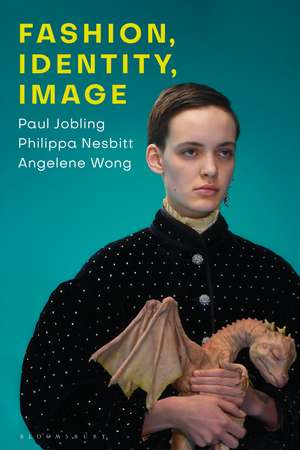
Fashion, Identity, Image
Autor Paul Jobling, Philippa Nesbitt, Angelene Wongen Limba Engleză Paperback – 5 mai 2022
Jobling, Nesbitt and Wong explore issues of intersectionality and inclusivity through groundbreaking shows, including Maria Grazia Chiuri's 'We Should All Be Feminists' catwalk show for Dior (Spring-Summer 2017), Alexander McQueen's 'The Widows of Culloden' collection (Fall-Winter 2006), and the role of transgender models such as Oslo Grace since 2015. Looking to the future of our relationship with fashion, there's also an investigation of the android as a redemptive figure in Alessandro Michele's cross-cultural cyborg collection for Gucci (Autumn-Winter 2018/2019) and the impact of the ageing population with analysis of age and memory in work such as Magali Nougarède's Crossing the Line (2002), and pleasure and morality in fashion publicity since the 1990s for the likes of Calvin Klein, D&G and American Apparel.
Preț: 157.22 lei
Preț vechi: 187.39 lei
-16%
Puncte Express: 236
Carte disponibilă
Livrare economică 15-26 mai
Livrare express 01-07 mai pentru 54.42 lei
Specificații
ISBN-13: 9781350183209
ISBN-10: 1350183202
Pagini: 176
Ilustrații: 40 colour illus
Dimensiuni: 156 x 232 x 10 mm
Greutate: 0.32 kg
Editura: Bloomsbury Publishing
Colecția Bloomsbury Visual Arts
Locul publicării:London, United Kingdom
ISBN-10: 1350183202
Pagini: 176
Ilustrații: 40 colour illus
Dimensiuni: 156 x 232 x 10 mm
Greutate: 0.32 kg
Editura: Bloomsbury Publishing
Colecția Bloomsbury Visual Arts
Locul publicării:London, United Kingdom
V-ar putea interesa
-
 Preț: 333.28 lei
 -
 The Rose in Fashion: RavishingAmy De La HayePreț: 287.98 lei
 -
 Costume and FashionJames Laver-18%Preț: 114.86 lei140.37 lei
 -
 Staging Fashion: The Fashion Show and Its SpacesDr Tiziana Ferrero-Regis-19%Preț: 186.31 lei229.96 lei
 -
 Rethinking Fashion GlobalizationSarah Cheang-24%Preț: 185.51 lei245.18 lei
 -
 A Cultural History of Dress and Fashion in the Modern AgeProfessor Alexandra Palmer-25%Preț: 195.85 lei260.85 lei
 -
 Latin American and Latinx Fashion Design Today - ¡Moda Hoy!Tanya Melendez-Escalante-41%Preț: 227.93 lei389.54 lei
 -
 Queer and Trans Fashion Brands: Resistance and Revolution in the 21st CenturyDr Kelly Reddy-Best-22%Preț: 174.46 lei224.81 lei
 -
 -22%Preț: 175.79 lei225.66 lei
 -
 -33%Preț: 533.22 lei794.93 lei
 -
 Style and Substance: Why What We Wear MattersBay Garnett-27%Preț: 65.77 lei89.82 lei
 -
 Black in Fashion: 100 Years of Style, Influence & CultureTara Donaldson-29%Preț: 293.92 lei411.63 lei
 -
 -33%Preț: 204.88 lei305.56 lei
 -
 -29%Preț: 185.50 lei261.59 lei
 -
 Fifty Dresses that Changed the World: Design Museum FiftyDESIGN MUSEUM ENTERPRISE LTDPreț: 116.78 lei
 -
 The Nature of FashionCarry SomersPreț: 152.88 lei
 -
 AppearancesCarol DyhousePreț: 183.19 lei
 -
 An Opinionated Guide to Fashion LondonChekii Harling-21%Preț: 58.13 lei74.00 lei
 -
 Vivienne WestwoodTom Rasmussen-24%Preț: 141.04 lei185.56 lei
 -
 Fashion & InteriorsRomy CockxPreț: 345.40 lei
Cuprins
List of Illustrations
Acknowledgements
Introduction
1. Authoring Fashion, Intersecting Sex and Gender
Introduction
Maria Grazia Chiuri's 'We Should All Be Feminists' T-Shirt for Christian Dior: Branding, identity and authorship
Between the womb and the gay parade: Alexander McQueen's 'The Widows of Culloden' as poetic text
Subverting the symbolic order: McQueen's abject woman
Conclusion: Squaring up to the phallic mother
Notes
2. Written on the body: Fashion, clothing and age
Introduction
'Active ageing', youthfulness and fashion
'Fashion For All Ages' and the new old model army
Race and reversing convention
Conclusion: From idiotic methods to the realities of time and place
Notes
3. (Un)Gendering the runway
Introduction
Forerunners of transgender and non-binary identities in fashion
The advent of transgendered models
The abject trans-model
Between abjection and acceptance
'Come into the (trans)garden': The heterotopia of fashion
The authentic self
Other models: Intersectionality and wider diversity in the fashion industry
Tokenism versus activism
Conclusion: Between tokenism and authenticity
Notes
4. Loving the alien: Fashion and cyborg identities
Introduction
Andrea Giacobbe and 'Simplex Concordia'
Alessandro Michele and the Gucci Cyborg
Compromising race and diversity
A 'genuine cyborg manifesto'?
Conclusion: Towards emancipatory possibilities
Notes
Epilogue
Acknowledgements
Introduction
1. Authoring Fashion, Intersecting Sex and Gender
Introduction
Maria Grazia Chiuri's 'We Should All Be Feminists' T-Shirt for Christian Dior: Branding, identity and authorship
Between the womb and the gay parade: Alexander McQueen's 'The Widows of Culloden' as poetic text
Subverting the symbolic order: McQueen's abject woman
Conclusion: Squaring up to the phallic mother
Notes
2. Written on the body: Fashion, clothing and age
Introduction
'Active ageing', youthfulness and fashion
'Fashion For All Ages' and the new old model army
Race and reversing convention
Conclusion: From idiotic methods to the realities of time and place
Notes
3. (Un)Gendering the runway
Introduction
Forerunners of transgender and non-binary identities in fashion
The advent of transgendered models
The abject trans-model
Between abjection and acceptance
'Come into the (trans)garden': The heterotopia of fashion
The authentic self
Other models: Intersectionality and wider diversity in the fashion industry
Tokenism versus activism
Conclusion: Between tokenism and authenticity
Notes
4. Loving the alien: Fashion and cyborg identities
Introduction
Andrea Giacobbe and 'Simplex Concordia'
Alessandro Michele and the Gucci Cyborg
Compromising race and diversity
A 'genuine cyborg manifesto'?
Conclusion: Towards emancipatory possibilities
Notes
Epilogue
Recenzii
Gives currency to the importance of fashion as an arbiter of change at a time when the multiplicity and fragmentation of gender is affecting the ways we perceive and experience our bodies and our identities. Its contents will incite ideas and heated debates and I am sure it will be a book whose pages will be well-thumbed and whose subject matter will make for long and passionate arguments and conversations.
Utilizing recent and historic examples, the authors offer a robust account of the role of the fashion industry in creating age, race, gender, and posthuman identities, both actual and fantastic. I finished this book with inspiration for my teaching and research.
Utilizing recent and historic examples, the authors offer a robust account of the role of the fashion industry in creating age, race, gender, and posthuman identities, both actual and fantastic. I finished this book with inspiration for my teaching and research.