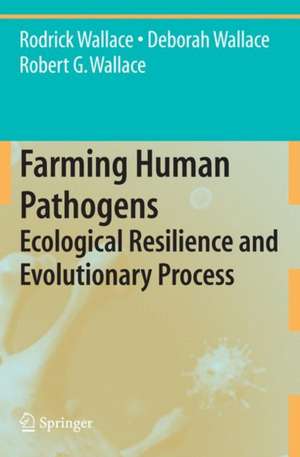
Farming Human Pathogens
Autor Rodrick Wallace, Deborah Wallace, Robert G Wallaceen Limba Engleză Hardback – 13 mai 2009
Preț: 618.23 lei
Preț vechi: 727.33 lei
-15% Nou
Puncte Express: 927
Preț estimativ în valută:
109.40€ • 128.28$ • 96.07£
109.40€ • 128.28$ • 96.07£
Carte tipărită la comandă
Livrare economică 11-25 februarie 26
Preluare comenzi: 021 569.72.76
Specificații
ISBN-13: 9780387922126
ISBN-10: 0387922121
Pagini: 216
Ilustrații: IX, 216 p.
Dimensiuni: 166 x 244 x 23 mm
Greutate: 0.49 kg
Ediția:2009 edition
Editura: Springer
Locul publicării:New York, NY, United States
ISBN-10: 0387922121
Pagini: 216
Ilustrații: IX, 216 p.
Dimensiuni: 166 x 244 x 23 mm
Greutate: 0.49 kg
Ediția:2009 edition
Editura: Springer
Locul publicării:New York, NY, United States
V-ar putea interesa
-
 Epidemiology and Demography in Public HealthJaphet Killewo-26%Preț: 519.88 lei700.97 lei
 -
 -20%Preț: 244.88 lei305.37 lei
 -
 Epidemiology: A Very Short IntroductionRodolfo Saracci-25%Preț: 53.87 lei72.22 lei
 -
 Obesity Epidemiology: From Aetiology to Public HealthDavid Crawford-11%Preț: 688.89 lei775.18 lei
 -
 -28%Preț: 535.02 lei740.06 lei
 -
 -18%Preț: 1066.08 lei1300.10 lei
 -
 -5%Preț: 725.53 lei763.71 lei
 -
 Handbook of Statistics in Clinical OncologyJohn Crowley-31%Preț: 913.16 lei1323.14 lei
 -
 -5%Preț: 270.07 lei284.29 lei
 -
 -5%Preț: 491.08 lei516.92 lei
Public țintă
ResearchCuprins
Formal theory I.- Formal theory II.- Coevolution.- Eigen#x2019;s paradox.- Farming human pathogens.- Final Remarks.
Textul de pe ultima copertă
Farming Human Pathogens: Ecological Resilience and Evolutionary Process introduces a cutting-edge formalism based on the asymptotic limit theorems of information theory to describe how punctuated shifts in mesoscale ecosystems can entrain patterns of gene expression and organismal evolution. The development is applied to several infectious diseases that have evolved in response to the world as humans have made it. Many pathogens emerging from underneath epidemiological control are 'farmed' in the metaphorical sense, as the evolution of drug resistant HIV makes clear, but some, like avian influenza, emerge quite literally as the result of new practices in industrial farming. Effective disease control in the 21st Century must necessarily involve broad economic and social reform for reasons embedded in the basics of pathogen evolution.