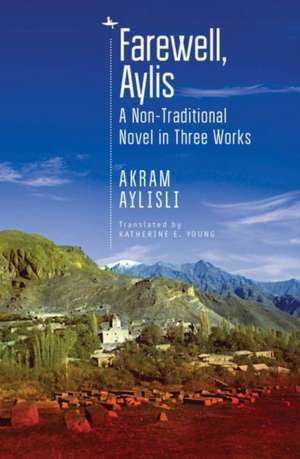
Farewell, Aylis: A Non-Traditional Novel in Three Works: Central Asian Literatures in Translation
Autor Akram Aylisli Traducere de Katherine E. Youngen Limba Engleză Paperback – 5 iun 2019
In Yemen, a Soviet traveler takes an afternoon stroll and finds himself suspected of defecting to America. In Stone Dreams, an actor explores the limits of one man’s ability to live a moral life amid conditions of sociopolitical upheaval, ethnic cleansing, and petty professional intrigue. In A Fantastical Traffic Jam, those who serve the aging leader of a corrupt, oil-rich country scheme to stay alive.
Farewell, Aylis, a new essay by the author that reflects on the political firestorm surrounding these novellas and his current situation as a prisoner of conscience in Azerbaijan, was commissioned especially for this Academic Studies Press edition.

Preț: 108.65 lei
Preț vechi: 127.29 lei
-15%
Puncte Express: 163
Carte disponibilă
Livrare economică 30 octombrie-13 noiembrie
Livrare express 16-22 octombrie pentru 54.34 lei
Livrare prin curier în România Termenul estimat este afișat lângă disponibilitate.
Transport gratuit de la 400.00 lei Plată online sau ramburs, în funcție de opțiunile comenzii.
Retur gratuit în 14 zile Comandă securizată și suport în română.
Specificații
ISBN-13: 9781644690840
ISBN-10: 1644690845
Pagini: 338
Dimensiuni: 159 x 238 x 21 mm
Greutate: 0.55 kg
Editura: Academic Studies Press
Colecția Academic Studies Press
Seria Central Asian Literatures in Translation
Locul publicării:Boston, MA, United States
ISBN-10: 1644690845
Pagini: 338
Dimensiuni: 159 x 238 x 21 mm
Greutate: 0.55 kg
Editura: Academic Studies Press
Colecția Academic Studies Press
Seria Central Asian Literatures in Translation
Locul publicării:Boston, MA, United States
V-ar putea interesa
-
 Soderberg, A: The Andalucian FriendAlexander Soderberg-64%Preț: 46.84 lei129.41 lei
 -
 The SlaveIsaac Bashevis Singer-20%Preț: 62.00 lei77.26 lei
 -
 The OutsiderAlbert Camus-28%Preț: 51.03 lei70.72 lei
 -
 Night at the CrossroadsGeorges Simenon-35%Preț: 49.71 lei76.77 lei
 -
 The Grand Banks CaféGeorges Simenon-35%Preț: 50.08 lei76.46 lei
 -
 -42%Preț: 47.20 lei81.91 lei
 -
 Environmental Management In Tropical AgricultureRobert Goodland-18%Preț: 1112.48 lei1356.68 lei
 -
 Echoes of the CityLars Saabye ChristensenPreț: 106.06 lei
 -
 Red LoveMaxim LeoPreț: 93.33 lei
 -
 Rembrandt's WhoreSylvie MattonPreț: 70.05 lei
 -
 Bourazopoulou, I: What Lot's Wife SawIoanna Bourazopoulou-17%Preț: 70.92 lei85.56 lei
 -
 Preț: 75.51 lei
 -
 The Other NameJon FossePreț: 92.86 lei
 -
 New Finnish GrammarDiego MaraniPreț: 91.41 lei
 -
 Welcome to AmericaLinda Bostrom Knausgaard-20%Preț: 62.09 lei77.31 lei
Recenzii
“Reading Farewell,Aylis is like sitting by the fire at night with the older menof the village and listening to their stories, which in truth are the oralhistory of a people and a region, which in truth could turn out to beprophecies of our own lives. … In [the essay Farewell,Aylis, Aylisli] writes, ‘And I want to serve my motherland not as a patriotbut as a writer.’ And that is what he has done with these stories, making himperhaps the true patriot who does what is truly needed for his country and notwhat pleases and flatters. One, however, needs to read him first and foremostas a writer and be enamored of the allure of his storytelling.” —PoupehMissaghi, Asymptote
“Working from Russian translations of the original Azeri(two by the author himself), Young has given great attention to Aylisli’sunique style that combines elements of socialist realism, Middle Eastern andPersian tales, and social satire. Each piece is set in a different time andplace and is populated by different protagonists, yet a continuity existsacross the whole. What unites these four works is their engagement withhistoric trauma and the way hushed-up violence and wrongdoing are transmittedthrough generations, destroying not only individual lives but also thecharacter of the village, region, and country that guilty people inhabit. … Awriter, Aylisli teaches us, has no allegiances to a country, an ethnicity, areligion, not even to his own birthplace. ‘But he’s always responsible for themoral appearance of his own people, for the spiritual state of his own fellowcitizens.’ And this writer has found the spiritual state of his fellow citizensto be in a dire condition. … As Farewell, Aylis concludes, it leaves areader with a sense that an individual voice trying to resist the culture ofviolence is powerless against the status quo; nonetheless, Aylisli’s voicefeels necessary and urgent.” —Olga Zilberbourg, The Common
“Working from Russian translations of the original Azeri(two by the author himself), Young has given great attention to Aylisli’sunique style that combines elements of socialist realism, Middle Eastern andPersian tales, and social satire. Each piece is set in a different time andplace and is populated by different protagonists, yet a continuity existsacross the whole. What unites these four works is their engagement withhistoric trauma and the way hushed-up violence and wrongdoing are transmittedthrough generations, destroying not only individual lives but also thecharacter of the village, region, and country that guilty people inhabit. … Awriter, Aylisli teaches us, has no allegiances to a country, an ethnicity, areligion, not even to his own birthplace. ‘But he’s always responsible for themoral appearance of his own people, for the spiritual state of his own fellowcitizens.’ And this writer has found the spiritual state of his fellow citizensto be in a dire condition. … As Farewell, Aylis concludes, it leaves areader with a sense that an individual voice trying to resist the culture ofviolence is powerless against the status quo; nonetheless, Aylisli’s voicefeels necessary and urgent.” —Olga Zilberbourg, The Common