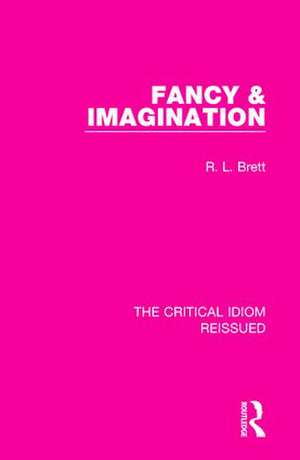
Fancy & Imagination: The Critical Idiom Reissued
Autor R. L. Bretten Limba Engleză Paperback – 17 ian 2019
This work will be of particular interest to those studying Coleridge and the Romantic Movement.
| Toate formatele și edițiile | Preț | Express |
|---|---|---|
| Paperback (1) | 303.05 lei 6-8 săpt. | |
| Taylor & Francis – 17 ian 2019 | 303.05 lei 6-8 săpt. | |
| Hardback (1) | 511.67 lei 6-8 săpt. | |
| Taylor & Francis – 10 iul 2017 | 511.67 lei 6-8 săpt. |
Din seria The Critical Idiom Reissued
-
 Preț: 303.05 lei
 -
 Preț: 328.74 lei
 -
 Preț: 303.22 lei
 -
 Preț: 303.57 lei
 -
 Preț: 303.95 lei
 -
 Preț: 303.95 lei
 -
 Preț: 303.05 lei
 -
 Preț: 303.22 lei
 -
 Preț: 303.22 lei
 -
 Preț: 303.05 lei
 - 32%
 Preț: 506.63 lei
 -
 Preț: 303.22 lei
 -
 Preț: 303.22 lei
 -
 Preț: 303.05 lei
 - 31%
 Preț: 511.67 lei
 -
 Preț: 303.22 lei
 - 31%
 Preț: 511.67 lei
 -
 Preț: 303.05 lei
 -
 Preț: 304.15 lei
 - 31%
 Preț: 511.67 lei
 - 31%
 Preț: 511.67 lei
 - 40%
 Preț: 11474.08 lei
 - 32%
 Preț: 614.86 lei
 -
 Preț: 303.57 lei
 -
 Preț: 303.42 lei
 -
 Preț: 304.53 lei
 -
 Preț: 303.22 lei
 - 31%
 Preț: 511.67 lei
 - 31%
 Preț: 511.67 lei
 - 32%
 Preț: 614.86 lei
 - 32%
 Preț: 614.86 lei
 - 31%
 Preț: 511.67 lei
 -
 Preț: 303.95 lei
Preț: 303.05 lei
Nou
Puncte Express: 455
Preț estimativ în valută:
53.63€ • 62.88$ • 47.09£
53.63€ • 62.88$ • 47.09£
Carte tipărită la comandă
Livrare economică 05-19 februarie 26
Preluare comenzi: 021 569.72.76
Specificații
ISBN-13: 9781138241916
ISBN-10: 1138241911
Pagini: 94
Dimensiuni: 129 x 198 x 5 mm
Greutate: 0.1 kg
Ediția:1
Editura: Taylor & Francis
Colecția Routledge
Seria The Critical Idiom Reissued
Locul publicării:Oxford, United Kingdom
ISBN-10: 1138241911
Pagini: 94
Dimensiuni: 129 x 198 x 5 mm
Greutate: 0.1 kg
Ediția:1
Editura: Taylor & Francis
Colecția Routledge
Seria The Critical Idiom Reissued
Locul publicării:Oxford, United Kingdom
V-ar putea interesa
-
 The Literature WorkbookClara Calvo-33%Preț: 246.34 lei367.51 lei
 -
 Introducing MetaphorMurray Knowles-35%Preț: 612.00 lei947.05 lei
 -
 -15%Preț: 677.19 lei796.69 lei
 -
 The Literary FreudPerry Meisel-33%Preț: 253.57 lei377.12 lei
 -
 -32%Preț: 845.38 lei1235.09 lei
 -
 On JamesonCaren Irr-19%Preț: 564.63 lei697.08 lei
 -
 -19%Preț: 430.34 lei531.28 lei
 -
 TracesErnst BlochPreț: 144.80 lei
 -
 Moderating Masculinity in Early Modern CultureTodd W. ReeserPreț: 242.50 lei
 -
 The Emergence of Standard EnglishJohn H. FisherPreț: 184.12 lei
 -
 Essentials of the Theory of FictionMichael J. HoffmanPreț: 285.58 lei
 -
 Preț: 293.24 lei
 -
 Preț: 97.56 lei
 -
 Doing English: A Guide for Literature StudentsRobert EaglestonePreț: 185.05 lei
 -
 Modern Criticism and Theory: A ReaderNigel Wood-34%Preț: 786.76 lei1193.53 lei
 -
 A Reader's Guide to Contemporary Literary TheoryRaman Selden-34%Preț: 789.71 lei1195.35 lei
 -
 A Glossary of Literary and Cultural TheoryPeter Brooker-33%Preț: 905.15 lei1359.01 lei
 -
 Preț: 444.99 lei
 -
 Preț: 461.82 lei
 -
 On Literature, Culture, and Religion: Irving BabbittIrving BabbittPreț: 444.27 lei
Public țintă
General, Postgraduate, and UndergraduateCuprins
General Editor’s Preface; 1. Imagination and the Association of Ideas 2. Coleridge’s Distinction between Fancy and Imagination 3. Symbol and Concept; Bibliography; Index
Descriere
First published in 1969, this book provides a concise and helpful introduction to the terms ‘fancy’ and ‘imagination’. Although they are generally associated with Samuel Taylor Coleridge, the work begins with a discussion the history of these concepts which were also known to Aristotle, the Elizabethans, Hobbes, Locke and Blake. It then goes on to examine Coleridge’s theory of imagination and the distinction he drew between fancy and imagination.
This work will be of particular interest to those studying Coleridge and the Romantic Movement.
This work will be of particular interest to those studying Coleridge and the Romantic Movement.