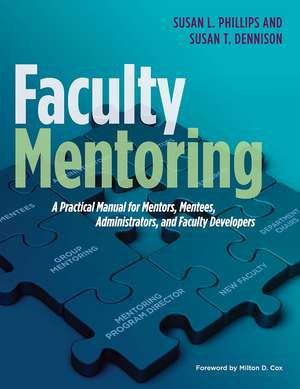
Faculty Mentoring: A Practical Manual for Mentors, Mentees, Administrators, and Faculty Developers
Autor Susan L. Phillips, Susan T. Dennisonen Limba Engleză Paperback – 24 aug 2015
Preț: 331.27 lei
Puncte Express: 497
Carte disponibilă
Livrare economică 28 octombrie-11 noiembrie
Livrare prin curier în România Termenul estimat este afișat lângă disponibilitate.
Transport gratuit de la 400.00 lei Plată online sau ramburs, în funcție de opțiunile comenzii.
Retur gratuit în 14 zile Comandă securizată și suport în română.
Specificații
ISBN-13: 9781620361726
ISBN-10: 1620361728
Pagini: 146
Dimensiuni: 219 x 276 x 13 mm
Greutate: 0.39 kg
Ediția:1
Editura: Taylor & Francis
Colecția Routledge
Locul publicării:Oxford, United Kingdom
ISBN-10: 1620361728
Pagini: 146
Dimensiuni: 219 x 276 x 13 mm
Greutate: 0.39 kg
Ediția:1
Editura: Taylor & Francis
Colecția Routledge
Locul publicării:Oxford, United Kingdom
V-ar putea interesa
-
 -18%Preț: 1260.05 lei1536.64 lei
 -
 Preț: 354.90 lei
 -
 Tools for Dossier Success: A Guide for Promotion and TenureJoy J. BurnhamPreț: 337.05 lei
 -
 Leading for Instructional ImprovementStephen FinkPreț: 240.09 lei
 -
 Managing Online Instructor WorkloadSimone C O ConceiçãoPreț: 212.45 lei
 -
 Beyond FoundationsThomas J GritesPreț: 392.76 lei
 -
 Academic Working Lives: Experience, Practice and ChangeDr Lynne Gornall-24%Preț: 904.69 lei1193.68 lei
 -
 A Guided Inquiry Approach to High School ResearchRandell K. Schmidt-20%Preț: 261.88 lei325.54 lei
 -
 Supporting and Supervising your Teaching AssistantDr Jill Morgan-43%Preț: 104.07 lei182.68 lei
Public țintă
Postgraduate and Professional Practice & DevelopmentCuprins
Foreword—Milton D. Cox Acknowledgments Introduction. Overview and Purpose of the Manual 1. Tips for Mentors Inside or Outside the Department 2. Guidelines for Setting Up, Planning, and Facilitating a Mentoring Group 3. New Faculty Tips on Having a Successful Mentoring Experience 4. Tips for Guidance of Departmental Mentoring 5. Guidelines for Administrators 6. Advice for the Director of a Faculty Mentoring Program 7. Review of Mentoring in the Higher Education Literature Appendices Appendix A. Book and Web Resources Appendix B. Relationship-Building Exercises Appendix C. Active Mentoring Worksheets Appendix D. Closure Activities Appendix E. Group Mentoring Materials Appendix F. Program Implementation Materials Appendix G. Program Assessment Materials Appendix H. Department-Level Materials Appendix I. Sample Program Documents About the Authors Index
Notă biografică
Susan L. Phillips developed the New Faculty Mentoring Program for The University of North Carolina at Greensboro and served as the Director for five years. She has conducted regional and national workshops on mentoring and the tenure process at Lilly Conferences, the POD Conference, and to doctoral students, and has published articles on mentoring in the Journal of Excellence in College Teaching and The Department Chair. She has been at UNCG since 1999, and is an Associate Professor of Audiology in the Department of Communication Sciences and Disorders. She has an active teaching load and research agenda, which includes NIH-funded projects. Susan T. Dennison is an Associate Professor in the Department of Social Work at UNCG where she has been on faculty for 20 years. She has an active teaching and research program at UNCG with external funding at both the state and foundation levels. Susan’s expertise, teaching, and research have focused on group work for the past 30 years resulting in nine books along with numerous articles. She ran a national group consulting company and presented at both national and international conferences on group work. Susan was an ongoing consultant and trainer for the UNCG Faculty Mentoring Program. Milton D. Cox is Project Director, FIPSE Project on Faculty Learning Communities Center for the Enhancement of Learning, Teaching and University Assessment, Miami University, Ohio.
Recenzii
“This text speaks to a wide audience. The full volume will be useful for planners and directors of mentoring programs; individual chapters form stand-alone resources for their target readers (mentors, mentees, and administrators.) Faculty and administrators at institutions of all sizes will find usable insight in the text for mentoring programs funded at a variety of levels. Though geared toward the mentoring of early career faculty, the tools provided in Phillips and Dennison’s text may benefit even mid-career mentees. Finally, though written with mentoring efforts that are supported by institutions in mind, the volume also offers insight for those seeking or offering mentoring outside of formally run programs.”
Reflective Teaching (Wabash Center)
"Phillips and Dennison's book is written for everyone involved in a faculty mentoring program: the mentors; the mentees; the department chairs, deans, and provosts who may play a supportive or evaluative role; and the person in charge of setting up and directing such a program, whether it focuses on individual or group mentoring. The work is concisely written, research-grounded, and wonderfully practical. It supplies all the how-tos of recruiting, relationship building, training, and cost estimating."
Linda B. Nilson, Director, Office of Teaching Effectiveness and Innovation, Clemson University
"Faculty Mentoring: A Practical Manual For Mentors, Mentees, Administrators, and Faculty Developers is short, easy to read, and practically focused (more than half of the volume consists of appendices such as templates, forms, and schedules). The literature review is sequestered in the final chapter where those who are interested can seek it out, and others can readily bypass it. The chapters target specific audiences: mentors, mentoring group facilitators, mentees, chairs, administrators, and directors of mentoring programs (in that order). As such, the busy academic can quickly find and read what she or he needs."
The Department Chair
“Mentoring in and by groups has worked effectively in my years of experience in higher education, and what was surprising at first but clear in the following years was the similarity of successful group mentoring strategies and outcomes for both students and faculty. Effective mentoring occurs by building community and nurturing learning and scholarship.
I encourage your reading of this book to find, among its wealth of perspectives, the approach that works best for you, your students, and your colleagues.”
Milton D. Cox, Director, Original Lilly Conference on College Teaching; and Editor-in-Chief, Journal on Excellence in College Teaching and Learning Communities Journal
Miami University
Reflective Teaching (Wabash Center)
"Phillips and Dennison's book is written for everyone involved in a faculty mentoring program: the mentors; the mentees; the department chairs, deans, and provosts who may play a supportive or evaluative role; and the person in charge of setting up and directing such a program, whether it focuses on individual or group mentoring. The work is concisely written, research-grounded, and wonderfully practical. It supplies all the how-tos of recruiting, relationship building, training, and cost estimating."
Linda B. Nilson, Director, Office of Teaching Effectiveness and Innovation, Clemson University
"Faculty Mentoring: A Practical Manual For Mentors, Mentees, Administrators, and Faculty Developers is short, easy to read, and practically focused (more than half of the volume consists of appendices such as templates, forms, and schedules). The literature review is sequestered in the final chapter where those who are interested can seek it out, and others can readily bypass it. The chapters target specific audiences: mentors, mentoring group facilitators, mentees, chairs, administrators, and directors of mentoring programs (in that order). As such, the busy academic can quickly find and read what she or he needs."
The Department Chair
“Mentoring in and by groups has worked effectively in my years of experience in higher education, and what was surprising at first but clear in the following years was the similarity of successful group mentoring strategies and outcomes for both students and faculty. Effective mentoring occurs by building community and nurturing learning and scholarship.
I encourage your reading of this book to find, among its wealth of perspectives, the approach that works best for you, your students, and your colleagues.”
Milton D. Cox, Director, Original Lilly Conference on College Teaching; and Editor-in-Chief, Journal on Excellence in College Teaching and Learning Communities Journal
Miami University
Descriere
The book provides step-by-step guidelines for setting up, planning, and facilitating mentoring programs for new faculty members, whether one-on-one, or using a successful group model developed and refined over twenty-five years by the authors.