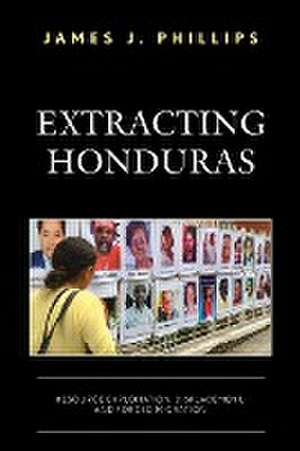
Extracting Honduras: Resource Exploitation, Displacement, and Forced Migration: Lexington Books
Autor James J. Phillipsen Limba Engleză Paperback – 22 aug 2023
Highlighting how this situation is tied to the colonial (or imperial) extractive relationship of Honduras to the United States, Phillips contends that the usual policy of development aid and investment to stem migration will only worsen the conditions that create migration. With this book, Phillips depicts how the Central American immigration "crisis" shapes life in the United States and Honduras, while making clear that the effects are not what populist politics imagine.
Din seria Lexington Books
- 19%
 Preț: 426.72 lei
 - 32%
 Preț: 729.20 lei
 - 59%
 Preț: 427.24 lei
 - 23%
 Preț: 318.57 lei
 - 25%
 Preț: 362.03 lei
 - 23%
 Preț: 322.75 lei
 - 27%
 Preț: 355.41 lei
 - 29%
 Preț: 345.71 lei
 - 25%
 Preț: 306.14 lei
 - 33%
 Preț: 710.24 lei
 - 31%
 Preț: 437.25 lei
 - 29%
 Preț: 342.12 lei
 - 25%
 Preț: 361.02 lei
 - 29%
 Preț: 344.18 lei
 - 28%
 Preț: 347.76 lei
 - 28%
 Preț: 346.74 lei
 - 23%
 Preț: 318.96 lei
 - 37%
 Preț: 660.07 lei
 - 24%
 Preț: 309.62 lei
 - 29%
 Preț: 599.98 lei
 - 24%
 Preț: 369.89 lei
 - 36%
 Preț: 730.77 lei
 - 33%
 Preț: 642.37 lei
 - 29%
 Preț: 345.71 lei
 - 27%
 Preț: 354.68 lei
 - 29%
 Preț: 342.63 lei
 - 28%
 Preț: 252.34 lei
 - 27%
 Preț: 354.28 lei
 - 22%
 Preț: 332.36 lei
 - 22%
 Preț: 338.89 lei
 - 23%
 Preț: 321.63 lei
 - 23%
 Preț: 319.79 lei
 - 28%
 Preț: 346.74 lei
 - 23%
 Preț: 321.53 lei
 - 35%
 Preț: 560.77 lei
 - 24%
 Preț: 308.07 lei
 - 23%
 Preț: 321.63 lei
 - 27%
 Preț: 263.04 lei
 - 23%
 Preț: 333.36 lei
 - 34%
 Preț: 630.22 lei
 - 22%
 Preț: 341.76 lei
 - 33%
 Preț: 358.06 lei
 - 34%
 Preț: 418.63 lei
 - 34%
 Preț: 601.39 lei
 - 35%
 Preț: 593.04 lei
 - 25%
 Preț: 884.44 lei
 - 33%
 Preț: 640.95 lei
Preț: 222.24 lei
Preț vechi: 307.73 lei
-28%
Puncte Express: 333
Carte tipărită la comandă
Livrare economică 23 noiembrie-07 decembrie
Livrare prin curier în România Termenul estimat este afișat lângă disponibilitate.
Transport gratuit de la 400.00 lei Plată online sau ramburs, în funcție de opțiunile comenzii.
Retur gratuit în 14 zile Comandă securizată și suport în română.
Specificații
ISBN-13: 9781793630353
ISBN-10: 1793630356
Pagini: 272
Ilustrații: 20 b/w illustrations;
Dimensiuni: 154 x 230 x 20 mm
Greutate: 0.4 kg
Editura: Bloomsbury Publishing
Colecția Lexington Books
Seria Lexington Books
Locul publicării:New York, United States
ISBN-10: 1793630356
Pagini: 272
Ilustrații: 20 b/w illustrations;
Dimensiuni: 154 x 230 x 20 mm
Greutate: 0.4 kg
Editura: Bloomsbury Publishing
Colecția Lexington Books
Seria Lexington Books
Locul publicării:New York, United States
V-ar putea interesa
-
 -12%Preț: 304.48 lei347.85 lei
 -
 The Social Evolution of International PoliticsShiping Tang-11%Preț: 367.03 lei412.82 lei
 -
 The New American Militarism: How Americans Are Seduced by WarAndrew J. BacevichPreț: 117.50 lei
 -
 Preț: 331.08 lei
 -
 The Future of Political CommunityGideon BakerPreț: 328.19 lei
 -
 Preț: 462.35 lei
 -
 Afrasia: A Tale of Two ContinentsSeifudein Adem, Ph.D-26%Preț: 361.83 lei487.33 lei
 -
 Israel's Security NetworksGabriel Sheffer-14%Preț: 709.17 lei824.61 lei
 -
 Power PlaysAllison Carnegie-14%Preț: 695.61 lei808.86 lei
 -
 From Classrooms to Conflict in RwandaElisabeth KingPreț: 296.57 lei
 -
 -22%Preț: 301.41 lei385.57 lei
 -
 -22%Preț: 302.34 lei386.12 lei
 -
 China's Industrial Policymaking ProcessNathaniel Ahrens-22%Preț: 302.25 lei386.07 lei
 -
 Demography of a Reunified KoreaElizabeth Hervey Stephen-22%Preț: 301.32 lei385.51 lei
 -
 Global Health Policy in the Second Obama TermJ. Stephen Morrison-25%Preț: 423.38 lei562.99 lei
 -
 U.S. Navy Humanitarian Assistance in an Era of AusterityGary Roughead-22%Preț: 303.33 lei386.72 lei
 -
 Our Shared Opportunity: A Vision for Global ProsperityThomas A. Daschle-20%Preț: 326.13 lei405.23 lei
 -
 The New Foreign Policy Frontier: U.S. Interests and Actors in the ArcticHeather A. Conley-26%Preț: 341.71 lei459.87 lei
 -
 -26%Preț: 341.39 lei459.67 lei
 -
 -20%Preț: 312.60 lei392.23 lei
 -
 Enhancing India-ASEAN ConnectivityTed Osius-26%Preț: 339.05 lei458.27 lei
 -
 Die EU im geopolitischen Wettbewerb mit RusslandMariam BochorishviliPreț: 405.13 lei
 -
 Beyond the Rhetorics of ComplianceAnitta M. HipperPreț: 386.90 lei
 -
 Australia in the AnthropoceneErik Paul-18%Preț: 699.13 lei852.60 lei
 -
 Preț: 254.18 lei
Cuprins
Chapter 1: Mapping the Terrain
Chapter 2: Latin American Immigration and the United States
Chapter 3: Imperialism, Development, Honduras
Chapter 4: Migration, Development, and Honduras
Chapter 5: Evolution of the Honduran Political Economy
Chapter 6: Honduras: Characteristics and Consequences of Neoextractive Development
Mining
Chapter 7: The Militarization of Honduras, Emigration, and the United States
Chapter 8: Migration and the Human Spirit: Body and Soul in Honduras
Chapter 9: Reflecting on the Journey
Chapter 2: Latin American Immigration and the United States
Chapter 3: Imperialism, Development, Honduras
Chapter 4: Migration, Development, and Honduras
Chapter 5: Evolution of the Honduran Political Economy
Chapter 6: Honduras: Characteristics and Consequences of Neoextractive Development
Mining
Chapter 7: The Militarization of Honduras, Emigration, and the United States
Chapter 8: Migration and the Human Spirit: Body and Soul in Honduras
Chapter 9: Reflecting on the Journey
Recenzii
In order to understand the immigration crisis at the southern border of the United States, it is imperative to understand why someone would want to leave their homeland. This important new book explores the roots of that crisis, and situates it in extractive economies and militarized societies. Anthropologist Phillips is not content to leave this story on the level of what is wrong and so includes reflections on how to solve the extreme human rights abuses that drive immigration from Honduras. This book is critical for understanding how we can move forward to create a more just and peaceful world.
Honduras is a major originating country for current immigrants. Everyone who wants to understand the real causes of this migration should read this book. While gang violence is well-known, global mining and logging are less well-known, yet crucial, as is the US-supported Honduran government militarization used to implement them.
This exactly the book we need to understand the realities behind the news we read about Honduras. Vividly connects past to present and shows how different forms of extractive development have contributed to the poverty, corruption and violence that are spurring today's migration. The author has a deep knowledge of Honduras and its history and situates the country clearly in its global context.
Simply the best book I have read in many, many a year. Beautifully written, this deeply immersive, fully-substantiated account of the shaping and making of the failed Honduran state and relative role of the United States absolutely conveys the remarkable resilience of the Honduran people. James J. Phillips' Extracting Honduras educates, inspires, and demands to be read again and again.
Extracting Resources and Exporting Lives-With a military coup d'état in 2009 that was supported and cemented into place by the United States, Honduras was 'opened for business.' Extractive industries invaded territories and communities throughout Honduras to plunder natural resources, a move that was facilitated by a regime that is servile to the United States and its extractivist policies. This colonial relationship has produced a massive dispossession and exportation of Hondurans, who are forced to flee. Those who survive the journey north become shock absorbers for the economic deficit of Honduras; their remittances are a principal source of revenue that represents nearly 20% of Honduras' Gross Domestic Product. For the regime that expels and 'exports' them, they become contributors. There is a total loss of fundamental human rights for them, their families, and their communities. We acknowledge and extend our deep gratitude to James Phillips for showing the other side of the coin in this neocolonial business in which our people are just one more commodity.
The relationship between the policy of the United States government and the phenomena of migration is intrinsic. With more intervention from the north, there is more dependency and less sovereignty for countries like Honduras. This generates a lack of opportunities, marginalization, and exclusion that eventually leads to migratory flows and violence. The challenge is to transform the interventionist presence into a presence of solidarity and respect for the self-determination of the people. This is the task that is needed in order to create new international relations and drastically reduce the root causes that produce forced migration.
This important book studies how various political and economic issues interact negatively with one another to the detriment of both Honduras and its bilateral relationship with the United States. Through solid analysis, Phillips convincingly shows how compounding problems in Honduras apply to other countries in Central America and elsewhere. This book skillfully dissects the intricacies of Honduras's political economy. Recommended. Advanced undergraduates through faculty.
Honduras is a major originating country for current immigrants. Everyone who wants to understand the real causes of this migration should read this book. While gang violence is well-known, global mining and logging are less well-known, yet crucial, as is the US-supported Honduran government militarization used to implement them.
This exactly the book we need to understand the realities behind the news we read about Honduras. Vividly connects past to present and shows how different forms of extractive development have contributed to the poverty, corruption and violence that are spurring today's migration. The author has a deep knowledge of Honduras and its history and situates the country clearly in its global context.
Simply the best book I have read in many, many a year. Beautifully written, this deeply immersive, fully-substantiated account of the shaping and making of the failed Honduran state and relative role of the United States absolutely conveys the remarkable resilience of the Honduran people. James J. Phillips' Extracting Honduras educates, inspires, and demands to be read again and again.
Extracting Resources and Exporting Lives-With a military coup d'état in 2009 that was supported and cemented into place by the United States, Honduras was 'opened for business.' Extractive industries invaded territories and communities throughout Honduras to plunder natural resources, a move that was facilitated by a regime that is servile to the United States and its extractivist policies. This colonial relationship has produced a massive dispossession and exportation of Hondurans, who are forced to flee. Those who survive the journey north become shock absorbers for the economic deficit of Honduras; their remittances are a principal source of revenue that represents nearly 20% of Honduras' Gross Domestic Product. For the regime that expels and 'exports' them, they become contributors. There is a total loss of fundamental human rights for them, their families, and their communities. We acknowledge and extend our deep gratitude to James Phillips for showing the other side of the coin in this neocolonial business in which our people are just one more commodity.
The relationship between the policy of the United States government and the phenomena of migration is intrinsic. With more intervention from the north, there is more dependency and less sovereignty for countries like Honduras. This generates a lack of opportunities, marginalization, and exclusion that eventually leads to migratory flows and violence. The challenge is to transform the interventionist presence into a presence of solidarity and respect for the self-determination of the people. This is the task that is needed in order to create new international relations and drastically reduce the root causes that produce forced migration.
This important book studies how various political and economic issues interact negatively with one another to the detriment of both Honduras and its bilateral relationship with the United States. Through solid analysis, Phillips convincingly shows how compounding problems in Honduras apply to other countries in Central America and elsewhere. This book skillfully dissects the intricacies of Honduras's political economy. Recommended. Advanced undergraduates through faculty.