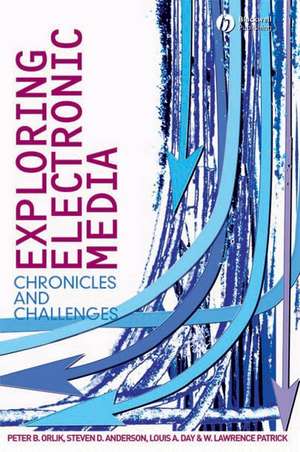
Exploring Electronic Media
Autor Orlik, Anderson, Dayen Limba Engleză Hardback – 5 ian 2007
- Written by leading authors who collectively bring a wealth of not only teaching, but also multifaceted industry experience to the subject.
- Covers the historical influences and contemporary issues in programming, technology, regulation, and the business of media.
- Features chapter reviews and discussion questions, as well as an introductory chapter that orients the reader to the broad electronic media landscape.
- Explores the fundamentals for understanding human communication as an underpinning to the study of media communication systems.
- Considers the future and great potential in this ever-changing field.
Preț: 686.12 lei
Preț vechi: 939.90 lei
-27%
Puncte Express: 1029
Carte tipărită la comandă
Livrare economică 09-23 noiembrie
Livrare prin curier în România Termenul estimat este afișat lângă disponibilitate.
Transport gratuit pentru acest produs Plată online sau ramburs, în funcție de opțiunile comenzii.
Retur gratuit în 14 zile Comandă securizată și suport în română.
Specificații
ISBN-13: 9781405150545
ISBN-10: 1405150548
Pagini: 292
Dimensiuni: 157 x 235 x 20 mm
Greutate: 0.58 kg
Ediția:New.
Editura: Wiley
Locul publicării:Chichester, United Kingdom
ISBN-10: 1405150548
Pagini: 292
Dimensiuni: 157 x 235 x 20 mm
Greutate: 0.58 kg
Ediția:New.
Editura: Wiley
Locul publicării:Chichester, United Kingdom
V-ar putea interesa
-
 -27%Preț: 875.62 lei1199.49 lei
 -
 Understanding MediaJames CurranPreț: 92.20 lei
 -
 Understanding Media CultureJostein GripsrudPreț: 167.60 lei
 -
 Understanding MediaMarshall McLuhanPreț: 173.97 lei
 -
 Encyclopedia of New MediaSteve Jones-9%Preț: 1028.24 lei1129.94 lei
 -
 The Global Media AtlasProf. Mark Balnaves-23%Preț: 249.66 lei325.98 lei
 -
 Sport and the Media: Managing the NexusMerryn SherwoodPreț: 425.63 lei
 -
 Preț: 379.16 lei
 -
 -24%Preț: 212.54 lei278.74 lei
 -
 AQA Media Studies for A Level: Student Book - Revised EditionElspeth Stevenson-16%Preț: 381.43 lei455.61 lei
 -
 Media Studies: A Complete Introduction: Teach YourselfJoanne Hollows-27%Preț: 77.19 lei105.68 lei
 -
 The Medium Is Still the MessageGrant N. HaversPreț: 229.99 lei
 -
 A Social History of the MediaAsa BriggsPreț: 169.73 lei
 -
 Media Industry StudiesAmanda D. LotzPreț: 98.53 lei
 -
 Preț: 138.84 lei
 -
 Digital Media Law: Rights, Rules, and Regulations in the Age of AIMichael E. Jones-21%Preț: 247.07 lei311.90 lei
 -
 Take Me to the RiverJackie KempPreț: 144.22 lei
 -
 MiddlelandRory StewartPreț: 157.71 lei
 -
 Media from Chaos to Clarity and Back AgainJudy Ungar Franks-16%Preț: 160.18 lei191.19 lei
 -
 -26%Preț: 193.23 lei259.62 lei
Public țintă
first year undergraduates and above studying electronic media within mass media and communication studies; media and broadcasting professionalsNotă biografică
Peter B. Orlik is Professor and Director of Central Michigan University's School of Broadcast and Cinematic Arts.
Steven D. Anderson is Professor in the School of Media Arts and Design at James Madison University where he conducts courses in electronic media technologies.
Louis A. Day is an alumni Professor in Louisiana State University's Manship School of Mass Communication.
W. Lawrence Patrick is President of Patrick Communications, LLC, a leading media investment banking and brokerage firm as well as owner of Legend Communications, a 16-station radio group.
Steven D. Anderson is Professor in the School of Media Arts and Design at James Madison University where he conducts courses in electronic media technologies.
Louis A. Day is an alumni Professor in Louisiana State University's Manship School of Mass Communication.
W. Lawrence Patrick is President of Patrick Communications, LLC, a leading media investment banking and brokerage firm as well as owner of Legend Communications, a 16-station radio group.
Cuprins
Illustrations.
About the Authors.
Preface.
Acknowledgments.
1. Bringing Electronic Media into Focus. Peter B. Orlik.
Components of Communication.
Communications Vehicles.
The Broadcast and Nonbroadcast Electronic Media.
Obtaining Feedback.
Local/Network Dynamics.
Chapter Rewind.
Self-Interrogation.
Notes.
Part I: Chronicles.
2. Technological Chronicles. Steven D. Anderson.
Early Communications Breakthroughs.
Radio's Wireless Ancestors.
Attaining Radio.
Channels and the Electromagnetic Spectrum.
Television Broadcasting.
Electronic Recording - Audio.
Electronic Recording - Video.
Cable Television.
Satellite Technology.
Analog vs. Digital.
Digital Television.
Chapter Rewind.
Self-Interrogation.
Notes.
3. Content Chronicles. Peter B. Orlik.
Broadcasting: Stumbling upon a Business.
Radio's Gilt-Edged Years.
Post-War Adaptations.
Radio's Second Half-Century.
Video Enters the Living Room.
Television at Center Stage.
Content for the Second and Third Screens.
Chapter Rewind.
Self-Interrogation.
Notes.
4. Regulatory Chronicles. Louis A. Day.
Early Electronic Media Regulation.
Radio Regulation's Foundation in the United States.
Administrative Structure for Broadcast Regulation.
The Structure of the Industry.
Content Regulation.
Political Programming and the Public Sphere.
Policing New Technologies.
Chapter Rewind.
Self-Interrogation.
Notes.
5. Business Chronicles. W. Lawrence Patrick.
The Mass Audience.
The Rise of the Network Model.
Cable Flexes Its Muscles.
New Technologies Change the Business.
Vertical Integration as a Survival Strategy.
A Smaller Slice of a Larger Pie.
Chapter Rewind.
Self-Interrogation.
Notes.
Part II: Challenges.
6. Technological Challenges. Steven D. Anderson.
Changes to Traditional Media.
Device Convergence.
The Internet and Broadband.
Internet Applications.
Future Communication Technologies.
Chapter Rewind.
Self-Interrogation.
Notes.
7. Content Challenges. Peter B. Orlik.
The Consumer-Centric Cosmos.
A Video Programming Overview.
Video News Issues.
The Incredible Sports Hulk.
Reality Vehicles and Product Placement.
The Ethnic and Global Dimension.
Chapter Rewind.
Self-Interrogation.
Notes.
8. Regulatory Challenges. Louis A. Day.
History's Legal Lessons.
Beyond Broadcasting: Laws for New Media.
Convergence and the Legal Landscape.
The State of Electronic "Free Speech".
Chapter Rewind.
Self-Interrogation.
Notes.
9. Business Challenges. W. Lawrence Patrick.
Feeding the Media Machine.
Partners and Joint Ventures.
Consumers and Advertisers.
Restructuring the Media Landscape.
Living in a Personal Media World.
What's Ahead.
Chapter Rewind.
Self-Interrogation.
Notes.
Index.
Preface.
Acknowledgments.
1. Bringing Electronic Media into Focus. Peter B. Orlik.
Components of Communication.
Communications Vehicles.
The Broadcast and Nonbroadcast Electronic Media.
Obtaining Feedback.
Local/Network Dynamics.
Chapter Rewind.
Self-Interrogation.
Notes.
Part I: Chronicles.
2. Technological Chronicles. Steven D. Anderson.
Early Communications Breakthroughs.
Radio's Wireless Ancestors.
Attaining Radio.
Channels and the Electromagnetic Spectrum.
Television Broadcasting.
Electronic Recording - Audio.
Electronic Recording - Video.
Cable Television.
Satellite Technology.
Analog vs. Digital.
Digital Television.
Chapter Rewind.
Self-Interrogation.
Notes.
3. Content Chronicles. Peter B. Orlik.
Broadcasting: Stumbling upon a Business.
Radio's Gilt-Edged Years.
Post-War Adaptations.
Radio's Second Half-Century.
Video Enters the Living Room.
Television at Center Stage.
Content for the Second and Third Screens.
Chapter Rewind.
Self-Interrogation.
Notes.
4. Regulatory Chronicles. Louis A. Day.
Early Electronic Media Regulation.
Radio Regulation's Foundation in the United States.
Administrative Structure for Broadcast Regulation.
The Structure of the Industry.
Content Regulation.
Political Programming and the Public Sphere.
Policing New Technologies.
Chapter Rewind.
Self-Interrogation.
Notes.
5. Business Chronicles. W. Lawrence Patrick.
The Mass Audience.
The Rise of the Network Model.
Cable Flexes Its Muscles.
New Technologies Change the Business.
Vertical Integration as a Survival Strategy.
A Smaller Slice of a Larger Pie.
Chapter Rewind.
Self-Interrogation.
Notes.
Part II: Challenges.
6. Technological Challenges. Steven D. Anderson.
Changes to Traditional Media.
Device Convergence.
The Internet and Broadband.
Internet Applications.
Future Communication Technologies.
Chapter Rewind.
Self-Interrogation.
Notes.
7. Content Challenges. Peter B. Orlik.
The Consumer-Centric Cosmos.
A Video Programming Overview.
Video News Issues.
The Incredible Sports Hulk.
Reality Vehicles and Product Placement.
The Ethnic and Global Dimension.
Chapter Rewind.
Self-Interrogation.
Notes.
8. Regulatory Challenges. Louis A. Day.
History's Legal Lessons.
Beyond Broadcasting: Laws for New Media.
Convergence and the Legal Landscape.
The State of Electronic "Free Speech".
Chapter Rewind.
Self-Interrogation.
Notes.
9. Business Challenges. W. Lawrence Patrick.
Feeding the Media Machine.
Partners and Joint Ventures.
Consumers and Advertisers.
Restructuring the Media Landscape.
Living in a Personal Media World.
What's Ahead.
Chapter Rewind.
Self-Interrogation.
Notes.
Index.
Descriere
* This dynamic, new approach to teaching electronic media and culture balances a presentation of media history with analysis of contemporary media considerations and concerns. * Covers the key areas of programming, technology, regulation, and business, treating both historical aspects and contemporary conditions and projections.