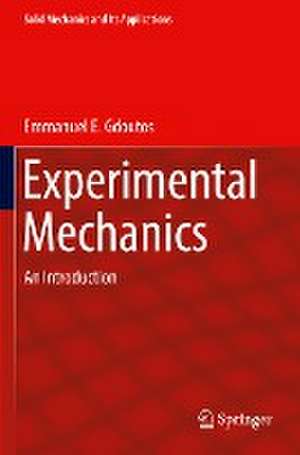
Experimental Mechanics: Solid Mechanics and Its Applications, cartea 269
Autor Emmanuel E. Gdoutosen Limba Engleză Paperback – 17 noi 2022
The book presents in a clear, simple, straightforward, novel and unified manner the most used methods of experimental mechanics of solids for the determination of displacements, strains and stresses. Emphasis is given on the principles of operation of the various methods, not in their applications to engineering problems. The book is divided into sixteen chapters which include strain gages, basic optics, geometric and interferometric moiré, optical methods (photoelasticity, interferometry, holography, caustics, speckle methods, digital image correlation), thermoelastic stress analysis, indentation, optical fibers, nondestructive testing, and residual stresses. The book will be used not only as a learning tool, but as a basis on which the researcher, the engineer, the experimentalist, the student can develop their new own ideas to promote research in experimental mechanics of solids.
Din seria Solid Mechanics and Its Applications
- 18%
 Preț: 1461.10 lei
 -
 Preț: 628.16 lei
 - 18%
 Preț: 1283.23 lei
 - 15%
 Preț: 661.76 lei
 - 15%
 Preț: 731.65 lei
 - 18%
 Preț: 1166.95 lei
 - 15%
 Preț: 666.92 lei
 - 18%
 Preț: 1156.92 lei
 - 18%
 Preț: 1784.98 lei
 - 18%
 Preț: 1049.94 lei
 - 18%
 Preț: 775.37 lei
 - 18%
 Preț: 1279.44 lei
 - 15%
 Preț: 673.19 lei
 - 15%
 Preț: 642.19 lei
 - 18%
 Preț: 984.21 lei
 - 20%
 Preț: 636.75 lei
 - 18%
 Preț: 988.03 lei
 - 18%
 Preț: 914.83 lei
 - 18%
 Preț: 763.70 lei
 - 18%
 Preț: 1271.93 lei
 - 18%
 Preț: 1278.08 lei
 - 18%
 Preț: 934.80 lei
 - 18%
 Preț: 990.14 lei
 - 20%
 Preț: 1031.80 lei
 - 18%
 Preț: 1285.90 lei
 - 18%
 Preț: 993.09 lei
 - 18%
 Preț: 994.79 lei
 - 18%
 Preț: 981.22 lei
 - 18%
 Preț: 909.21 lei
 -
 Preț: 418.39 lei
 - 18%
 Preț: 1040.97 lei
 - 18%
 Preț: 990.58 lei
 - 15%
 Preț: 671.79 lei
 - 18%
 Preț: 1155.14 lei
 - 18%
 Preț: 960.16 lei
 - 18%
 Preț: 1269.85 lei
 - 18%
 Preț: 1285.25 lei
 - 18%
 Preț: 989.31 lei
 - 24%
 Preț: 1867.10 lei
 - 18%
 Preț: 993.52 lei
 - 24%
 Preț: 690.04 lei
 - 18%
 Preț: 1238.74 lei
 - 15%
 Preț: 675.76 lei
 - 24%
 Preț: 1855.18 lei
Preț: 519.94 lei
Preț vechi: 611.69 lei
-15%
Puncte Express: 780
Carte indisponibilă temporar
Livrare prin curier în România Termenul estimat este afișat lângă disponibilitate.
Transport gratuit pentru acest produs Plată online sau ramburs, în funcție de opțiunile comenzii.
Retur gratuit în 14 zile Comandă securizată și suport în română.
Specificații
ISBN-13: 9783030894689
ISBN-10: 3030894681
Pagini: 336
Ilustrații: XXI, 311 p. 150 illus., 1 illus. in color.
Dimensiuni: 155 x 235 x 19 mm
Greutate: 0.47 kg
Ediția:1st ed. 2022
Editura: Springer
Colecția Solid Mechanics and Its Applications
Seria Solid Mechanics and Its Applications
Locul publicării:Cham, Switzerland
ISBN-10: 3030894681
Pagini: 336
Ilustrații: XXI, 311 p. 150 illus., 1 illus. in color.
Dimensiuni: 155 x 235 x 19 mm
Greutate: 0.47 kg
Ediția:1st ed. 2022
Editura: Springer
Colecția Solid Mechanics and Its Applications
Seria Solid Mechanics and Its Applications
Locul publicării:Cham, Switzerland
Cuprins
Chapter 1. Electrical Resistance Strain Gages.- Chapter 2. Fundamentals of optics.- Chapter 3. Geometric Moiré.- Chapter 4. Coherent Moiré and Moiré Interferometry.- Chapter 5. Moiré patterns formed by remote gratings.- Chapter 6. The method of caustics.- Chapter 7. Photoelasticity.- Chapter 8. Interferometry.- Chapter 9. Holography.- Chapter 10. Optical Fiber Strain Sensors.- Chapter 11. Speckle Methods.- Chapter 12. Digital Image Correlation (DIC).- Chapter 13. Thermoelastic Stress Analysis (TSA).- Chapter 14. Indentation Testing.- Chapter 15. Nondestructive Testing (NDT).- Chapter 16. Residual Stresses – The Hole Drilling Method.
Notă biografică
Emmanuel Gdoutos is Full Member of the Academy of Athens in the chair of Theoretical and Experimental Mechanics (2016). He is member of many academies worldwide, fellow of scientific societies and received numerous awards. His book “Fracture Mechanics – An Introduction, 3rd edition” published by Springer accompanied by a solutions manual is used as a textbook by many universities worldwide. His book “Matrix Theory of Photoelasticity” published by Springer-Verlag presents a novel and unified interpretation of the problems of photoelastic stress analysis using the modern methods of description of polarized light. He is the book series editor of the Springer series “Springerbriefs in Structural Mechanics”. His research interest include problems of the theory of elasticity, fracture mechanics, experimental mechanics (with emphasis in the optical methods), mechanics of composite materials, sandwich structures and nanotechnology (composite nanomaterials).
Textul de pe ultima copertă
The book presents in a clear, simple, straightforward, novel and unified manner the most used methods of experimental mechanics of solids for the determination of displacements, strains and stresses. Emphasis is given on the principles of operation of the various methods, not in their applications to engineering problems. The book is divided into sixteen chapters which include strain gages, basic optics, geometric and interferometric moiré, optical methods (photoelasticity, interferometry, holography, caustics, speckle methods, digital image correlation), thermoelastic stress analysis, indentation, optical fibers, nondestructive testing, and residual stresses. The book will be used not only as a learning tool, but as a basis on which the researcher, the engineer, the experimentalist, the student can develop their new own ideas to promote research in experimental mechanics of solids.
Caracteristici
Contains a comprehensive treatise of the subjects of experimental mechanics with new up-to-date methods and techniques Covers strain gages, geometric and interferometric moiré, and optical methods Details various experimental techniques and an entire chapter on fundamental principles of the theory of optics