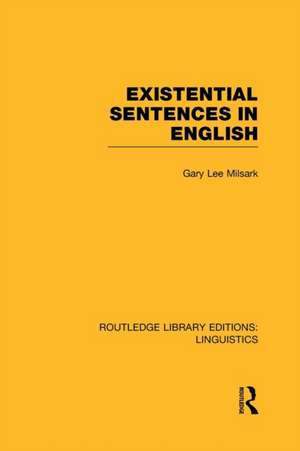
Existential Sentences in English (RLE Linguistics D: English Linguistics): Routledge Library Editions: Linguistics
Autor Gary L. Milsarken Limba Engleză Paperback – 9 dec 2015
Din seria Routledge Library Editions: Linguistics
- 18%
 Preț: 1119.70 lei
 - 18%
 Preț: 688.23 lei
 - 18%
 Preț: 1070.21 lei
 - 18%
 Preț: 1072.48 lei
 - 18%
 Preț: 649.88 lei
 - 18%
 Preț: 1098.94 lei
 - 18%
 Preț: 1069.42 lei
 - 18%
 Preț: 881.81 lei
 - 18%
 Preț: 1120.74 lei
 - 18%
 Preț: 888.95 lei
 - 18%
 Preț: 1070.21 lei
 - 18%
 Preț: 687.49 lei
 - 18%
 Preț: 1074.77 lei
 - 18%
 Preț: 1207.61 lei
 - 18%
 Preț: 1368.96 lei
 - 18%
 Preț: 889.29 lei
 - 18%
 Preț: 884.86 lei
 - 18%
 Preț: 968.08 lei
 - 18%
 Preț: 1071.71 lei
 - 18%
 Preț: 1201.50 lei
 - 18%
 Preț: 1071.71 lei
 - 18%
 Preț: 1427.57 lei
 - 18%
 Preț: 1122.83 lei
 - 18%
 Preț: 1070.97 lei
 - 18%
 Preț: 688.23 lei
 - 18%
 Preț: 1098.16 lei
 - 18%
 Preț: 1069.42 lei
 - 18%
 Preț: 1258.58 lei
 - 18%
 Preț: 1206.85 lei
 -
 Preț: 463.13 lei
 - 18%
 Preț: 1116.20 lei
 - 18%
 Preț: 1208.35 lei
 - 18%
 Preț: 1077.14 lei
 - 18%
 Preț: 1078.82 lei
 - 18%
 Preț: 1264.25 lei
 - 18%
 Preț: 1206.07 lei
 - 18%
 Preț: 1076.13 lei
 - 18%
 Preț: 884.86 lei
 - 18%
 Preț: 1256.58 lei
 - 18%
 Preț: 1070.97 lei
 -
 Preț: 350.29 lei
 - 18%
 Preț: 1434.65 lei
 - 18%
 Preț: 1213.15 lei
 - 18%
 Preț: 1070.21 lei
 - 18%
 Preț: 887.96 lei
 - 18%
 Preț: 1078.15 lei
 - 18%
 Preț: 962.70 lei
 - 18%
 Preț: 1372.02 lei
 - 18%
 Preț: 2015.97 lei
 - 18%
 Preț: 1252.93 lei
Preț: 464.26 lei
Puncte Express: 696
Carte tipărită la comandă
Livrare economică 22 august-05 septembrie
Livrare prin curier în România Termenul estimat este afișat lângă disponibilitate.
Transport gratuit pentru acest produs Plată online sau ramburs, în funcție de opțiunile comenzii.
Retur gratuit în 14 zile Comandă securizată și suport în română.
Specificații
ISBN-13: 9781138969285
ISBN-10: 1138969281
Pagini: 288
Dimensiuni: 156 x 234 x 14 mm
Greutate: 0.45 kg
Ediția:1
Editura: Taylor & Francis
Colecția Routledge
Seria Routledge Library Editions: Linguistics
Locul publicării:Oxford, United Kingdom
ISBN-10: 1138969281
Pagini: 288
Dimensiuni: 156 x 234 x 14 mm
Greutate: 0.45 kg
Ediția:1
Editura: Taylor & Francis
Colecția Routledge
Seria Routledge Library Editions: Linguistics
Locul publicării:Oxford, United Kingdom
V-ar putea interesa
-
 Lexical Semantics without Thematic RolesYael Ravin-26%Preț: 192.73 lei261.35 lei
 -
 -32%Preț: 299.43 lei441.14 lei
 -
 The Origins of Grammar: Language in the Light of Evolution IIJames R. Hurford-10%Preț: 474.05 lei529.65 lei
 -
 The Complementizer Phase: Subjects and OperatorsE. Phoevos Panagiotidis-19%Preț: 406.04 lei500.10 lei
 -
 Oxford A-Z of English UsageJeremy Butterfield-20%Preț: 55.83 lei70.20 lei
 -
 Oxford A-Z of Better SpellingCharlotte Buxton-21%Preț: 55.56 lei70.16 lei
 -
 The Oxford Handbook of CompoundingRochelle Lieber-20%Preț: 366.02 lei456.25 lei
 -
 Syntactic TheoryGeoffrey PoolePreț: 270.48 lei
 -
 Grammar and Context: An Advanced Resource BookAnn Hewings-15%Preț: 426.46 lei501.72 lei
 -
 -15%Preț: 439.20 lei516.71 lei
 -
 Exploring English Grammar: From formal to functionalCaroline CoffinPreț: 488.24 lei
 -
 English for Journalists: Twentieth Anniversary EditionWynford HicksPreț: 302.69 lei
 -
 Vocabulary: Applied Linguistic PerspectivesRonald CarterPreț: 407.16 lei
 -
 Case, Argument Structure, and Word OrderShigeru Miyagawa-18%Preț: 1296.24 lei1580.77 lei
 -
 Preț: 402.45 lei
 -
 -28%Preț: 65.76 lei91.59 lei
 -
 An Introduction to English SyntaxJim Miller-5%Preț: 142.39 lei150.38 lei
 -
 MorphologyAntonio Fábregas-15%Preț: 178.16 lei208.46 lei
 -
 Preț: 111.13 lei
 -
 Halliday's Introduction to Functional GrammarM. A. K. Halliday-15%Preț: 491.57 lei578.32 lei
 -
 Preț: 78.29 lei
Cuprins
Part 1: Do We Have to Have a There-Insertion Rule? 1. ES and the There-Insertion Analysis 2. Emonds’ Analysis 3. The PS Hypothesis 4. The Cleft Reduction Hypothesis 5. The Loc-Front Proposal Part 2: What Can Be Done About It? 6. Ontological, Locational, and Periphrastic ES 7. Verbal ES
Descriere
In order to bring some minimal amount of order to the chaos that almost inevitably attends the use of the word ‘existential’ in a linguistic investigation, the author reserved the term existential sentence (ES) to designate all and only those English sentences in which there appears an occurrence of the unstressed, non-deictic, ‘existential’ there. Thus the term will be used as a characterisation of a class of syntactic objects, not as a semantic description. With ES sentences including formations such as ‘There were several people talking’ and ‘There ensued a riot’, perhaps nowhere else do we find so clearly displayed the complexity and subtlety of the syntactic and semantic interactions which determine the nature of human language.