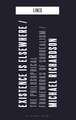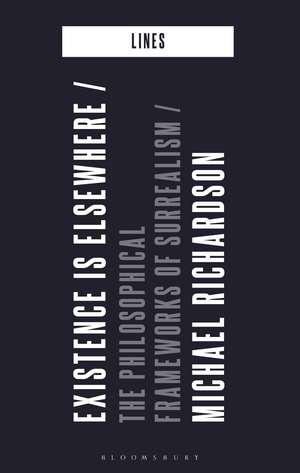
Existence is Elsewhere: The Philosophical Frameworks of Surrealism
Seria Lines
387.28 lei Preț vechi: 516.65 lei -25% Precomandă
Carte nepublicată încă Apare 18 feb 2027. O trimitem imediat ce e disponibilă.
Te anunțăm când e disponibilă:
Se trimite...
Adaugă în listă581 Puncte Express
- Livrare prin curier de la 16.99 lei, gratuită de la 400 lei
- Plată online sau ramburs
- Retur gratuit în 14 zile
Despre carte
Existence is Elsewhere offers the first comprehensive account of surrealism as a movement sustained by philosophical ideas.
Moving far beyond the familiar narrative linking surrealism to Freud, this study reveals a century-long engagement with thinkers as diverse as Hegel, Heraclitus, Parmenides, Schelling, Novalis, Nietzsche, and Fourier, as well as traditions outside the Western canon, from ancient Egypt to Chinese thought.
Michael Richardson shows that surrealism was born of a network of encounters: collective experiments, shared crises after the First World War, and intense friendships that shaped its emergence between 1919 and 1924. Its philosophical orientation arose not from systematic study but from a "philosophical poetics" - a way of thinking through practice, intuition, and experiment.
Across ten chapters, Richardson traces surrealism's relationship with dialectical thinking, analogy, myth, and the marvellous. Hegel's ideas on mediation and becoming illuminate Breton's concerns with identity and recognition; Heraclitus' unity of opposites and Parmenides' journey into the unknown resonate with surrealism's pursuit of an "elsewhere" beyond perceptual reality; Schelling's philosophy of nature and the unconscious opens new vistas for understanding surrealism's animist sensibility, while Nietzsche's pessimism and affirmation of life sharpen its critique of modernity.
Existence is Elsewhere is an essential resource for readers in philosophy, literature, art history, and modern intellectual history, offering a bold reconceptualization of the history of surrealism, and what it may still become.