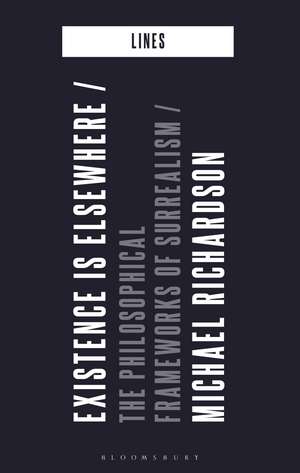
Existence is Elsewhere: The Philosophical Frameworks of Surrealism: Lines
Autor Michael Richardsonen Limba Engleză Paperback – 18 feb 2027
Moving far beyond the familiar narrative linking surrealism to Freud, this study reveals a century-long engagement with thinkers as diverse as Hegel, Heraclitus, Parmenides, Schelling, Novalis, Nietzsche, and Fourier, as well as traditions outside the Western canon, from ancient Egypt to Chinese thought.
Michael Richardson shows that surrealism was born of a network of encounters: collective experiments, shared crises after the First World War, and intense friendships that shaped its emergence between 1919 and 1924. Its philosophical orientation arose not from systematic study but from a "philosophical poetics" - a way of thinking through practice, intuition, and experiment.
Across ten chapters, Richardson traces surrealism's relationship with dialectical thinking, analogy, myth, and the marvellous. Hegel's ideas on mediation and becoming illuminate Breton's concerns with identity and recognition; Heraclitus' unity of opposites and Parmenides' journey into the unknown resonate with surrealism's pursuit of an "elsewhere" beyond perceptual reality; Schelling's philosophy of nature and the unconscious opens new vistas for understanding surrealism's animist sensibility, while Nietzsche's pessimism and affirmation of life sharpen its critique of modernity.
Existence is Elsewhere is an essential resource for readers in philosophy, literature, art history, and modern intellectual history, offering a bold reconceptualization of the history of surrealism, and what it may still become.

Preț: 136.65 lei
Precomandă
Puncte Express: 205
Carte nepublicată încă
Livrare prin curier în România Precomanda se expediază când titlul devine disponibil.
Transport gratuit de la 400.00 lei Plată online sau ramburs, în funcție de opțiunile comenzii.
Retur gratuit în 14 zile Comandă securizată și suport în română.
Doresc să fiu notificat când acest titlu va fi disponibil:
Se trimite...
Specificații
ISBN-13: 9781350531376
ISBN-10: 1350531375
Pagini: 224
Ilustrații: 10 bw illus
Dimensiuni: 138 x 216 x 25 mm
Greutate: 0.45 kg
Editura: Bloomsbury Publishing
Colecția Bloomsbury Academic
Seria Lines
Locul publicării:London, United Kingdom
ISBN-10: 1350531375
Pagini: 224
Ilustrații: 10 bw illus
Dimensiuni: 138 x 216 x 25 mm
Greutate: 0.45 kg
Editura: Bloomsbury Publishing
Colecția Bloomsbury Academic
Seria Lines
Locul publicării:London, United Kingdom
Cuprins
Introduction
1. Poetry and Philosophy in Nineteenth-century France
2. Hegel and the Surrealist Imagination
3. Intimations from Ancient Egypt
4. Heraclitus and the Dynamic of Existence
5. Parmenides and Existence as 'Other'
6. Schelling and the Ages of the World
7. Novalis and Poetry's Revolutionary Potential
8. The Spectre of Nietzsche
9. The Materiality of the World
10. Fourier and Utopian Vision
Bibliography
Appendix
1. Poetry and Philosophy in Nineteenth-century France
2. Hegel and the Surrealist Imagination
3. Intimations from Ancient Egypt
4. Heraclitus and the Dynamic of Existence
5. Parmenides and Existence as 'Other'
6. Schelling and the Ages of the World
7. Novalis and Poetry's Revolutionary Potential
8. The Spectre of Nietzsche
9. The Materiality of the World
10. Fourier and Utopian Vision
Bibliography
Appendix
Recenzii
Existence is Elsewhere presents a fresh perspective on surrealism, highlighting its role as a significant contributor to the history of ideas rather than confining it to the realms of art history and literature. By expanding his expert analysis beyond Europe and the interwar period, Richardson enhances our understanding of surrealism as a dynamic and intellectually vibrant international movement.
Existence is Elsewhere addresses a glaring gap in the scholarship on surrealism, persuading the reader that this century-old movement should really be thought of not as an aspect of literature and the visual arts, but as a revolutionary current of thought. Richardson guides us with insight through the movement's conversations with individual philosophers, some familiar and others more unexpected, yet at the heart of this study is the contention that surrealism engages not just with particular concepts and intellectual frameworks, but with the transformative potential of thought and knowledge themselves.
Existence is Elsewhere unites for the first time perspectives and reflections on the surrealists' engagement with philosophical ideas in a comprehensive fashion. The resulting picture of this relationship is a striking one: of writers and artists connected to the Surrealist Movement being consistently engaged with philosophical principles, which they are intent on tempering or repurposing for and through certain key concepts of Surrealism. Philosophies ancient and modern reemerge here in brilliant new spectra as they whirl out of the Surrealist centrifuge.'
Existence is Elsewhere addresses a glaring gap in the scholarship on surrealism, persuading the reader that this century-old movement should really be thought of not as an aspect of literature and the visual arts, but as a revolutionary current of thought. Richardson guides us with insight through the movement's conversations with individual philosophers, some familiar and others more unexpected, yet at the heart of this study is the contention that surrealism engages not just with particular concepts and intellectual frameworks, but with the transformative potential of thought and knowledge themselves.
Existence is Elsewhere unites for the first time perspectives and reflections on the surrealists' engagement with philosophical ideas in a comprehensive fashion. The resulting picture of this relationship is a striking one: of writers and artists connected to the Surrealist Movement being consistently engaged with philosophical principles, which they are intent on tempering or repurposing for and through certain key concepts of Surrealism. Philosophies ancient and modern reemerge here in brilliant new spectra as they whirl out of the Surrealist centrifuge.'