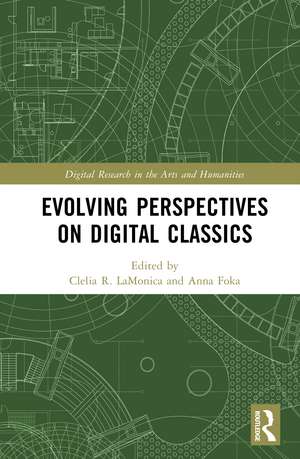
Evolving Perspectives on Digital Classics: Digital Research in the Arts and Humanities
Editat de Clelia R. LaMonica, Anna Fokaen Limba Engleză Hardback – 6 noi 2025
The volume includes contributions from Sweden, Norway, Greece, Italy, the US, the UK, and Australia and primarily examines ancient textual and material data that connect multiple disciplines, focusing on what researchers can do beyond rigid boundaries. Part I discusses annotating and describing ancient narratives and entities. Part II explores the digital representation and modelling of ancient spaces. Part III highlights computational and AI-driven literary analysis. Part IV focuses on philological methods in digital text analysis. Part V considers innovative applications in cultural and educational contexts.
Evolving Perspectives on Digital Classics demonstrates how digital methodologies can deepen understanding of the ancient world. The book encourages readers to adopt sound practices in data curation and analysis. It will appeal to scholars and students from a wide range of disciplines, including digital humanities, classics, philology, archaeology, and ancient history.
Din seria Digital Research in the Arts and Humanities
-
 Preț: 439.13 lei
 -
 Preț: 476.36 lei
 - 18%
 Preț: 1116.57 lei
 -
 Preț: 437.63 lei
 - 15%
 Preț: 435.45 lei
 - 15%
 Preț: 473.86 lei
 -
 Preț: 437.63 lei
 - 15%
 Preț: 466.30 lei
 -
 Preț: 405.86 lei
 -
 Preț: 436.93 lei
 - 15%
 Preț: 440.15 lei
 - 15%
 Preț: 439.07 lei
 - 18%
 Preț: 1115.87 lei
 -
 Preț: 431.77 lei
 - 15%
 Preț: 462.55 lei
 - 15%
 Preț: 456.99 lei
 -
 Preț: 436.23 lei
 -
 Preț: 435.13 lei
 -
 Preț: 363.71 lei
 - 18%
 Preț: 1118.30 lei
 -
 Preț: 375.71 lei
 -
 Preț: 416.66 lei
 - 18%
 Preț: 1112.48 lei
 - 18%
 Preț: 1116.77 lei
 - 18%
 Preț: 1111.68 lei
 -
 Preț: 416.15 lei
 - 18%
 Preț: 1112.48 lei
 - 18%
 Preț: 1252.93 lei
 -
 Preț: 414.25 lei
 -
 Preț: 464.72 lei
 - 18%
 Preț: 1251.67 lei
 - 18%
 Preț: 1003.12 lei
 - 18%
 Preț: 1115.12 lei
 -
 Preț: 417.45 lei
Preț: 1337.33 lei
Preț vechi: 1630.89 lei
-18%
Puncte Express: 2006
Carte tipărită la comandă
Livrare economică 19 noiembrie-03 decembrie
Livrare prin curier în România Termenul estimat este afișat lângă disponibilitate.
Transport gratuit pentru acest produs Plată online sau ramburs, în funcție de opțiunile comenzii.
Retur gratuit în 14 zile Comandă securizată și suport în română.
Specificații
ISBN-13: 9781032899824
ISBN-10: 1032899824
Pagini: 230
Ilustrații: 70
Dimensiuni: 156 x 234 x 17 mm
Greutate: 0.5 kg
Ediția:1
Editura: Taylor & Francis
Colecția Routledge
Seria Digital Research in the Arts and Humanities
Locul publicării:Oxford, United Kingdom
ISBN-10: 1032899824
Pagini: 230
Ilustrații: 70
Dimensiuni: 156 x 234 x 17 mm
Greutate: 0.5 kg
Ediția:1
Editura: Taylor & Francis
Colecția Routledge
Seria Digital Research in the Arts and Humanities
Locul publicării:Oxford, United Kingdom
V-ar putea interesa
-
 Classics: A Very Short IntroductionMary Beard-20%Preț: 55.96 lei70.24 lei
 -
 Virgil OperaRoger Mynors-25%Preț: 161.64 lei215.02 lei
 -
 Macroanalysis: Digital Methods and Literary HistoryMatthew L. Jockers-20%Preț: 663.49 lei829.36 lei
 -
 MeditationsMarcus AureliusPreț: 33.79 lei
 -
 Love, War, and DiplomacyEric H. ClinePreț: 253.71 lei
 -
 Preț: 379.65 leiRecomandat
 -
 A Cultural History of Ideas in Classical AntiquityClifford Ando-45%Preț: 397.20 lei721.20 lei
 -
 -22%Preț: 180.06 lei230.52 lei
 -
 Forms of the VisiblePhilippe DescolaPreț: 290.05 lei
 -
 Preț: 132.94 lei
 -
 Futures of Digital Scholarly EditingMatt CohenPreț: 199.43 lei
 -
 AlgospeakAdam AleksicPreț: 121.84 leiRecomandat
 -
 Cultural Data ScienceHarald Klinke-20%Preț: 578.38 lei722.97 lei
 -
 From Digital to Distant Diplomatics: Digital Diplomatics 2022Dr. Serena Ammirati-19%Preț: 494.92 lei611.01 lei
 -
 Preț: 216.03 lei
 -
 -18%Preț: 677.27 lei825.94 lei
 -
 Direct Speech in Greek and Latin Epic: Expanding the Methods and CanonChristopher Forstall-18%Preț: 658.17 lei802.65 lei
 -
 Brill’s Companion to Roman ProsopographyMarietta Horster-18%Preț: 854.20 lei1041.70 lei
Public țintă
Academic and PostgraduateCuprins
Introduction to Evolving Perspectives on Digital Classics: Innovation, Methodology, and the Ancient World; Part I Annotating and Describing Ancient Narratives and Entities; 1. Structuring the Sights and Stories of Pausanias with Wikidata; 2. SLaVEgents: Digital Prosopography of Enslaved Persons in Western Eurasia and North Africa (1000 BCE-300 CE); Part II Ancient Spaces; 3. The Data of Mythic Spaces; 4. From the Pillars of Heracles to Ecbatana: Digital Representation of Ancient Travel Narratives; Part III Computational and AI-Driven Literary Analysis; 5. Artificial Intelligence for Classical Literary Texts; 6. Stylometry for Latin Literary Criticism; Part IV Philological Methods in Digital Text Analysis; 7. Pretrained Word Vectors for Latin Philology; 8. Deciphering Ancient Scripts: Integrated, State-of-the-Art Approaches; Part V Innovative Applications in Culture and Education; 9. New Technologies for Learning and Teaching Ancient Greek and Latin; 10. Digital Art History, Digital Humanities, and Digital Classics: Finding the Missing Link
Notă biografică
Clelia R. LaMonica is Senior Lecturer at Uppsala University and a research affiliate at the Culture, Cognition, and Coevolution Lab at Harvard University. Her research interests include digital humanities, socio-linguistics, philology, and natural language processing.
Anna Foka is Professor of Digital Humanities and Founder and Director of the Centre for Digital Humanities at the Department of ALM (Archives, Library and Information Studies, Museum and Heritage Studies), at Uppsala University. Her research focuses on digital humanities, especially the use of AI and digital technologies in cultural heritage and historical collections. She explores intersections with classics, archaeology, and gender studies and is interested in concepts of sustainability, diversity, and the impact of digital methods and infrastructure on knowledge production in the humanities.
Anna Foka is Professor of Digital Humanities and Founder and Director of the Centre for Digital Humanities at the Department of ALM (Archives, Library and Information Studies, Museum and Heritage Studies), at Uppsala University. Her research focuses on digital humanities, especially the use of AI and digital technologies in cultural heritage and historical collections. She explores intersections with classics, archaeology, and gender studies and is interested in concepts of sustainability, diversity, and the impact of digital methods and infrastructure on knowledge production in the humanities.
Recenzii
"Evolving Perspectives in Digital Classics adopts a methodological perspective that allows the reader to grasp the processes and concepts involved in the production of a variety of digital tools that investigate Graeco-Roman Antiquity. The book aims to present to the public a collection of cutting-edge digital projects, to reflect on these projects, and to introduce various subfields of digital humanities, such as word vectors or Geographical Information Systems."
Camille Marrou, Bryn Mawr Classical Review
Camille Marrou, Bryn Mawr Classical Review
Descriere
Evolving Perspectives on Digital Classics contributes to a broader understanding of how digital humanities methods enhance classical studies. It offers an overview of current approaches and considers how new techniques can address diverse research questions.