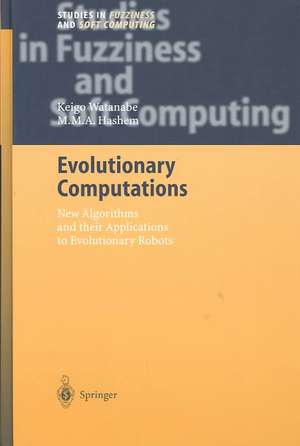
Evolutionary Computations: New Algorithms and their Applications to Evolutionary Robots: Studies in Fuzziness and Soft Computing, cartea 147
Autor Keigo Watanabe, M.M.A. Hashemen Limba Engleză Hardback – 5 mar 2004
Actualizarea adusă de Evolutionary Computations în cadrul prestigiosului flux de cercetare al editurii Springer constă în prezentarea și analizarea riguroasă a unor algoritmi evolutivi adaptați pentru controlul robotic complex, depășind limitările modelelor teoretice standard. Observăm o tranziție clară de la prezentarea generală a algoritmilor stocastici către dezvoltarea unor operatori de variație inovatori, structurați să răspundă nevoilor specifice din ingineria electronică și automatică.
Remarcăm organizarea progresivă a volumului, care debutează cu o revizuire critică a algoritmilor evolutivi existenți, punctând meritele și demeritele acestora, înainte de a introduce „Novel Evolution Strategy” (NES). Acest nou algoritm este piesa centrală a lucrării, autorii Keigo Watanabe și M.M.A. Hashem oferind nu doar fundamentul matematic, ci și dovezi ale performanței prin investigații empirice. Ca și Dipankar Dasgupta în Evolutionary Algorithms in Engineering Applications, autorii distilează experiența reală în principii acționabile, axându-se pe modul în care optimizarea poate fi aplicată în medii cu constrângeri tehnice severe.
Prin comparație cu Introduction to Evolutionary Computing de A. E. Eiben, care oferă o perspectivă didactică de ansamblu, lucrarea de față este un tratat specializat, o monografie ce explorează nișa roboților evolutivi. Apreciem în mod deosebit capitolul dedicat funcțiilor de fitness condiționate, esențial pentru orice proiect de cercetare care vizează implementarea algoritmilor în sisteme fizice unde siguranța și limitele operaționale sunt critice. Textul, deși dens și tehnic, rămâne accesibil cercetătorilor datorită clarității cu care sunt expuse mecanismele de bază și diferențele dintre variantele de algoritmi.
Din seria Studies in Fuzziness and Soft Computing
- 20%
 Preț: 967.66 lei
 - 20%
 Preț: 653.89 lei
 - 20%
 Preț: 627.77 lei
 - 20%
 Preț: 1002.81 lei
 - 20%
 Preț: 1014.25 lei
 - 20%
 Preț: 1004.51 lei
 - 20%
 Preț: 1118.28 lei
 - 18%
 Preț: 1011.71 lei
 - 20%
 Preț: 1009.84 lei
 - 20%
 Preț: 962.94 lei
 - 18%
 Preț: 917.09 lei
 - 20%
 Preț: 319.49 lei
 - 20%
 Preț: 335.46 lei
 - 20%
 Preț: 958.81 lei
 -
 Preț: 376.75 lei
 - 20%
 Preț: 624.97 lei
 - 20%
 Preț: 947.70 lei
 - 18%
 Preț: 921.36 lei
 - 20%
 Preț: 957.69 lei
 - 20%
 Preț: 960.53 lei
 - 15%
 Preț: 648.99 lei
 - 20%
 Preț: 654.35 lei
 - 20%
 Preț: 959.13 lei
 - 15%
 Preț: 643.28 lei
 - 20%
 Preț: 1012.49 lei
 - 20%
 Preț: 954.05 lei
 -
 Preț: 392.55 lei
 - 18%
 Preț: 1227.78 lei
 - 20%
 Preț: 626.25 lei
 - 18%
 Preț: 954.94 lei
Preț: 616.95 lei
Preț vechi: 725.82 lei
-15%
Carte tipărită la comandă
Livrare economică 16-30 noiembrie
Specificații
ISBN-10: 3540209018
Pagini: 192
Ilustrații: XIX, 172 p.
Dimensiuni: 155 x 235 x 16 mm
Greutate: 0.45 kg
Ediția:2004
Editura: Springer Berlin, Heidelberg
Colecția Springer
Seria Studies in Fuzziness and Soft Computing
Locul publicării:Berlin, Heidelberg, Germany
V-ar putea interesa
-
 PHP: The Complete ReferenceSteven Holzner-35%Preț: 319.39 lei493.20 lei
 -
 Introduction to Pattern Recognition: A Matlab ApproachSergios Theodoridis-30%Preț: 197.90 lei283.66 lei
 -
 The Oxford Handbook of Membrane ComputingGheorghe Paun-32%Preț: 867.54 lei1276.19 lei
 -
 Pulsed Neural NetworksWolfgang Maass-20%Preț: 393.58 lei491.97 lei
 -
 Turing (A Novel about Computation)Christos H. PapadimitriouPreț: 156.23 lei
 -
 Neural NetworksPhil Picton-11%Preț: 470.82 lei529.00 lei
 -
 Computer Graphics with JavaGlenn Rowe-20%Preț: 453.47 lei566.83 lei
 -
 -20%Preț: 730.40 lei913.00 lei
 -
 Practical Software TestingIlene Burnstein-20%Preț: 749.58 lei936.97 lei
 -
 -20%Preț: 609.87 lei762.34 lei
 -
 Modeling and Reasoning with Bayesian NetworksAdnan Darwiche-20%Preț: 866.04 lei1082.56 lei
 -
 Spiking Neuron ModelsWulfram Gerstner-19%Preț: 613.14 lei756.96 lei
 -
 Cloud Application ArchitecturesGeorge Reese-20%Preț: 137.04 lei171.31 lei
 -
 Virtual Private Networks for DummiesMark S Merkow-20%Preț: 179.49 lei224.35 lei
 -
 Gray Hat PythonJustin Seitz-38%Preț: 194.36 lei312.31 lei
 -
 Theoretical Computer ScienceJuraj Hromkovi¿-20%Preț: 631.60 lei789.50 lei
 -
 Formal Languages and ApplicationsCarlos Martin-Vide-18%Preț: 1195.93 lei1458.44 lei
 -
 DNA ComputingGheorghe Paun-20%Preț: 603.88 lei754.86 lei
Public țintă
ResearchDe ce să citești această carte
Această lucrare este esențială pentru inginerii de control și cercetătorii care doresc să implementeze strategii evolutive în robotică. Cititorul câștigă acces la un algoritm nou, NES, optimizat pentru probleme cu constrângeri multiple. Este o resursă practică ce transformă teoria algoritmilor genetici în soluții viabile pentru automatizarea industrială și designul de controlere robotice complexe.