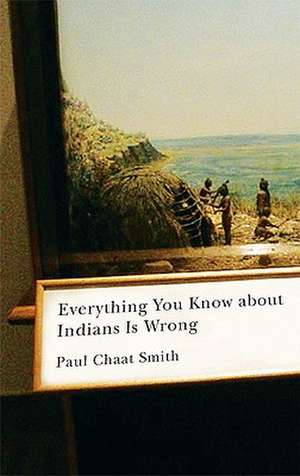
Everything You Know about Indians Is Wrong: Indigenous Americas
Autor Paul Chaat Smithen Limba Engleză Hardback – 14 apr 2009
În cadrul programelor de studii etnice și sociologie, volumul Everything You Know about Indians Is Wrong ocupă un loc central prin modul în care deconstruiește miturile fondatoare despre populațiile indigene din America de Nord. Publicată sub egida University of Minnesota Press în seria Indigenous Americas, lucrarea semnată de Paul Chaat Smith propune o analiză critică a „afacerii indiene”, pendulând între experiența personală a activistului din anii '70 și perspectiva oficială a curatorului de la Smithsonian. Considerăm că forța acestui volum rezidă în onestitatea brutală cu care autorul examinează modul în care popoarele native sunt transformate în simboluri de consum sau figuri tragice în media americană.
Structura eseistică ne permite să urmărim evoluția unei identități construite la intersecția dintre suburbia americană și radicalismul politic. Prin eseuri precum „Lost in Translation”, Smith explică de ce reprezentările contemporane eșuează constant în a captura realitatea indigenă, descriind cu ironie limitările televiziunii și ale discursului public. Cititorii familiarizați cu Do All Indians Live in Tipis? Second Edition vor aprecia modul în care volumul de față trece dincolo de simpla demontare a miturilor, oferind o perspectivă mult mai personală și nuanțată asupra eșecurilor bunelor intenții instituționale. Față de American Indians and the American Imaginary, care adoptă o metodă etnografică riguroasă, Smith alege un stil direct, adesea sardonic, care prioritizează experiența trăită în fața teoriei academice pure.
Această lucrare completează proiectul intelectual al autorului început cu Like a Hurricane, unde documenta luptele politice ale nativilor americani, și continuat în Officially Indian, unde analiza iconografia națională. Apreciem aici capacitatea lui Smith de a transforma critica culturală într-o pledoarie pentru complexitate, refuzând soluțiile simpliste în favoarea unei înțelegeri profunde a istoriei disputate.
Din seria Indigenous Americas
-
 Preț: 104.42 lei
 -
 Preț: 175.85 lei
 -
 Preț: 181.97 lei
 -
 Preț: 160.17 lei
 -
 Preț: 111.43 lei
 -
 Preț: 210.03 lei
 -
 Preț: 190.59 lei
 -
 Preț: 114.65 lei
 -
 Preț: 178.37 lei
 -
 Preț: 219.24 lei
 -
 Preț: 194.11 lei
 -
 Preț: 279.83 lei
 -
 Preț: 199.77 lei
 -
 Preț: 147.89 lei
 -
 Preț: 184.57 lei
 -
 Preț: 223.94 lei
 -
 Preț: 212.35 lei
 -
 Preț: 212.81 lei
 -
 Preț: 200.85 lei
 -
 Preț: 182.86 lei
 - 21%
 Preț: 134.55 lei
 - nou
 Preț: 149.05 lei
 -
 Preț: 154.50 lei
 - 11%
 Preț: 635.46 lei
 - 11%
 Preț: 693.02 lei
 -
 Preț: 169.92 lei
Preț: 121.13 lei
Carte disponibilă
Livrare economică 09-23 noiembrie
Livrare express 23-29 octombrie pentru 54.05 lei
Specificații
ISBN-10: 0816656010
Pagini: 192
Ilustrații: 16 b&w, 6 color photos
Dimensiuni: 137 x 216 x 25 mm
Greutate: 0.37 kg
Ediția:1
Editura: University of Minnesota Press
Colecția Univ Of Minnesota Press
Seria Indigenous Americas
De ce să citești această carte
Recomandăm această carte studenților și profesioniștilor din domeniul studiilor culturale care caută o perspectivă autentică, din interior, asupra identității indigene. Cititorul câștigă o înțelegere clară a modului în care cultura populară modelează percepția istorică. Este o lectură esențială pentru oricine dorește să depășească clișeele despre „indianul american” și să înțeleagă complexitatea politică și socială a acestei comunități în secolul XXI, explicată cu inteligență și umor sec.
Despre autor
Paul Chaat Smith este un critic cultural proeminent și curator la Muzeul Național al Indianului American din cadrul Institutului Smithsonian. Cu o experiență vastă care pornește de la activismul politic din cadrul Mișcării Indianului American în anii 1970, Smith a devenit una dintre cele mai respectate voci în analiza reprezentării vizuale și istorice a popoarelor native. Opera sa, care include titluri precum Like a Hurricane și Officially Indian, explorează constant tensiunea dintre identitatea indigenă și narațiunile naționale americane, aducând în prim-plan istorii adesea ignorate sau distorsionate.
Descriere scurtă
In this sweeping work of memoir and commentary, leading cultural critic Paul Chaat Smith illustrates with dry wit and brutal honesty the contradictions of life in “the Indian business.”
Raised in suburban Maryland and Oklahoma, Smith dove head first into the political radicalism of the 1970s, working with the American Indian Movement until it dissolved into dysfunction and infighting. Afterward he lived in New York, the city of choice for political exiles, and eventually arrived in Washington, D.C., at the newly minted National Museum of the American Indian (“a bad idea whose time has come”) as a curator. In his journey from fighting activist to federal employee, Smith tells us he has discovered at least two things: there is no one true representation of the American Indian experience, and even the best intentions sometimes result in catastrophe.
Everything You Know about Indians Is Wrong is a highly entertaining and, at times, searing critique of the deeply disputed role of American Indians in the United States. In “A Place Called Irony,” Smith whizzes through his early life, showing us the ironic pop culture signposts that marked this Native American’s coming of age in suburbia: “We would order Chinese food and slap a favorite video into the machine—the Grammy Awards or a Reagan press conference—and argue about Cyndi Lauper or who should coach the Knicks.” In “Lost in Translation,” Smith explores why American Indians are so often misunderstood and misrepresented in today’s media: “We’re lousy television.” In “Every Picture Tells a Story,” Smith remembers his Comanche grandfather as he muses on the images of American Indians as “a half-remembered presence, both comforting and dangerous, lurking just below the surface.”
Smith walks this tightrope between comforting and dangerous, offering unrepentant skepticism and, ultimately, empathy. “This book is called Everything You Know about Indians Is Wrong, but it’s a book title, folks, not to be taken literally. Of course I don’t mean everything, just most things. And ‘you’ really means we, as in all of us.”
Notă biografică
Recenzii
"After reading Everything You Know about Indians is Wrong by Paul Chaat Smith, I said, ‘A clever connect!’ Wounded Knee Massacre—winning of the West! Movies, an American past time—all that Indian land stolen—all those Indians killed! Celebrating liars, thieves, killers—a literal cultural force? Just to make movies? I then re-read a passage where Smith refers to Indigenous artists at Venice Biennale: ‘This symposium won’t be measured by how many Indians are in Venice. It will be measured by something much harder to quantify. What matters is . . . whether we can build new understandings of what it means to be human in the twenty-first century. It isn’t about us talking and you listening; it’s about an engagement that moves our collective understanding forward.’ Truly, that’s what will acknowledge, validate, and confirm our Existence as Indigenous peoples. And this may even help us to rethink the word-concept of ‘Indian.’ Smith’s very articulate book is highly recommended!"—Simon J. Ortiz, author of Out There Somewhere and Woven Stone
"Amusing and enlightening."—Publishers Weekly
"With acerbic wit and unflinching honesty, social critic Smith offers a collection of essays that were written over approximately a 15-year period. It is an eclectic collection that chronicles the evolution of his views on the politics of being a Native American, beginning with his obvious naivete as a committed activist within the American Indian Movement to his present employment with the federal government. No target is safe from his pointed barbs, not even himself. The explanation of how quickly his views toward the creation of the National Museum of the American Indian changed when the practicality of needing employment entered the equation is alone worth the price of the book. In addition to being an entertaining read, this book gives one much to consider as Smith challenges many of the tropes that too many authors utilize when writing about native peoples."—Library Journal
"While making sometimes heartening and at other times unsettling critical observations on conditions surrounding American Indians in historical and modern contexts, [Smith] conveys his observations in a casual, frequently funny and smart conversational form. Reading the book is almost like listening to a well seasoned, somewhat cynical old friend talking about something for which he deeply cares."—Win Awenen Nisototung
"In this rigorously insightful collection of essays written between 1992 to 2008, Smith, a wry, sharp-edged cultural critic, and associate curator for the National Museum of the American Indian, addresses the myriad ironic complexities of American Indian reality."—Washington Post
"Within Everything You Know about Indians Is Wrong . . . is a call to native artists to refuse to play the invented romantic, mythological and other clichéd roles assigned to them by others, and to demand ‘honesty in their own work and that of others that truly honors the outrageous story of our continued existence.’"—Washington Post
"It’s a very entertaining read; while it does critique at times the (often) disputed role Indians have had in the U.S., it also explores with dry wit and humor how today’s media portrays ‘the noble savage.’ The book walks the line between skepticism and empathy, and at the end the reader has to admit that the book title is indeed, accurate."—WeLoveDC.com
"The book is a nice, wild ride on Smith’s stream of consciousness as he shares his stories of an aching, but thankful heart."—Cherokee One Feather
"Everything You Know about Indians Is Wrong, a satisfyingly complex book by Paul Chaat Smith, who maintains that although we are considered somehow primitive and simple we are actually oceans of terrifying complexity. And this book, too, is so complicated that I found my emotions were all mixed up. Irony, laughter, rage, weariness. A mixture—a complex character trait but as one of my character flaws is a vague obscurity I appreciated the harsh wit and intelligence in these essays. A recommendation with many stars after it."—Louise Erdrich, Birchbark Books Blog
"This book achieves a balancing act that will be the envy of Indigenous authors, myself among them. Its articulate demonstration of the utter absurdities, past and present, of the culturally embedded representations of Native Americans charms rather than alienates its (non-Indigenous) audience. . . . His expose uses razor sharp observations, clarity of language, self-deprecating authorial tone and clever juxtapositions of humour and tragedy to blunt the power to take umbrage as a dismissive response. The book makes its searing critique engaging and irrefutable."—International Journal of Critical Indigenous Studies
"His lively prose, which shifts from the scholarly to the colloquial (sometimes within the same paragraph), and his insistent engagement with and awareness of his audience make this a compelling and vibrant collection of essays that should find a broad reading audience."—Sarita Cannon, Neomaricanist
"Smith provides an engaging and direct commentary about the experiences and history of Native Americans."—Multicultural Review
"If Paul Chaat Smith ever needs another job—he’s currently a curator at the National Museum of the American Indian at the Smithsonian‚ he would make an excellent stand-up comic. Unexpectedly, his latest book, Everything You Know about Indians Is Wrong, is a funny and painful collection of essays about a deeply serious subject: the ways in which Indian stereotypes infiltrate culture, damaging Indians and Non-Indians alike."—High Country News
"It’s lucky for us that Smith, a Comache born in West Texas, refuses to shut up. His insights on film are sharp and startling."—High Country News