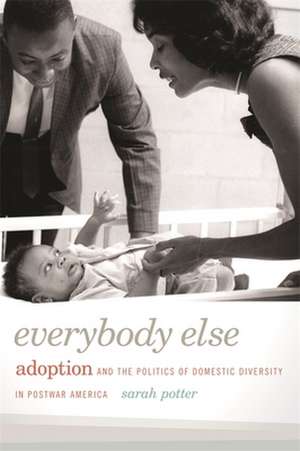
Everybody Else: Adoption and the Politics of Domestic Diversity in Postwar America
Autor Sarah Potteren Limba Engleză Hardback – 28 feb 2014
Preț: 707.23 lei
Preț vechi: 968.80 lei
-27%
Puncte Express: 1061
Carte tipărită la comandă
Livrare economică 16-30 noiembrie
Livrare prin curier în România Termenul estimat este afișat lângă disponibilitate.
Transport gratuit pentru acest produs Plată online sau ramburs, în funcție de opțiunile comenzii.
Retur gratuit în 14 zile Comandă securizată și suport în română.
Specificații
ISBN-13: 9780820344157
ISBN-10: 082034415X
Pagini: 254
Dimensiuni: 152 x 229 x 19 mm
Greutate: 0.56 kg
Editura: University of Georgia Press
ISBN-10: 082034415X
Pagini: 254
Dimensiuni: 152 x 229 x 19 mm
Greutate: 0.56 kg
Editura: University of Georgia Press
V-ar putea interesa
-
 -21%Preț: 76.97 lei97.95 lei
 -
 The Purchase of IntimacyViviana A. ZelizerPreț: 278.33 lei
 -
 Preț: 152.18 lei
 -
 Mister Rogers' PlaytimeFred RogersPreț: 115.06 lei
 -
 The Wonder of BoysKaren HenrichPreț: 132.01 lei
 -
 -24%Preț: 244.89 lei323.29 lei
 -
 -25%Preț: 180.29 lei241.62 lei
Textul de pe ultima copertă
In the popular imagination, the twenty years after World War II are associated with simpler, happier, more family-focused living. We think of stereotypical baby boom families like the Cleavers: white, suburban, and well on their way to middle-class affluence. For these couples and their children, a happy, stable family life provided an antidote to the anxieties and uncertainties of the emerging nuclear age.
But not everyone looked or lived like the Cleavers. For those who could not have children, or have as many children as they wanted, the postwar baby boom proved a source of social stigma and personal pain. Further, in 1950 roughly one in three Americans made below middle-class incomes, and over fifteen million lived under Jim Crow segregation. For these individuals, home life was not an oasis but a challenge, intimately connected to the era s many political and social upheavals.
Everybody Else by Sarah Potter provides a comparative analysis of diverse postwar families and examines the lives and case records of men and women who applied to adopt or provide pre-adoptive foster care in the 1940s and 1950s. It considers an array of individuals both black and white, middle and working class who found themselves on the margins of a social world that privileged family membership. These couples wanted adoptive and foster children to achieve a sense of personal mission and meaning, as well as a deeper feeling of belonging to their communities. But their quest for parenthood also highlighted the many inequities of that era. These individuals experiences seeking children reveal that the baby boom family was about much more than togetherness or a quiet house in the suburbs; it also shaped people s ideas about the promises and perils of getting ahead in postwar America.
"Broadly conceived, imaginatively researched, and eminently readable, Everybody Else provides a new narrative about 'family values' that highlights the aspirations of ordinary men and women, black and white, middle and working class, who found in children a motivating force for civic engagement, self-fulfillment, and racial justice. In providing a deep social history of the subjective embrace of children by couples without any or enough, Sarah Potter underscores how domesticity is never merely private but imbricated in larger social and cultural structures."
Eileen Boris, coauthor of Caring for America
SARAH POTTER is assistant professor of history at the University of Memphis.
Cover design:
Cover photo:
Author photo: Rhonda Cosentino, University of Memphis
The University of Georgia Press
Athens, Georgia 30602
www.ugapress.org
ISBN 978-0-8203-4416-4"
But not everyone looked or lived like the Cleavers. For those who could not have children, or have as many children as they wanted, the postwar baby boom proved a source of social stigma and personal pain. Further, in 1950 roughly one in three Americans made below middle-class incomes, and over fifteen million lived under Jim Crow segregation. For these individuals, home life was not an oasis but a challenge, intimately connected to the era s many political and social upheavals.
Everybody Else by Sarah Potter provides a comparative analysis of diverse postwar families and examines the lives and case records of men and women who applied to adopt or provide pre-adoptive foster care in the 1940s and 1950s. It considers an array of individuals both black and white, middle and working class who found themselves on the margins of a social world that privileged family membership. These couples wanted adoptive and foster children to achieve a sense of personal mission and meaning, as well as a deeper feeling of belonging to their communities. But their quest for parenthood also highlighted the many inequities of that era. These individuals experiences seeking children reveal that the baby boom family was about much more than togetherness or a quiet house in the suburbs; it also shaped people s ideas about the promises and perils of getting ahead in postwar America.
"Broadly conceived, imaginatively researched, and eminently readable, Everybody Else provides a new narrative about 'family values' that highlights the aspirations of ordinary men and women, black and white, middle and working class, who found in children a motivating force for civic engagement, self-fulfillment, and racial justice. In providing a deep social history of the subjective embrace of children by couples without any or enough, Sarah Potter underscores how domesticity is never merely private but imbricated in larger social and cultural structures."
Eileen Boris, coauthor of Caring for America
SARAH POTTER is assistant professor of history at the University of Memphis.
Cover design:
Cover photo:
Author photo: Rhonda Cosentino, University of Memphis
The University of Georgia Press
Athens, Georgia 30602
www.ugapress.org
ISBN 978-0-8203-4416-4"