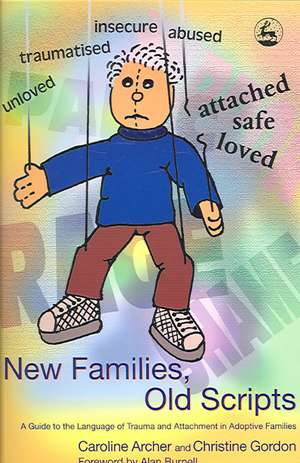
New Families, Old Scripts: A Guide to the Language of Trauma and Attachment in Adoptive Families
Autor Caroline Archeren Limba Engleză Paperback – 8 feb 2006
New Families, Old Scripts is an accessible introduction to understanding these challenges and helping children and their families to develop a shared language and understanding of one another. Steeped in the experience of the authors, the book offers a wealth of practical guidance and intervention in a no-nonsense style that will be readily understandable to both families and the professionals who work with them. Case examples bring the issues to life, while sample letters addressed to the parent offer sensitive, jargon-free advice on the issues they are likely to encounter - whether it be dealing with anger and aggression, understanding sibling issues or how to react to sexualised behaviour. The authors also explain some of the theoretical background to trauma to encourage a better understanding of the relationship between trauma, attachment and development.
The accessible combination of theoretical approaches and practical advice makes New Families, Old Scripts an ideal resource for social workers and adoptive or foster parents.
Family Futures Consortium provides services for parents and professionals working with adopted and fostered children, including training and consultation for statutory and voluntary agencies nationwide. In their therapeutic work with families, they have evolved a unique intensive, multi-disciplinary approach to supporting children with attachment and trauma-related difficulties.
Preț: 180.29 lei
Preț vechi: 241.62 lei
-25%
Puncte Express: 270
Carte disponibilă
Livrare economică 16-30 noiembrie
Livrare prin curier în România Termenul estimat este afișat lângă disponibilitate.
Transport gratuit de la 400.00 lei Plată online sau ramburs, în funcție de opțiunile comenzii.
Retur gratuit în 14 zile Comandă securizată și suport în română.
Specificații
ISBN-13: 9781843102588
ISBN-10: 1843102587
Pagini: 256
Dimensiuni: 163 x 234 x 19 mm
Greutate: 0.39 kg
Ediția:New.
Editura: JESSICA KINGSLEY PUBLISHERS
Colecția Jessica Kingsley Publishers
Locul publicării:London, United Kingdom
ISBN-10: 1843102587
Pagini: 256
Dimensiuni: 163 x 234 x 19 mm
Greutate: 0.39 kg
Ediția:New.
Editura: JESSICA KINGSLEY PUBLISHERS
Colecția Jessica Kingsley Publishers
Locul publicării:London, United Kingdom
V-ar putea interesa
-
 NctPenney HamesPreț: 46.75 lei
 -
 -27%Preț: 479.44 lei660.43 lei
 -
 The Family Systems Test (FAST): Theory and ApplicationThomas M. Gehring-5%Preț: 1174.31 lei1236.12 lei
 -
 Preț: 490.93 lei
 -
 The Phaidon Archive of Graphic DesignNick Bell-12%Preț: 1101.74 lei1254.13 lei
 -
 -35%Preț: 541.08 lei835.73 lei
 -
 Taking Parenting Public: The Case for a New Social MovementSylvia Ann Hewlett-19%Preț: 315.93 lei389.85 lei
 -
 The Hidden World of RelationshipsJudith TurnerPreț: 151.78 lei
 -
 The End of HomeworkEtta KralovecPreț: 152.34 lei
 -
 Depressed ChildDougals A. RileyPreț: 125.72 lei
 -
 Virtual ForeplayEve Eschner HoganPreț: 82.40 lei
 -
 Being in Charge: Reflective Leadership in Infant/Family ProgramsRebecca ParlakianPreț: 65.52 lei
 -
 Culture, Creation, and ProcreationMonika BöckPreț: 272.01 lei
 -
 -5%Preț: 385.81 lei406.12 lei
 -
 Preț: 268.22 lei
 -
 -26%Preț: 224.04 lei303.51 lei
 -
 -19%Preț: 132.73 lei164.84 lei
 -
 -25%Preț: 205.88 lei274.36 lei
 -
 -20%Preț: 132.09 lei165.13 lei
 -
 Next Steps in Parenting the Child Who Hurts: Tykes and TeensCaroline Archer-19%Preț: 136.04 lei167.49 lei
Recenzii
Aimed at adoptive parents and the professionals who support them, this handbook describes the lasting effects of early maltreatment, separations, and losses on children's development. Case studies illustrate some of the behavioural challenges commonly faced by parents who adopt older children. To facilitate quick reference, the volume is organized alphabetically by topic. Some of the issues addressed include aggressive behaviour, dissociative states, emotional outburst, sibling rivalry and sexualized behaviour.
This book is designed for direct use with children and their adoptive parents, as well as a resource for working with wider family members, social workers and other professionals involved with adoptive children and families. The authors are both well known for their work in this field and bring credibility and knowledge to their writing.
Practitioners in the after adoption field will find this book valuable in a number of ways, as will those working with adopters at any stage in the process, or indeed anyone coming new to this area of work. The authors convey a strong sense of what it feels like to parent a child who has been traumatised and had difficult and poor attachment experiences.
I would encourage everyone to approach this as a helpful and thought provoking addition to their toolkit and to reflect on where it challenges and where it adds insight and practical tools.
This is a book to help children manage their feelings, make sense of their behaviour and help them reconnect in new families with a calm , quiet, voice and gentle touch. It reminds all parents that with understanding commitment and support young people can find a way of understanding `all of themselves' and learn to integrate their relationships with the world.
This book is designed for direct use with children and their adoptive parents, as well as a resource for working with wider family members, social workers and other professionals involved with adoptive children and families. The authors are both well known for their work in this field and bring credibility and knowledge to their writing.
Practitioners in the after adoption field will find this book valuable in a number of ways, as will those working with adopters at any stage in the process, or indeed anyone coming new to this area of work. The authors convey a strong sense of what it feels like to parent a child who has been traumatised and had difficult and poor attachment experiences.
I would encourage everyone to approach this as a helpful and thought provoking addition to their toolkit and to reflect on where it challenges and where it adds insight and practical tools.
This is a book to help children manage their feelings, make sense of their behaviour and help them reconnect in new families with a calm , quiet, voice and gentle touch. It reminds all parents that with understanding commitment and support young people can find a way of understanding `all of themselves' and learn to integrate their relationships with the world.
Cuprins
Foreword by Alan Burnell, Family Futures. Introduction. Thumbnail sketches. Alphabet of Issues. 1. Accent on change. 2. Aggressive and angry behaviour. 3. Attention seeking/ needing. 4. Basic building blocks of the brain. 5. Bedtime and sleep. 6. Cracking the code. 7. Control issues. 8. Cradling for closeness and comfort. 9. Critical connections. 10. Dealing with danger. 11. Dissociative connections. 12. Dissociative states. 13. Eating and food issues. 14. Emotional outbursts. 15. F is for feelings. 16. F1 kids. 17. Games to encourage attachment. 18. Good child (am I being good enough?) 19. Impact on parents. 20. Looking after yourself. 21. Managing separations. 22. `NO'. 23. Nutrition. 24. Putting it all behind us. 25. Puzzling pain responses. 26. Reassurance or validation. 27. Rivalry between siblings. 28. Rudeness and swearing. 29. Self-regulation. 30. Sensory issues. 31. Sexualised behaviour. 32. Taking, borrowing or stealing. 33. Terrible shame. 34. Think toddler think (T3). 35. What not to do! 36. Your way forward - final reflections. 37. References. Resources and related reading. Index.