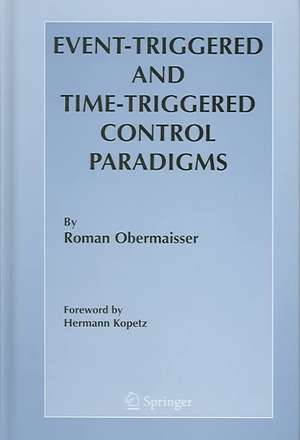
Event-Triggered and Time-Triggered Control Paradigms: Real-Time Systems Series, cartea 22
Autor Roman Obermaisseren Limba Engleză Hardback – 29 sep 2004
Event-Triggered and Time-Triggered Control Paradigms offers significant insights into the architecture and design of integrated embedded systems, both at the conceptual and at the practical level.
Preț: 622.97 lei
Preț vechi: 778.71 lei
-20%
Puncte Express: 934
Carte tipărită la comandă
Livrare economică 06-20 iunie
Specificații
ISBN-13: 9780387230436
ISBN-10: 0387230432
Pagini: 164
Ilustrații: X, 153 p. 46 illus.
Dimensiuni: 160 x 241 x 14 mm
Greutate: 0.42 kg
Ediția:2005
Editura: Springer
Colecția Real-Time Systems Series
Seria Real-Time Systems Series
Locul publicării:New York, NY, United States
ISBN-10: 0387230432
Pagini: 164
Ilustrații: X, 153 p. 46 illus.
Dimensiuni: 160 x 241 x 14 mm
Greutate: 0.42 kg
Ediția:2005
Editura: Springer
Colecția Real-Time Systems Series
Seria Real-Time Systems Series
Locul publicării:New York, NY, United States
V-ar putea interesa
-
 -9%Preț: 350.48 lei385.15 lei
 -
 -34%Preț: 167.01 lei251.65 lei
 -
 Handbook of Hybrid Systems ControlJan Lunze-20%Preț: 890.72 lei1113.40 lei
 -
 Fundamentals of Object TrackingSubhash Challa-11%Preț: 681.40 lei765.61 lei
 -
 Beginning Arduino ProgrammingBrian EvansPreț: 342.44 lei
 -
 Engineering Systems Integration: Theory, Metrics, and MethodsGary O. Langford-20%Preț: 1264.38 lei1580.47 lei
 -
 Make: Arduino Bots and GadgetsTero KarvinenPreț: 202.45 lei
 -
 Geometric Methods and ApplicationsJean Gallier-15%Preț: 526.26 lei619.14 lei
 -
 Model Predictive ControlEduardo F. Camacho-15%Preț: 497.15 lei584.88 lei
 -
 Mechatronic SystemsRolf Isermann-15%Preț: 582.71 lei685.54 lei
 -
 BTEC First EngineeringMike Tooley-8%Preț: 413.95 lei449.95 lei
 -
 Logistik-Wörterbuch. Dictionary of LogisticsVanessa Scott-Sabic-18%Preț: 756.35 lei922.38 lei
 -
 Automotive Mechatronics: Operational and Practical Issues: Volume IIB. T. Fijalkowski-18%Preț: 1180.51 lei1439.64 lei
Public țintă
ResearchCuprins
Basic Concepts and Related Work.- Requirements of an Integrated Architecture.- Integrated System Architecture for Event-Triggered and Time-Triggered Control Paradigms.- Controller Area Network Emulation in the Time-Triggered Architecture.- Results and Validation.- Conclusion.
Textul de pe ultima copertă
Event-Triggered and Time-Triggered Control Paradigms presents a valuable survey about existing architectures for safety-critical applications and discusses the issues that must be considered when moving from a federated to an integrated architecture. The book focuses on one key topic--the amalgamation of the event-triggered and the time-triggered control paradigm into a coherent integrated architecture. The architecture provides for the integration of independent distributed application subsystems by introducing multi-criticality nodes and virtual networks of known temporal properties.
Caracteristici
No other books on this topic Applicable to industry as well as researchers Includes supplementary material: sn.pub/extras