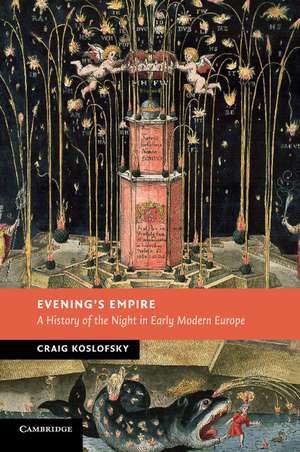
Evening's Empire: A History of the Night in Early Modern Europe: New Studies in European History
Autor Craig Koslofskyen Limba Engleză Paperback – 29 iun 2011
Ceea ce aduce nou Evening's Empire în peisajul istoriografiei europene este mutarea atenției de la evenimentele diurne către o sferă adesea ignorată: noaptea ca spațiu de transformare socială și politică. Reținem că această lucrare nu este doar o cronică a tehnologiei iluminatului, ci o analiză profundă a modului în care europenii din perioada modernă timpurie au început să „nocturnalizeze” expresia politică și timpul cotidian. Autorul Craig Koslofsky demonstrează cum frica ancestrală de întuneric, asociată în perioada 1450–1650 cu forțele malefice, a făcut loc treptat unei nopți moderne, utilizate pentru muncă, recreere și dezbatere publică.
Cititorii familiarizați cu Nights in the Big City de Joachim Schlör vor aprecia modul în care Craig Koslofsky extinde perspectiva cronologică, mergând dincolo de secolul al XIX-lea pentru a identifica rădăcinile acestei revoluții urbane în Reformă și Iluminism. Structura volumului este una progresivă: începe cu dimensiunea religioasă a întunericului, trece prin ritualurile nocturne de la curțile princiare și culminează cu apariția iluminatului stradal între 1660 și 1700. Credem că este fascinant modul în care autorul conectează noaptea de teme precum genul, colonizarea și rezistența socială, arătând că ocuparea spațiului nocturn a fost, în esență, un act de putere. Prin utilizarea unor surse inedite, de la dosare de vrăjitorie la jurnale intime, lucrarea oferă o perspectivă proaspătă asupra modului în care noaptea a devenit o frontieră a modernității, transformând definitiv ritmul vieții umane.
Din seria New Studies in European History
- 14%
 Preț: 774.28 lei
 - 11%
 Preț: 522.95 lei
 - 14%
 Preț: 662.13 lei
 -
 Preț: 346.00 lei
 -
 Preț: 407.65 lei
 -
 Preț: 290.44 lei
 -
 Preț: 337.06 lei
 -
 Preț: 407.25 lei
 -
 Preț: 247.73 lei
 -
 Preț: 430.32 lei
 -
 Preț: 407.45 lei
 -
 Preț: 427.02 lei
 -
 Preț: 446.42 lei
 -
 Preț: 388.56 lei
 -
 Preț: 345.41 lei
 - 14%
 Preț: 1055.48 lei
 - 14%
 Preț: 726.41 lei
 -
 Preț: 333.90 lei
 -
 Preț: 402.82 lei
 -
 Preț: 439.46 lei
 - 11%
 Preț: 669.05 lei
 -
 Preț: 410.59 lei
 - 11%
 Preț: 671.53 lei
 -
 Preț: 283.77 lei
 -
 Preț: 427.92 lei
 -
 Preț: 432.81 lei
 - 14%
 Preț: 839.80 lei
 -
 Preț: 428.56 lei
 - 14%
 Preț: 685.44 lei
 -
 Preț: 300.73 lei
 - 14%
 Preț: 687.82 lei
Preț: 213.44 lei
Carte disponibilă
Livrare economică 12-26 iunie
Specificații
ISBN-10: 0521721067
Pagini: 448
Ilustrații: 36 b/w illus. 2 maps
Dimensiuni: 152 x 228 x 21 mm
Greutate: 0.7 kg
Editura: Cambridge University Press
Colecția Cambridge University Press
Seria New Studies in European History
Locul publicării:Cambridge, United Kingdom
V-ar putea interesa
-
 Queen AnneAnne SomersetPreț: 121.88 lei
 -
 CyberpsychologyAlison Attrill-18%Preț: 358.60 lei435.83 lei
 -
 The Oxford Handbook of the History of NationalismJohn Breuilly-24%Preț: 298.47 lei392.09 lei
 -
 Literature and the Great War 1914-1918Randall Stevenson-9%Preț: 271.82 lei300.27 lei
 -
 Introduction to General Relativity, Black Holes, and CosmologyYvonne Choquet-Bruhat-12%Preț: 315.91 lei358.25 lei
 -
 A People of One Book: The Bible and the VictoriansTimothy Larsen-5%Preț: 269.74 lei284.46 lei
 -
 Quantitative Genetics in the WildAnne Charmantier-22%Preț: 527.76 lei679.61 lei
 -
 Animal Social NetworksJens Krause-22%Preț: 462.40 lei594.80 lei
 -
 Europe Isn't WorkingLarry ElliottPreț: 80.40 lei
 -
 The Last Great FrenchmanCharles WilliamsPreț: 154.40 lei
 -
 Pietism and the Making of Eighteenth-Century PrussiaRichard L. GawthropPreț: 344.52 lei
 -
 -8%Preț: 437.05 lei475.06 lei
 -
 The Dynasty of Chernigov, 1146–1246Martin DimnikPreț: 446.38 lei
 -
 Rebuilding Germany: The Creation of the Social Market Economy, 1945–1957James C. Van HookPreț: 297.62 lei
 -
 Mass Oratory and Political Power in the Late Roman RepublicRobert Morstein-MarxPreț: 345.84 lei
 -
 Prince A. M. Kurbsky's History of Ivan IVJ. L. I. FennellPreț: 319.03 lei
 -
 Louis XV and the Parlement of Paris, 1737–55John RogisterPreț: 326.61 lei
 -
 Preț: 314.32 lei
 -
 She-WolvesHelen CastorPreț: 93.84 lei
 -
 Russia and the RussiansGeoffrey Hosking-19%Preț: 107.00 lei132.28 lei
 -
 -28%Preț: 66.69 lei92.15 lei
 -
 The Balfour Declaration: The Origins of the Arab-Israeli ConflictJonathan Schneer-27%Preț: 88.23 lei121.15 lei
 -
 Coming Up Trumps: A MemoirJean Trumpington-34%Preț: 40.83 lei62.16 lei
 -
 Preț: 361.73 lei
De ce să citești această carte
Recomandăm această carte cercetătorilor și studenților la istorie care doresc să înțeleagă rădăcinile culturale ale stilului nostru de viață modern. Cititorul câștigă o perspectivă unică asupra modului în care noaptea a încetat să mai fie un teritoriu al fricii, devenind un spațiu al libertății și inovației. Este o lectură esențială pentru a vedea cum iluminatul public și schimbările de mentalitate au remodelat orașele europene.
Despre autor
Craig Koslofsky este profesor asociat în cadrul Departamentului de Istorie de la University of Illinois, Urbana-Champaign. Specializat în istoria Europei moderne timpurii, cercetările sale se concentrează pe intersecția dintre viața cotidiană, ritual și transformările sociale. Printre publicațiile sale anterioare se numără „The Reformation of the Dead: Death and Ritual in Early Modern Germany” (2001), o lucrare care, la fel ca Evening's Empire, explorează modul în care schimbările religioase și culturale au influențat experiența umană fundamentală în spațiul germanic și european.
Descriere scurtă
Cuprins
Recenzii
'Koslofsky plays skilfully with the oppositions of light and darkness, day and night, to reveal dramatic changes in both the social and the symbolic worlds of early modern Europeans. This is a sensitive and [thought-provoking] synoptic study, of very great interest for all students of European society, thought, and culture.' Robin Briggs, University of Oxford
'Evening's Empire is a remarkable foray into a long-neglected dimension of early modern history: Europe's conquest of darkness and night time. Craig Koslofsky convincingly proves that the transition to modernity and the emergence of the public sphere cannot be fully understood without taking the 'colonization' of night into account. An enlightening study, in every way.' Carlos M. N. Eire, Yale University
'Ambitious … a valuable study, and a genuinely supranational one, of the way in which nightlife in the modern sense was created, as the essentially urban phenomenon it remains. It was, as the author clearly shows, one expression of the increasing self-confidence and aggression of early modern European humanity.' Ronald Hutton, The Times Higher Education Supplement
'Sometimes the most obvious and important historical subjects are among the least explored … Craig Koslofsky's thoughtful and imaginative study of the experience of the night for early modern people goes some way towards redressing that balance. It is, in a word, enlightening.' Literary Review
'Craig Koslofsky has given so much in this consistently stimulating, cogently argued and elegantly written book.' Tim Blanning, The Times Literary Supplement
'This is a tremendous read, full of human stories and suggestive argument. Like many of the best history books it makes one pause for thought not only about the past but about the present too.' BBC History Magazine
'Evening's Empire offers a fertile and richly European account of deep and sometimes unexpected cultural associations … This is a valuable contribution to the history of the everyday and, especially, of the experience of temporality.' History Today
'Any book worthy of the Longman/History Today prize should be elegantly written, exhaustively researched, profoundly original and methodologically bold. Craig Koslofsky's Evening's Empire is all of these … [it] is worthy of the widest possible audience, a work that stands alongside that of Jurgen Habermas in the light it sheds on our understanding of the transformation of the public sphere and the origins of modernity.' History Today
'… a triumph of detailed, patient scholarship, clearly and enthusiastically communicated. It imparts considerable subtlety of texture to the fresco of the pre-industrial night so vividly painted by Ekirch in particular. Consequently, it should remain authoritative for decades to come, influencing scholars of literature as well as history.' H-France Review (h-france.net)
'… learned and imaginative …' Keith Thomas, Common Knowledge
'… this ambitious book is a remarkable achievement, illuminating early modern European history from a new and original perspective …' Central European History
'Koslofsky's work is impressive for its elegant model, a clear depiction of change over time and in the great variety of sources used.' Elizabeth Tingle, European History Quarterly