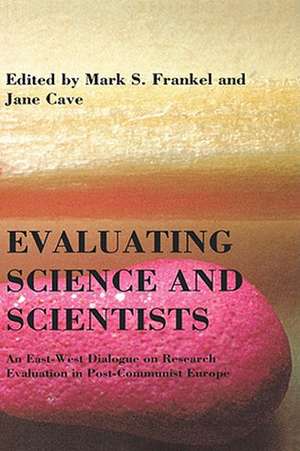
Evaluating Science and Scientists
Autor Mark S. Frankel Editat de Jane Caveen Limba Engleză Hardback – 1997
Preț: 661.90 lei
Preț vechi: 727.37 lei
-9%
Puncte Express: 993
Carte disponibilă
Livrare economică 14-28 noiembrie
Livrare prin curier în România Termenul estimat este afișat lângă disponibilitate.
Transport gratuit pentru acest produs Plată online sau ramburs, în funcție de opțiunile comenzii.
Retur gratuit în 14 zile Comandă securizată și suport în română.
Specificații
ISBN-13: 9781858660790
ISBN-10: 1858660793
Pagini: 240
Ilustrații: 1
Dimensiuni: 152 x 229 x 19 mm
Greutate: 0.6 kg
Ediția:1
Editura: Amsterdam University Press
Colecția Central European University Press
Locul publicării:Oxford, United Kingdom
ISBN-10: 1858660793
Pagini: 240
Ilustrații: 1
Dimensiuni: 152 x 229 x 19 mm
Greutate: 0.6 kg
Ediția:1
Editura: Amsterdam University Press
Colecția Central European University Press
Locul publicării:Oxford, United Kingdom
V-ar putea interesa
-
 Only a TheoryKenneth R. MillerPreț: 146.52 lei
 -
 Emergence: From Chaos to OrderJohn H. Holland-16%Preț: 166.67 lei199.49 lei
 -
 The Essential TuringB. Jack. Copeland-9%Preț: 255.91 lei280.24 lei
 -
 -32%Preț: 815.71 lei1192.95 lei
 -
 -11%Preț: 284.88 lei319.89 lei
 -
 Evidence, Explanation, and Realism: Essays in Philosophy of SciencePeter Achinstein-27%Preț: 524.91 lei719.99 lei
 -
 New Waves in Philosophy of TechnologyJan Kyrre Berg Olsen-15%Preț: 664.27 lei781.50 lei
 -
 The Demon-Haunted WorldCarl SaganPreț: 125.93 lei
 -
 The Quark And The Jaguar: Adventures in the Simple and the ComplexMurray Gell-Mann-26%Preț: 79.42 lei107.77 lei
 -
 The Cambridge Companion to the Philosophy of BiologyMichael RusePreț: 337.64 lei
 -
 -44%Preț: 134.09 lei240.57 lei
 -
 The Evolutionary MindRupert SheldrakePreț: 103.71 lei
 -
 The Quantum and the LotusMatthieu RicardPreț: 105.22 lei
 -
 An Introduction to Science and Technology Studies 2eSergio SismondoPreț: 270.93 lei
 -
 Against MethodPaul FeyerabendPreț: 137.75 lei
 -
 Ascent Of ManJacob Bronowski-23%Preț: 88.26 lei114.65 lei
 -
 Operating Manual for Spaceship EarthR. Buckminster Fuller-12%Preț: 111.38 lei127.24 lei
Public țintă
AcademicCuprins
List of Contributors, Acknowledgments, Introduction, Part I. Evaluating Science and Scientists, Part II. Peer Review, Part III. Quantitative Techniques for Evaluating Performance, Index
Notă biografică
Mark S. Frankel, is director of the Scientific Freedom, Responsibility and Law program at the American Association for the advancement of Science (AAAS).
Jane Cave is a researcher and translator specializing in contemporary Eastern European politics.
Jane Cave is a researcher and translator specializing in contemporary Eastern European politics.
Descriere
This book examines how post-communist Eastern Europe's transition to market economies transformed science through funding cuts and peer review systems, providing first-hand accounts and analysis of these reforms' impact on scientific autonomy and resource allocation.