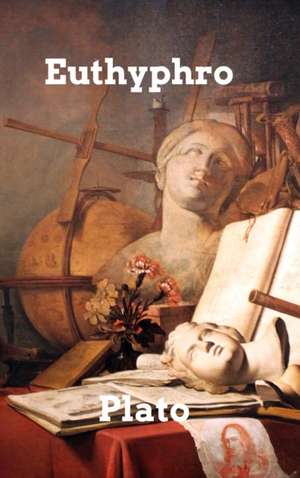
Euthyphro
Autor Platoen Limba Engleză Hardback – 23 mar 2023
Preț: 207.13 lei
Puncte Express: 311
Carte tipărită la comandă
Livrare economică 26 mai-09 iunie
Specificații
V-ar putea interesa
-
 The Hemlock CupBettany Hughes-19%Preț: 95.20 lei118.04 lei
 -
 -38%Preț: 55.24 lei88.70 lei
 -
 The RepublicPlato-31%Preț: 62.49 lei90.01 lei
 -
 Socrates' DefencePlato-40%Preț: 16.33 lei27.12 lei
 -
 Moral Psychology and Human Action in AristotleMichael Pakaluk-14%Preț: 663.65 lei771.68 lei
 -
 Selected MythsPlato-20%Preț: 48.81 lei61.39 lei
 -
 -7%Preț: 154.28 lei166.53 lei
 -
 The RepublicPlatoPreț: 45.37 lei
 -
 -12%Preț: 88.94 lei101.42 lei
 -
 Plato's Cosmology and its Ethical DimensionsGabriela Roxana CaronePreț: 308.17 lei
 -
 The Hellenistic Stoa: Political Thought and ActionAndrew Erskine-13%Preț: 306.96 lei352.16 lei
Notă biografică
Plato was an ancient Greek philosopher born in Athens during the Classical period in Ancient Greece. In Athens, Plato founded the Academy, a philosophical school where he taught the philosophical doctrines that would later become known as Platonism. Plato (or Platon) was a pen name derived, apparently, from the nickname given to him by his wrestling coach - allegedly a reference to his physical broadness. According to Alexander of Miletus quoted by Diogenes of Sinope his actual name was Aristocles, son of Ariston, of the deme Collytus (Collytus being a district of Athens).Plato was an innovator of the written dialogue and dialectic forms in philosophy. He raised problems for what later became all the major areas of both theoretical philosophy and practical philosophy. His most famous contribution is the Theory of forms, which has been interpreted as advancing a solution to what is now known as the problem of universals. He is also the namesake of Platonic love and the Platonic solids.