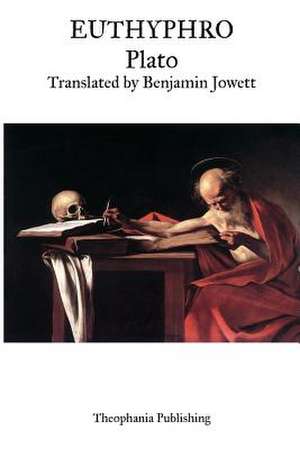
Euthyphro
Autor Platoen Limba Engleză Paperback
Preț: 101.01 lei
Puncte Express: 152
Carte tipărită la comandă
Livrare economică 30 noiembrie-14 decembrie
Livrare prin curier în România Termenul estimat este afișat lângă disponibilitate.
Transport gratuit de la 400.00 lei Plată online sau ramburs, în funcție de opțiunile comenzii.
Retur gratuit în 14 zile Comandă securizată și suport în română.
Specificații
ISBN-13: 9781469928579
ISBN-10: 1469928574
Pagini: 36
Dimensiuni: 152 x 229 x 2 mm
Greutate: 0.06 kg
Editura: CreateSpace Independent Publishing Platform
ISBN-10: 1469928574
Pagini: 36
Dimensiuni: 152 x 229 x 2 mm
Greutate: 0.06 kg
Editura: CreateSpace Independent Publishing Platform
V-ar putea interesa
-
 The Hemlock CupBettany Hughes-17%Preț: 102.49 lei124.06 lei
 -
 -37%Preț: 58.93 lei93.00 lei
 -
 The RepublicPlato-29%Preț: 66.87 lei94.49 lei
 -
 Socrates' DefencePlato-39%Preț: 17.33 lei28.43 lei
 -
 Moral Psychology and Human Action in AristotleMichael Pakaluk-31%Preț: 728.59 lei1055.44 lei
 -
 Selected MythsPlato-19%Preț: 52.19 lei64.47 lei
 -
 -17%Preț: 171.45 lei205.47 lei
 -
 The RepublicPlatoPreț: 47.83 lei
 -
 Preț: 106.14 lei
 -
 Plato's Cosmology and Its Ethical DimensionsGabriela Roxana CaronePreț: 317.90 lei
 -
 The Hellenistic Stoa: Political Thought and ActionAndrew Erskine-11%Preț: 324.63 lei364.65 lei
Notă biografică
Plato (428/27-348/47 bce) Plato was an Athenian philosopher from the Classical Period in Ancient Greece. He grew up during the Peloponnesian War (431-404 bce), and came of age around the time of Athens' final defeat and the turmoil that followed. He was a close associate of the great Greek philosopher Socrates, who is considered to be the founder of Western philosophy; he was later condemned to death. The Socratic method of dialogue and debate are extensively found in Plato's works. He wrote approximately 35 dialogues with Socrates as a character in order to bring out the ideas and beliefs of his teacher. Two of his notable works are Apologia, which recounts Socrates' trial, and Phaedo, a dialogue that chronicles the conversations on the day that Socrates was put to death. Following the execution of Socrates, Plato travelled to Egypt, Sicily, and Italy. He studied and contributed to philosophy, mathematics, and science. Upon his return to Athens, he founded the Academy-the first institution of higher learning in the West. The institute focused on research around philosophy and science. One of the famous students at Plato's Academy was Aristotle, who went on to challenge some of Plato's views on literature and poetry.