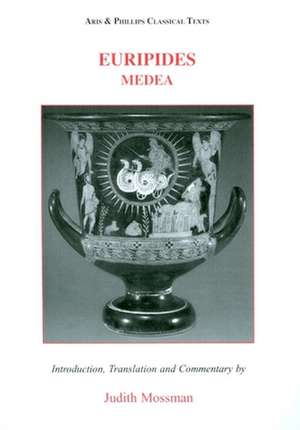
Euripides: Medea: Aris & Phillips Classical Texts
Autor Judith Mossmanen Limba Engleză Paperback – 12 ian 2011
Din seria Aris & Phillips Classical Texts
- 23%
 Preț: 941.42 lei
 -
 Preț: 324.59 lei
 -
 Preț: 408.54 lei
 - 23%
 Preț: 1206.06 lei
 - 23%
 Preț: 856.31 lei
 -
 Preț: 337.48 lei
 -
 Preț: 307.60 lei
 -
 Preț: 307.45 lei
 -
 Preț: 415.73 lei
 - 27%
 Preț: 884.12 lei
 -
 Preț: 410.18 lei
 -
 Preț: 308.30 lei
 -
 Preț: 386.98 lei
 -
 Preț: 417.20 lei
 -
 Preț: 411.29 lei
 -
 Preț: 456.71 lei
 - 27%
 Preț: 845.58 lei
 -
 Preț: 375.36 lei
 -
 Preț: 350.37 lei
 -
 Preț: 372.49 lei
 -
 Preț: 331.79 lei
 -
 Preț: 459.38 lei
 -
 Preț: 149.01 lei
 -
 Preț: 390.69 lei
 -
 Preț: 387.38 lei
 -
 Preț: 408.35 lei
 -
 Preț: 334.61 lei
 - 15%
 Preț: 429.26 lei
 -
 Preț: 370.46 lei
 - 9%
 Preț: 923.85 lei
 - 23%
 Preț: 788.75 lei
 - 9%
 Preț: 994.68 lei
 -
 Preț: 262.56 lei
Preț: 352.06 lei
Puncte Express: 528
Carte disponibilă
Livrare economică 29 octombrie-12 noiembrie
Livrare express 14-20 octombrie pentru 38.92 lei
Livrare prin curier în România Termenul estimat este afișat lângă disponibilitate.
Transport gratuit de la 400.00 lei Plată online sau ramburs, în funcție de opțiunile comenzii.
Retur gratuit în 14 zile Comandă securizată și suport în română.
Specificații
ISBN-13: 9780856687884
ISBN-10: 085668788X
Pagini: 392
Dimensiuni: 148 x 210 x 21 mm
Greutate: 0.54 kg
Ediția:New.
Editura: Liverpool University Press
Seria Aris & Phillips Classical Texts
ISBN-10: 085668788X
Pagini: 392
Dimensiuni: 148 x 210 x 21 mm
Greutate: 0.54 kg
Ediția:New.
Editura: Liverpool University Press
Seria Aris & Phillips Classical Texts
V-ar putea interesa
-
 A Christmas Carol and Other Christmas WritingsCharles Dickens-26%Preț: 48.68 lei65.69 lei
 -
 Medea and Other PlaysEuripides-27%Preț: 56.99 lei78.12 lei
 -
 The Bacchae and Other PlaysEuripides-18%Preț: 77.00 lei94.18 lei
 -
 Quarrel & QuandaryCynthia OzickPreț: 110.41 lei
 -
 999Al SarrantonioPreț: 121.71 lei
 -
 Oscar WildeKarl Beckson-8%Preț: 464.07 lei504.42 lei
 -
 Euripides: MedeaEuripidesPreț: 106.63 lei
 -
 To the Ends of the EarthWilliam GoldingPreț: 128.26 lei
 -
 The Red NotebookPaul AusterPreț: 78.18 lei
 -
 Preț: 232.81 lei
 -
 Preț: 232.86 lei
 -
 Dario Fo: Framing, Festival, and the Folkloric ImaginationAntonio Scuderi-27%Preț: 261.53 lei358.81 lei
 -
 Who's Afraid of Bernard Shaw?Stanley WeintraubPreț: 184.74 lei
 -
 HeraclesEuripides-18%Preț: 85.51 lei104.70 lei
 -
 MedeaEuripides-18%Preț: 86.18 lei105.09 lei
 -
 The Sentimental Theater of the French RevolutionCecilia Feilla-18%Preț: 1256.11 lei1531.84 lei
 -
 The Tragedy of TragediesHenry Fielding-18%Preț: 133.78 lei163.44 lei
 -
 -37%Preț: 660.95 lei1054.59 lei
 -
 Out of the ValleyRonald BlythePreț: 115.16 lei
 -
 MedeaEuripidesPreț: 29.58 lei
Descriere
Descriere de la o altă ediție sau format:
Few ancient authors are as challenging as Euripides, and few have provoked so many diverse critical opinions through the ages: Aristotle described him as 'most tragic', and yet many of his plays have been condemned by critics as barely qualifying as 'proper' tragedies at all. In general he has enjoyed a revival in reputation over the last few decades: his manipulation of convention and the skill of his dramaturgy are perhaps more widely admired now than at any time since the Renaissance. Moreover, his exploration of the emotions of the marginalized sections of Athenian society - women, slaves, foreigners - has given his work strong contemporary resonances. This volume aims to bring together for students some classic essays illustrating the main strands of Euripidean criticism over the last forty years. Two of the essays are translated here for the first time, and many others have been revised by their authors. All Greek has been translated.
Few ancient authors are as challenging as Euripides, and few have provoked so many diverse critical opinions through the ages: Aristotle described him as 'most tragic', and yet many of his plays have been condemned by critics as barely qualifying as 'proper' tragedies at all. In general he has enjoyed a revival in reputation over the last few decades: his manipulation of convention and the skill of his dramaturgy are perhaps more widely admired now than at any time since the Renaissance. Moreover, his exploration of the emotions of the marginalized sections of Athenian society - women, slaves, foreigners - has given his work strong contemporary resonances. This volume aims to bring together for students some classic essays illustrating the main strands of Euripidean criticism over the last forty years. Two of the essays are translated here for the first time, and many others have been revised by their authors. All Greek has been translated.
Recenzii
This is an excellent volume in a prestigious series, and it will certainly have an impact on Euripidean studies. Judith Mossman has shown great wisdom in her selection of articles ... It will prove extraordinarily convenient both for teachers and students to have access to them all in a single volume.
Mossman's Introduction is a model of literary sensibility, concision, elegance, and erudition, the product of many years' immersion in Euripides and his interpreters. Her book is a compulsory purchase for any school or college library.
Mossman's Introduction is a model of literary sensibility, concision, elegance, and erudition, the product of many years' immersion in Euripides and his interpreters. Her book is a compulsory purchase for any school or college library.
Notă biografică
Judith Mossman is Senior Lecturer in Classics at Trinity College, Dublin
Cuprins
- Introduction
- 1: Karl Reinhardt: The Intellectual Crisis in Euripides
- 2: R.P. Winnington-Ingram: Euripides: Poietes Sophos
- 3: C. Collard: Formal Debates in Euripides' Drama
- 4: D. J. Conacher: Rhetoric and Relevance in Euripidean Drama
- 5: M. R. Lefkowitz: 'Atheism' and 'Impiety' in Euripides' Dramas
- 6: H. P. Stahl: On 'extra-dramatic' communication in Euripides
- 7: P. Pucci: Euripides: The Monument and the Sacrifice
- 8: R. G. A. Buxton: Euripides' Alkestis: Five Aspects of an Interpretation
- 9: P. E. Easterling: The Infanticide in Euripides' Medea
- 10: R. P. Winnington-Ingram: Hipploytus: A Study in Causation
- 11: M. Heath: Iure principem locum tenet: Euripides' Hecuba
- 12: F. I. Zeitlin: The Argive Festival of Hera and Euripides' Electra
- 13: J. de Romilly: The Rejection of Suicide in the Heracles of Eurpides
- 14: D. J. Mastronarde: Iconography and Imagery in Euripides' Ion
- 15: F. I. Zeitlin: The Closet of Masks: Role-Playing and Myth-Making in the Orestes of Euripides
- 16: H. P. Foley: The Masque of Dionysus
- 17: I. F. de Jong: Three Off-Stage Characters in Euripides