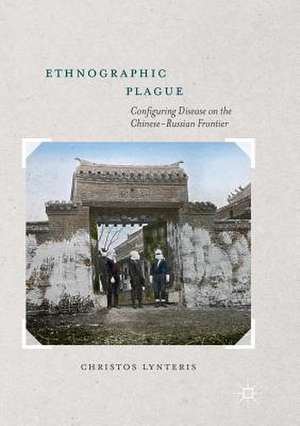
Ethnographic Plague
Autor Christos Lynterisen Limba Engleză Paperback – 10 iun 2018
Preț: 668.11 lei
Preț vechi: 786.01 lei
-15%
Puncte Express: 1002
Carte tipărită la comandă
Livrare economică 19 noiembrie-03 decembrie
Livrare prin curier în România Termenul estimat este afișat lângă disponibilitate.
Transport gratuit pentru acest produs Plată online sau ramburs, în funcție de opțiunile comenzii.
Retur gratuit în 14 zile Comandă securizată și suport în română.
Specificații
ISBN-13: 9781349955626
ISBN-10: 1349955620
Pagini: 220
Ilustrații: XIX, 199 p. 3 illus.
Dimensiuni: 148 x 210 x 13 mm
Greutate: 0.29 kg
Ediția:Softcover reprint of the original 1st ed. 2016
Editura: Palgrave MacMillan
Locul publicării:London, United Kingdom
ISBN-10: 1349955620
Pagini: 220
Ilustrații: XIX, 199 p. 3 illus.
Dimensiuni: 148 x 210 x 13 mm
Greutate: 0.29 kg
Ediția:Softcover reprint of the original 1st ed. 2016
Editura: Palgrave MacMillan
Locul publicării:London, United Kingdom
V-ar putea interesa
-
 Zhang XueliangAron ShaiPreț: 389.79 lei
 -
 The Knights Hospitaller in the Levant, C.1070-1309J. Riley-Smith-18%Preț: 922.27 lei1124.72 lei
 -
 Preț: 415.64 lei
 -
 Modernism and Japanese CultureR. StarrsPreț: 402.16 lei
 -
 A History of JapanK. Henshall-18%Preț: 840.16 lei1024.59 lei
 -
 Arming the PeripheryE. ChewPreț: 406.78 lei
 -
 Iran and the CIAD. BayandorPreț: 473.24 lei
 -
 Hiroshima NagasakiPaul Ham-18%Preț: 117.69 lei143.42 lei
 -
 How China Became CapitalistR. Coase-15%Preț: 617.43 lei726.38 lei
Cuprins
Introduction: Plague Beyond the Laboratory. - 1. The Native Knowledge Hypothesis. - 2. Medical Myths and Mythic Medicine. - 3. Ethno-Geographic Entanglements. - 4. Anthropological Types and Clustered Hypotheses. - Conclusion: Ethnographic Data as Medical Evidence.
Notă biografică
Christos Lynteris is a social anthropologist working on biopolitical and visual aspects of infectious disease epidemics. He is Senior Research Associate at CRASSH, University of Cambridge, UK, and Principal Investigator of the European Research Council funded project Visual Representations of the Third Plague Pandemic. He is also the author of The Spirit of Selflessness in Maoist China (2012).
Textul de pe ultima copertă
Challenging the concept that since the discovery of the plague bacillus in 1894 the study of the disease was dominated by bacteriology, Ethnographic Plague argues for the role of ethnography as a vital contributor to the configuration of plague at the turn of the nineteenth century. With a focus on research on the Chinese-Russian frontier, where a series of pneumonic plague epidemics shook the Chinese, Russian and Japanese Empires, this book examines how native Mongols and Buryats came to be understood as holding a traditional knowledge of the disease. Exploring the forging and consequences of this alluring theory, this book seeks to understand medical fascination with culture, so as to underline the limitations of the employment of the latter as an explanatory category in the context of infectious disease epidemics, such as the recent SARS and Ebola outbreaks.