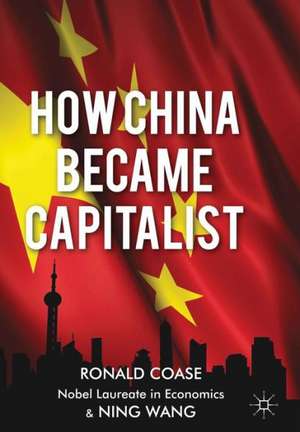
How China Became Capitalist
Autor R. Coase, N. Wangen Limba Engleză Paperback – 20 mar 2012
Observăm în ultimele decenii o reevaluare profundă a modului în care înțelegem ascensiunea economică a Asiei, iar How China Became Capitalist reprezintă un pilon central în această schimbare de paradigmă. Lucrarea semnată de R. Coase și N. Wang documentează tranziția surprinzătoare a Chinei de la o structură agrară socialistă la statutul de putere economică indomabilă. Reținem teza centrală a autorilor: transformarea nu a fost rezultatul unei strategii de stat riguros planificate spre capitalism, ci mai degrabă o serie de „revoluții marginale” care au reintrodus antreprenoriatul și piața printr-un proces organic, adesea neanticipat de liderii de la Beijing. Această analiză extinde cadrul propus de The Road Leading to the Market de Zhang Weiying cu date noi extrase din surse primare ce acoperă perioada de după 1978. În timp ce Zhang Weiying se concentrează pe răscrucea actuală a reformelor, R. Coase și N. Wang oferă o perspectivă istorică și instituțională, argumentând că China și-a redescoperit propriile rădăcini culturale prin adoptarea pieței. Structura cărții este cronologică și tematică, începând cu analiza Chinei la moartea lui Mao, trecând prin perioada de tranziție și „reforma pieței sub socialism”, până la capitolul final care explorează trecerea de la „capitalism la capitalisme”. Subliniem rigoarea cu care este tratat principiul chinez „căutarea adevărului din fapte”, element care a ghidat adaptarea teoriilor economice vestice la contextul local. Autorii nu evită însă avertismentele necesare, indicând faptul că absența unei „piețe a ideilor” și menținerea controlului politic centralizat ar putea limita potențialul de creștere pe termen lung al țării.
Preț: 617.43 lei
Preț vechi: 726.38 lei
-15%
Carte tipărită la comandă
Livrare economică 07-21 decembrie
Specificații
ISBN-10: 1137351438
Pagini: 272
Ilustrații: XI, 256 p.
Dimensiuni: 152 x 229 x 15 mm
Greutate: 0.4 kg
Ediția:2012
Editura: Palgrave MacMillan
Locul publicării:London, United Kingdom
V-ar putea interesa
-
 The Handbook of the GothicMarie Mulvey-Roberts-15%Preț: 591.20 lei695.53 lei
 -
 Advancing DevelopmentG. Mavrotas-18%Preț: 974.49 lei1188.41 lei
 -
 Economic Instruments of Security PolicyG. Shiffman-15%Preț: 451.09 lei530.70 lei
 -
 Preț: 341.13 lei
 -
 Introduction to Post-Keynesian EconomicsM. Lavoie-15%Preț: 510.61 lei600.72 lei
 -
 Plundered Nations?Paul Collier-15%Preț: 490.16 lei576.67 lei
 -
 Understanding Digital HumanitiesD. Berry-20%Preț: 732.01 lei915.02 lei
 -
 Memory in CultureA. ErllPreț: 218.06 lei
 -
 The Palgrave Macmillan Dictionary of DiplomacyG. Berridge-18%Preț: 964.99 lei1176.82 lei
 -
 Military EconomicsRon Smith-15%Preț: 658.62 lei774.85 lei
 -
 Preț: 384.85 lei
 -
 The Victorian Press and the Fairy TaleC. SumpterPreț: 399.60 lei
 -
 The Concept of the PoliticalHans J MorgenthauPreț: 428.75 lei
 -
 Humanities in the Twenty-First CenturyEleonora BelfiorePreț: 398.76 lei
 -
 The Decline and Fall of EuropeFrancesco M BongiovanniPreț: 403.15 lei
 -
 Human Development Report 2006United Nations Development ProgrammePreț: 405.49 lei
 -
 X-Rated!Marcel DanesiPreț: 397.04 lei
 -
 Preț: 308.19 lei
 -
 Reinventing Evidence in Social InquiryR. BiernackiPreț: 402.39 lei
 -
 Understanding the Crisis in GreeceM. MitsopoulosPreț: 374.71 lei
 -
 Preț: 416.09 lei
 -
 Business DiscourseFrancesca Bargiela-Chiappini-15%Preț: 638.66 lei751.36 lei
 -
 Governing Global FinanceAnthony Elson-15%Preț: 643.71 lei757.31 lei
 -
 -5%Preț: 216.15 lei227.53 lei
 -
 Discourse Theory and Critical Media PoliticsL. DahlbergPreț: 388.17 lei
 -
 Realism and the Audiovisual MediaL. NagibPreț: 399.10 lei
 -
 Intimacy and Friendship on FacebookA. LambertPreț: 396.24 lei
 -
 Preț: 430.90 lei
 -
 In Godzilla's FootstepsW. TsutsuiPreț: 406.26 lei
 -
 The Palgrave Macmillan Dictionary of Political ThoughtRoger ScrutonPreț: 420.83 lei
De ce să citești această carte
Această lucrare este esențială pentru cei care doresc să înțeleagă motorul real al dezvoltării chineze dincolo de retorica oficială. Cititorul câștigă o perspectivă istorică documentată asupra modului în care forțele de la marginea sistemului au forțat schimbarea economică. Este o recomandare certă pentru studenții la economie și istorie, oferind o explicație nuanțată a modului în care instituțiile și ideile modelează destinul unei națiuni.
Despre autor
R. Coase (1910–2013) a fost un economist britanic de renume, laureat al Premiului Nobel pentru Științe Economice în 1991, cunoscut pentru contribuțiile sale fundamentale la teoria costurilor de tranzacție și a drepturilor de proprietate. N. Wang este un cercetător asociat la Ronald Coase Institute, specializat în economie instituțională. Împreună, cei doi autori combină rigoarea analizei economice de tip Nobel cu o cunoaștere aprofundată a contextului chinez, reușind să ofere o interpretare care a influențat decisiv dezbaterea academică despre capitalismul de stat și dezvoltarea economică regională în Asia de Est.
Descriere scurtă
Cuprins
Recenzii
"As China is sure to become a hotly debated focal point in the presidential election, this book, with its emphasis on markets and history, becomes of paramount importance." - The Washington Times
"Anyone curious as to how China became the world's second biggest economy should read this interesting book." - The LSE Review of Books
"This is a major contribution to the whole literature on economic change as well as on China. Nowhere in all of the literature on economic change and development that I know is there such a detailed study of the fumbling efforts of a society to evolve and particularly one that had as long and as far to go as China did." - Douglass C. North, 1993 Nobel laureate in Economics
"Ronald Coase, now 100 years plus, and Ning Wang have written a compelling and exhaustive commentary about China's fitful transition from Socialism under Mao to today's distinctive capitalist economy. No student of China or socialism can afford to miss this volume." - Richard Epstein, University of Chicago Law School
"This book is one of the greatest works in economics and in studies of China, not only for today, but for the future." - Chenggang Xu, University of Hong Kong
"Coase finds a nation whose philosophy and policy have reflected the same simple principle - 'seeking truth from facts' - that has inspired his own path-breaking analyses of firms, markets and law. A fascinating and exceptionally thought-provoking account of how China, repeatedly seeking more efficient socialism, found itself turning capitalist." - Stephen Littlechild, Emeritus Professor, University of Birmingham, and Fellow, Judge Business School, University of Cambridge
Notă biografică
Ning Wang is Assistant Professor at the School of Politics and Global Studies, Arizona State University, USA.